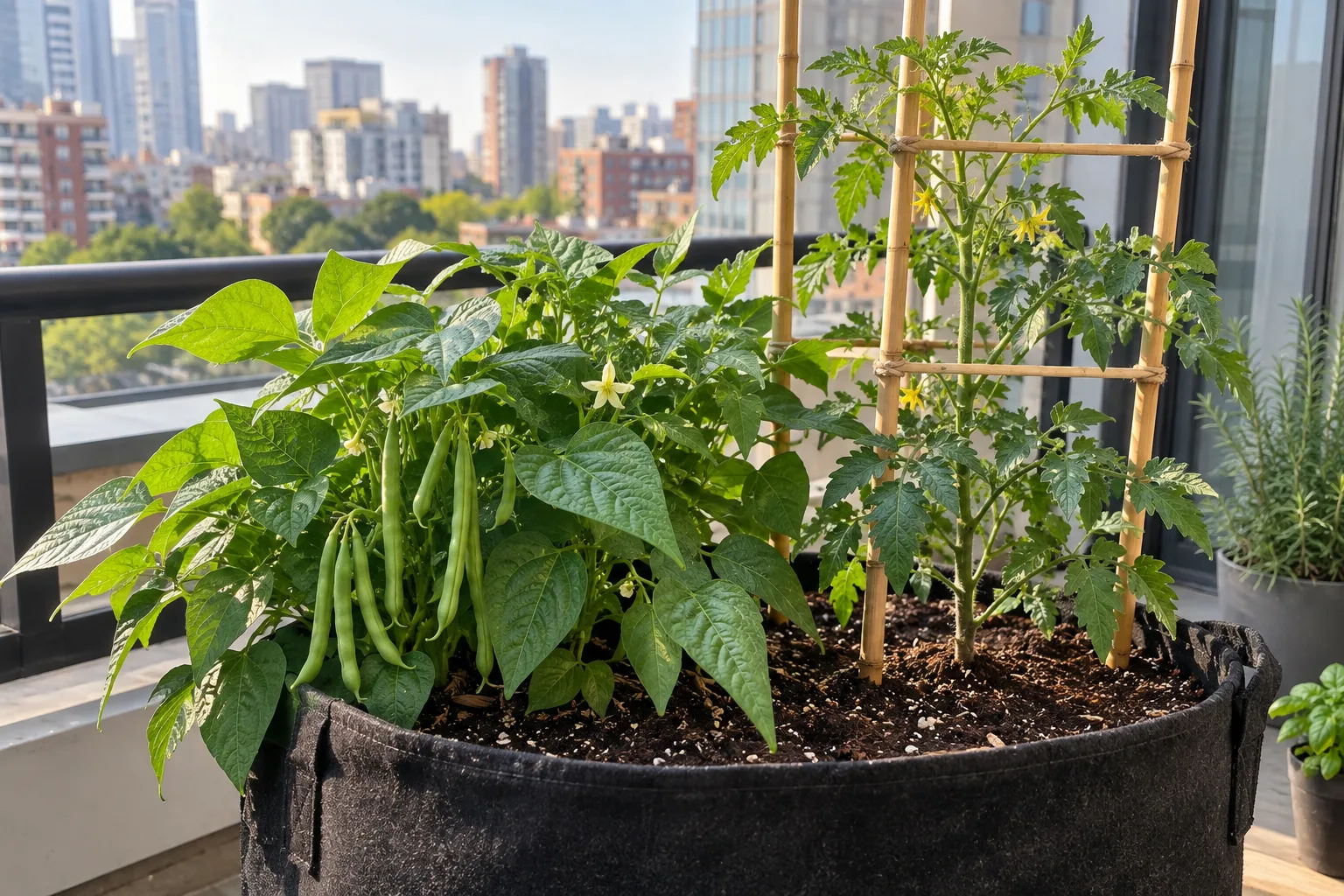
Plant beans next to your tomatoes and the tomatoes get fed, the story goes, since beans pull nitrogen from the air and share it with whatever’s growing nearby. It’s one of the most repeated claims in companion planting, and like a lot of companion planting folklore, the real answer is more interesting than the simple version: some nitrogen sharing does happen while both plants are alive and growing, but it’s modest and unreliable. The nitrogen benefit worth planning around comes later, after the legume is done, not while it’s still standing next to your tomato.
This guide covers what nitrogen fixation does, how much of it reaches a living neighbor versus how much is folklore, and the one practical habit that captures the real benefit in a container you’re reusing season after season.
How nitrogen fixation works
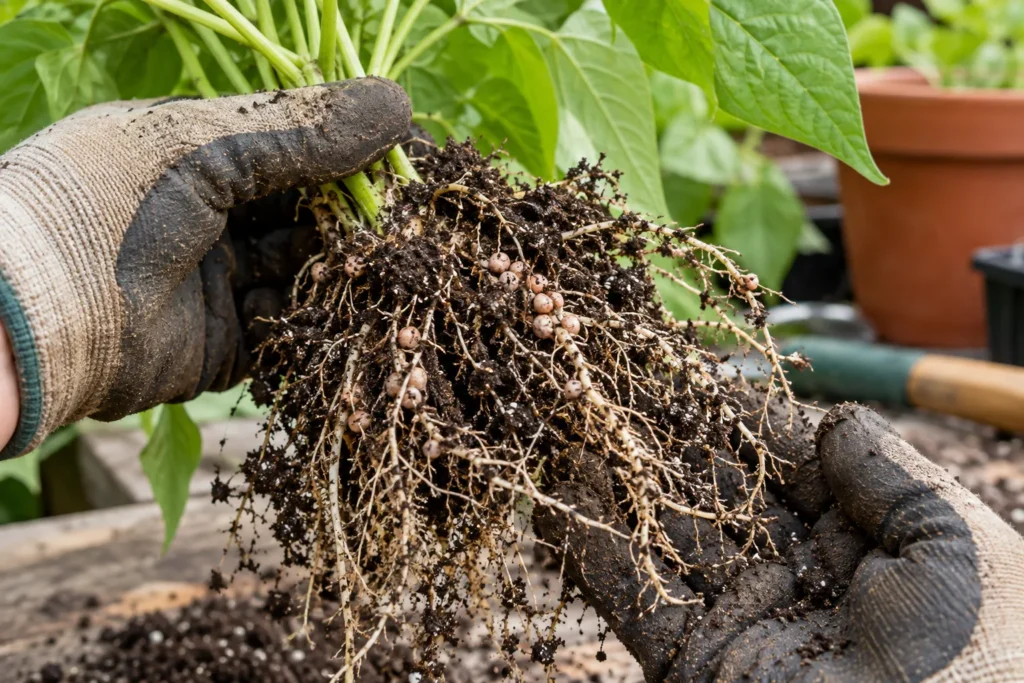
Legumes (beans, peas, and clover among them) host a specific type of soil bacteria called rhizobia in small nodules on their roots. Those bacteria pull nitrogen gas straight from the air, something almost no other plant can do, and convert it into a form the legume can use to grow. The legume is feeding itself first, not its neighbors. Any nitrogen that ends up helping a nearby plant is a side effect of that process.
Does the nitrogen reach a living neighbor?
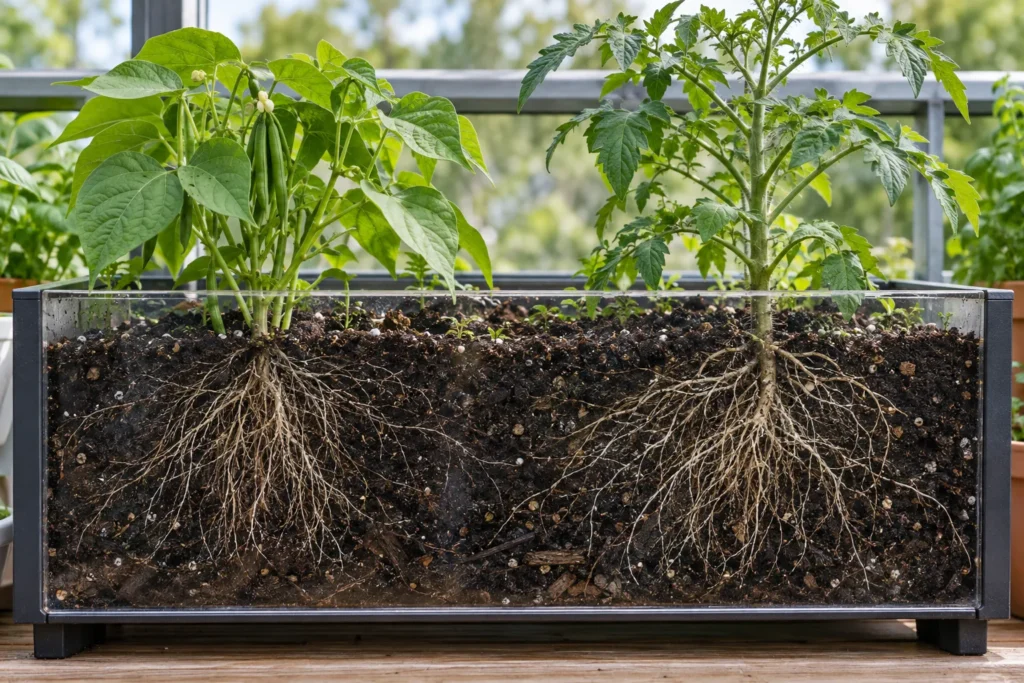
Some of it, yes, but the amount varies enormously and isn’t something you can count on. Research on intercropped legumes and grasses has measured nitrogen transfer to a living neighboring plant ranging from essentially nothing up to a meaningful share of that plant’s nitrogen uptake, with the exact amount depending heavily on which legume, which neighbor, and the growing conditions that season. The two routes this happens through while both plants are alive are root exudates, nitrogen compounds the legume’s roots leak into the soil that a neighbor’s roots can pick up, and, in some cases, shared mycorrhizal fungal networks connecting the two root systems underground. Both are real mechanisms. Neither is something a home gardener can reliably engineer or predict in a single container over a few months.
So the claim isn’t pure myth, there’s real science behind some same-season sharing, but treating it as a dependable feeding mechanism for this year’s tomato oversells what the evidence supports.
What about fungal networks sharing nutrients between plants?
Popular science has run hard with the idea of an underground “wood wide web,” fungal networks quietly moving nutrients between plants the way a shared circulatory system would. The mycorrhizal connection itself is real: many plants, legumes included, form partnerships with soil fungi that extend their root systems and can link neighboring plants to the same fungal network. Research on intercropped legumes and grasses has measured real nitrogen moving through exactly this kind of connection, in some documented cases accounting for a meaningful share of a neighboring plant’s nitrogen uptake.
Where the popular version oversells it is in implying this is a reliable, plannable feeding system a home gardener can count on. The research shows the amount transferred this way swings wildly depending on which species are involved, soil conditions, and the specific fungal partners present, from effectively nothing in some pairings to a real contribution in others. It’s a real, documented mechanism, just not something you can engineer by simply placing two containers near each other, and a container garden’s mix is usually sterile or close to it, which limits how much of this network even has a chance to establish in the first place.

Where the real, reliable nitrogen benefit comes from
The dependable payoff happens after the legume dies and its roots and nodules break down. Most of the nitrogen a legume fixes over its life is tied up in its own leaves, stems, and roots, not leaking out to neighbors in real time, and that nitrogen only becomes broadly available once the plant decomposes. University extension research on legume cover crops has measured this directly: a vigorous stand of clover or vetch can supply 100 to 200 pounds of nitrogen per acre to whatever’s planted after it, with roughly half of that released during decomposition following the legume being cut back or turned into the soil.
That’s the mechanism worth planning around in a container: not what the legume shares while it’s alive, but what it leaves behind once it’s done.

The practical habit this adds up to on a balcony
When a bean or pea planting finishes for the season, resist the urge to pull the whole plant, roots included, and start the next crop in fresh mix. Cut the plant off at the soil line instead, bin or compost the top growth, and leave the root system in place to break down undisturbed. Plant your next crop directly into that same container a few weeks later. The decomposing roots and nodules release their nitrogen gradually into the exact soil your next plant’s roots are growing through, which is a meaningfully better use of that nitrogen than it would get diffusing through open garden soil.

This is also the real reason to grow beans or peas in a container you plan to reuse, rather than treating them as a one-off crop: the nitrogen benefit shows up for whatever comes next in that same pot, not for whatever happens to be growing next to them right now.
Which legumes are worth it for this in a container
Bush beans and peas are the practical choices for a balcony specifically because they’re already crops you’d grow for their own harvest, so the nitrogen benefit is a genuine bonus rather than the reason to plant them. Clover is the other common option, grown purely as a living mulch and soil-builder rather than for harvest, cut back and left to decompose in place between plantings of something else. All three fix meaningful nitrogen and are easy to manage in container-sized quantities.

Common misconceptions worth retiring
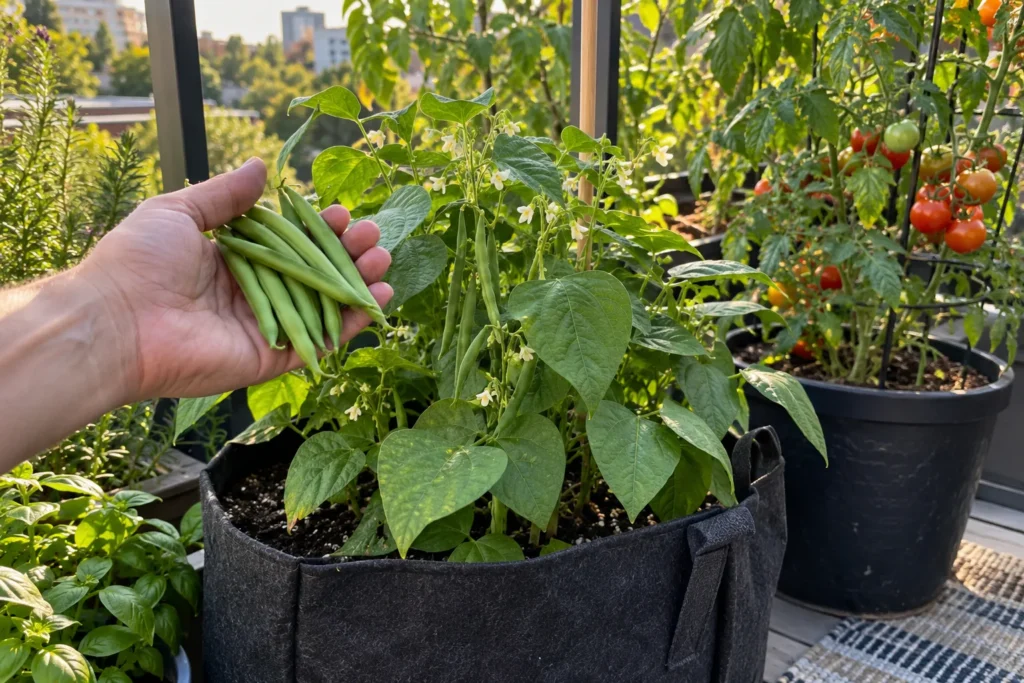
- “Plant beans next to a heavy feeder and it’ll grow better this season” oversells a real but modest, unpredictable mechanism. Don’t count on it for this year’s harvest.
- “Legumes don’t need any fertilizer because they make their own nitrogen” is true for the legume’s own nitrogen needs, but it doesn’t mean the container gets a general nitrogen boost while the legume is actively growing.
- “Pulling the whole bean plant, roots and all, at the end of the season is just good garden hygiene” throws away the nitrogen payoff. Cut it at the soil line instead and let the roots break down in place.