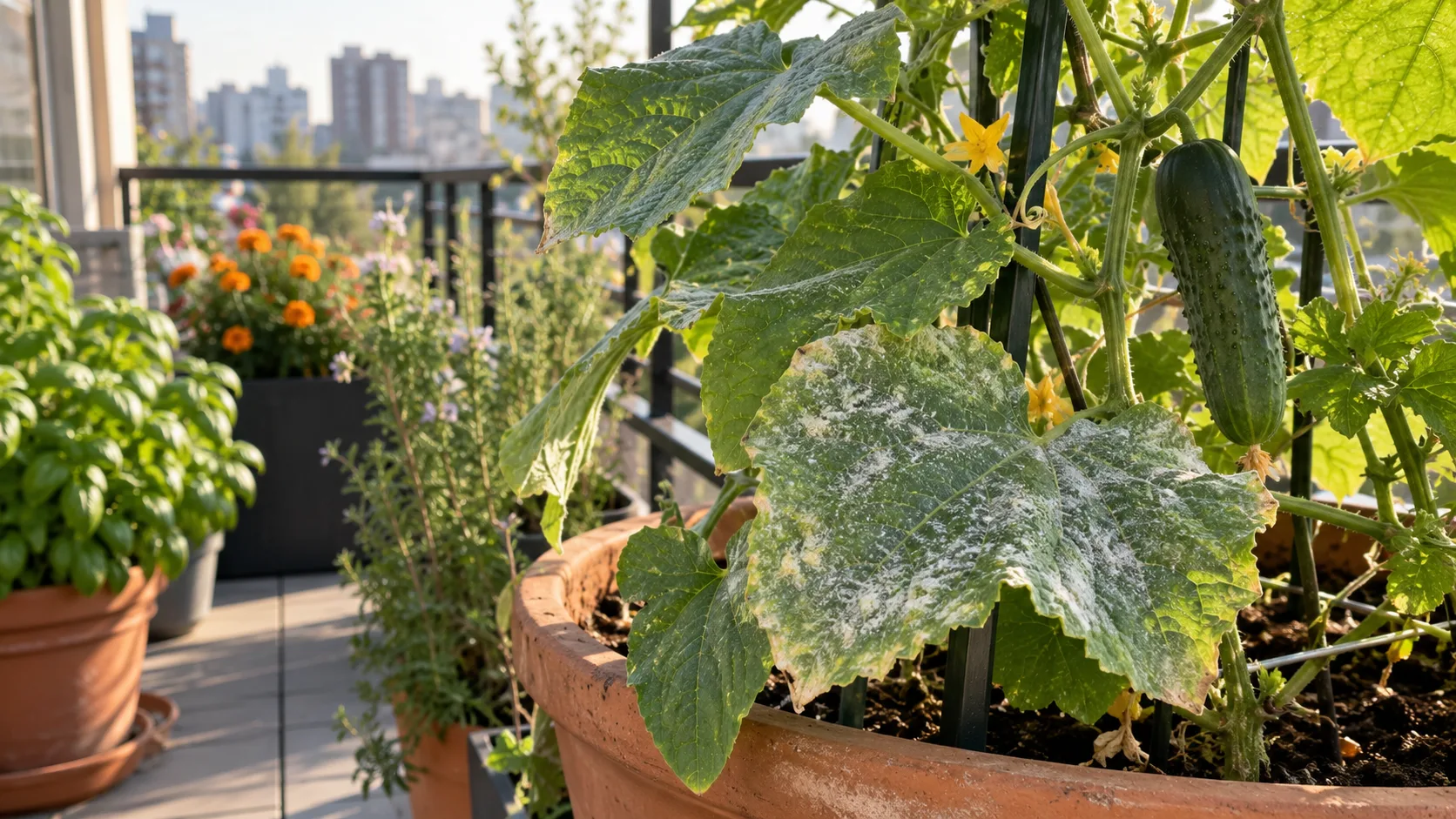
Start here: what does the problem look like on the leaf, precisely. That single detail separates a fungal disease from an insect infestation from a watering problem, and misreading it is why so many balcony growers spray for bugs that were never there in the first place. Fungal diseases on balcony plants fall into a short list of recognizable patterns, and each one has a specific cause, a specific set of conditions that let it take hold, and a specific, limited set of things that help once it’s established.
- A white, flour-like dusting on the top of leaves, often starting on older leaves near the base of the plant: powdery mildew.
- A fuzzy, gray-brown, almost velvety growth on stems, flowers, or soft fruit, sometimes paired with tan or brown lesions that spread in rings: botrytis, also called gray mold.
- Yellow blotches on the leaf’s top surface with a fuzzy gray or purplish growth underneath: downy mildew, a different organism from powdery mildew despite the similar name.
- Sticky, shiny residue on leaves with ants or small flying insects present, no powder or fuzz: not a fungal disease at all. That’s honeydew from aphids, and the correct response is covered in BalconySprout’s piece on removing aphids from balcony plants, not a fungicide.
The rest of this guide covers the two fungal problems that show up most often in container growing on a balcony: powdery mildew, which is by far the most common, and botrytis gray mold, which shows up less often but causes more damage when it does. Downy mildew gets a shorter mention since it behaves differently enough from the other two to need its own separate note on identification.
One more mix-up is worth heading off before going further: sooty mold, a black, soot-like coating that grows on the sticky honeydew aphids and other sap-feeding insects leave behind, gets mistaken for a fungal disease in its own right fairly often, since it is technically a fungus. The distinction that matters practically is that sooty mold doesn’t attack the plant directly; it grows on the honeydew sitting on the leaf surface. Treat the insect problem underneath it (aphids, scale, or whitefly) and the sooty mold stops being fed and fades on its own over the following weeks, without a fungicide ever entering the picture. If you see a black coating and want to confirm it’s sooty mold instead of a true leaf disease, check for the sticky residue underneath it first and look for the insects producing it.
Powdery mildew: what it is
Powdery mildew isn’t one single fungus. The University of Maryland Extension’s Home and Garden Information Center notes that different powdery mildew species infect different plant families, so the powdery mildew on your squash isn’t the same organism as the powdery mildew on your zinnias, even though both look nearly identical to the eye. What they share is the growth pattern: a white, powdery coating that spreads across the leaf surface, usually appearing on the older, lower leaves first before working upward through the plant.

UMD’s extension lists peas, beans, okra, cucumber, squash, muskmelon, and pumpkin among the vegetables most commonly affected, which lines up with what BalconySprout generally hears about on balconies growing cucumbers or squash in a single large container against a wall. Flowers and ornamentals get their own mildew species entirely, so a mixed balcony with both vegetables and flowering plants can end up with two unrelated powdery mildew problems running at once, each needing its own container-by-container attention instead of one blanket treatment across the whole balcony.
Why powdery mildew favors balconies specifically
This is the part that surprises people: powdery mildew does not need wet leaves to spread. The Pennsylvania State University Extension’s comparison of downy and powdery mildew is direct on this point, describing powdery mildew as favored by warm conditions in the 60 to 80°F (16 to 27°C) range and a dry climate, with no requirement for free water on the leaf to establish an infection. UMD adds that the fungus is favored by warm weather and grows rapidly under high humidity, even without the leaf surface itself being wet.
That combination (warm air, high humidity, no need for standing moisture) describes a lot of balconies more precisely than it describes an open garden bed. Pots lined up against a building wall, under a roof overhang, or behind a solid railing often sit in a pocket of still, humid air that a garden bed in the open doesn’t get, because there’s no cross-breeze moving through to dry the air between the leaves. BalconySprout’s piece on how wind affects balcony plants covers this same stagnant-air problem from the growth-rate angle; here, it’s the mildew angle. A balcony that blocks wind to protect plants from physical damage is, at the same time, creating exactly the humid, still pocket that powdery mildew spreads fastest in. There isn’t a way to have both total wind protection and low mildew pressure in the same container arrangement. You’re choosing a tradeoff, whether you realize it or not.
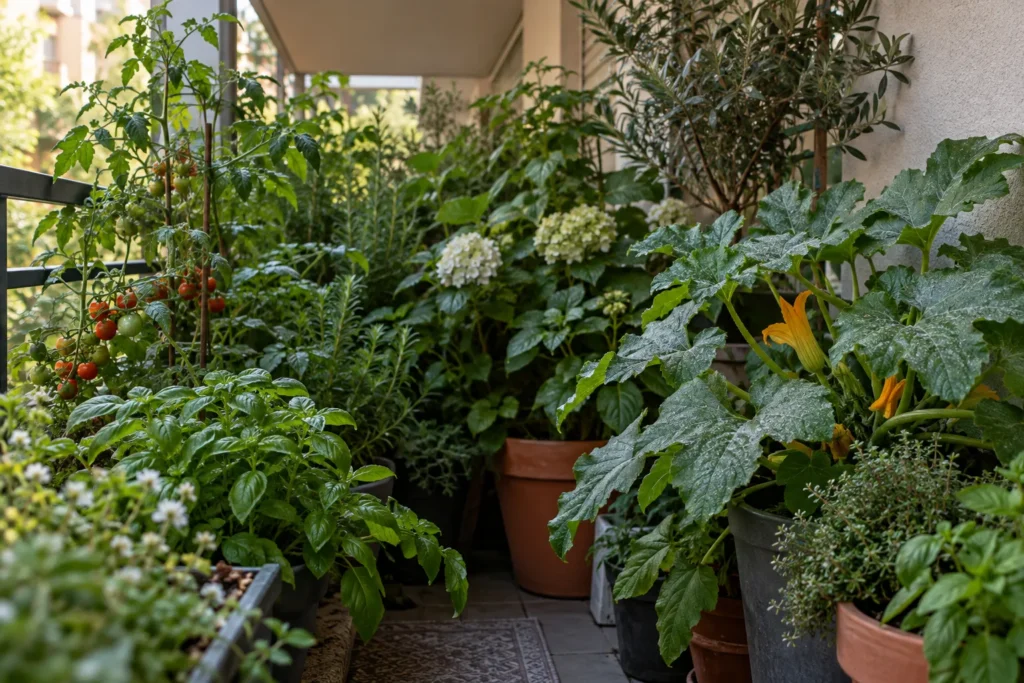
PSU’s guidance also notes that powdery mildew survives winter as mycelium on plant debris and weeds left in place, meaning a container that had mildew last season carries a head start on reinfection this season if the old plant material wasn’t fully cleared out and the potting mix wasn’t refreshed.
Botrytis (gray mold): a different fungus, a different trigger
Where powdery mildew spreads through dry, humid air, botrytis needs the opposite: actual water sitting on the plant. NC State Extension’s factsheet on botrytis gray mold states that 4 to 6 hours of free water on the leaf or stem surface, whether from dew, rain, or overhead watering, is enough time for an infection to establish. Once it does, the fungus produces a dense, velvety gray-brown spore mass on the infected tissue, tan to brown lesions on leaves and stems, and in some cases a soft, whitish rot on fruit. Small whitish rings called “ghost spots,” 3 to 8 mm across, can appear on fruit even when the infection doesn’t progress to full rot, and they’re enough to make fruit unmarketable even though the plant itself survives.

NC State lists optimum growth for the fungus at 65 to 73°F (18 to 23°C), with development slowing above roughly 70°F, and names tomato, pepper, bean, potato, onion, crucifers, and cucurbits among its hosts, alongside a long list of fruits, berries, and ornamentals. On a balcony, the most common way this infection starts is overhead watering in the evening, which wets the foliage and leaves it damp overnight exactly when temperatures are falling into botrytis’s preferred range and nothing is around to dry the leaves before morning. Dense, crowded container plantings make it worse, since leaves pressed against each other trap moisture in the same way an unpruned garden bed would, just at a smaller scale.
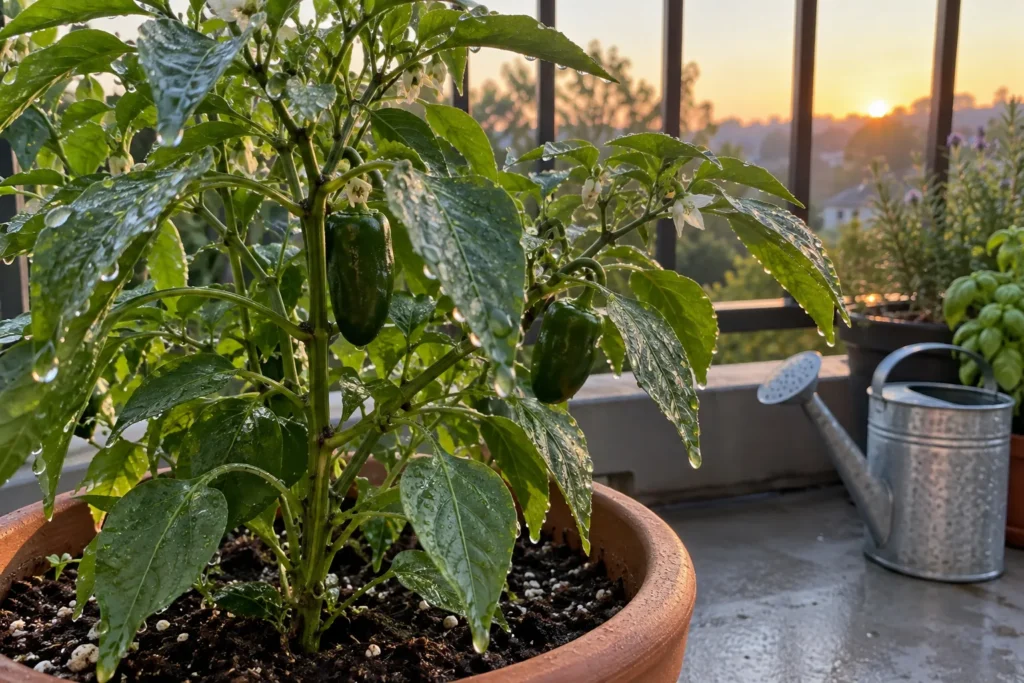
There’s a useful overlap here with another balcony problem: containers that stay consistently too wet at the root zone tend to also stay humid at the foliage level, especially in a dense planting. BalconySprout’s guide on telling overwatering and underwatering apart covers the root-level side of that same moisture problem, and the two often show up together: a container that’s overwatered at the roots is frequently also the container where botrytis or powdery mildew shows up first, because the same conditions that stress the roots are raising humidity around the leaves.
Downy mildew, briefly
Downy mildew is worth separating out mainly so you don’t treat it like powdery mildew and get no results. PSU’s extension classifies it as an oomycete, a water mold, not a true fungus, which is part of why it responds differently to treatment. It favors cooler temperatures, 58 to 78°F (14 to 26°C), with humidity above 85 percent, and produces fluffy growth on the underside of leaves (bluish, white, gray, or purple depending on the host) with corresponding yellow blotches visible from above. Spores can appear in as little as four days under favorable conditions, though 7 to 10 days is more typical, putting it roughly in the same window as the 3 to 14 days typical for a new round of powdery mildew spores. In Pennsylvania’s climate, PSU notes downy mildew doesn’t overwinter locally at all; it blows in from warmer regions each season, which means a balcony that had downy mildew last year isn’t necessarily at higher risk this year the way it would be with powdery mildew’s mycelium surviving in leftover debris.

Treating an active infection
None of these fungal problems have a true cure once a plant is infected. Every option below manages the spread and protects uninfected growth; none of them restores leaf tissue that’s already covered in mildew or rotted by gray mold.
- Remove infected material immediately. Cut off and dispose of mildew-covered or botrytis-affected leaves, stems, or fruit as soon as you spot them, instead of waiting to see if the plant fights it off on its own. Don’t drop the cuttings into a balcony compost bin; bag them for regular trash so the spores don’t get a second chance nearby.
- Horticultural oil, for powdery mildew on cucurbits specifically. UMD names horticultural oil products labeled for powdery mildew control as an option on cucumbers, squash, and melons. Check that the product label specifically lists powdery mildew and your plant type before applying.
- Neem oil or copper and phosphorus-based fungicides, for powdery and downy mildew. PSU lists these among the treatment options for both mildew types, applied according to the product label, generally as a preventive or early-stage treatment, not a cure for an advanced infection.
- Improve airflow immediately, not just for next season. Spacing containers further apart, pruning dense inner growth, and removing any physical barrier that’s trapping still air around an actively infected plant can slow the spread of a current outbreak, not just reduce the odds of a future one.

Timing and coverage matter as much as which product you reach for. Any oil or fungicide treatment works best applied in the early morning or evening, never in full midday sun, since oils and some copper products can scorch leaf tissue when combined with direct heat. Spray undersides of leaves as thoroughly as the tops, since both powdery mildew and botrytis spores can establish on the lower surface even when the visible symptoms are concentrated on top. A single application rarely finishes the job; plan on a repeat treatment 7 to 14 days later if the product label allows it, since new spores forming on tissue that looked clean at the first spray are the most common reason an infection appears to come back after treatment.
Resistant cultivars are the strongest long-term tool against all three diseases, but they don’t help with a plant that’s already infected this season. If a plant is a repeat offender, note the variety and switch to a resistant cultivar of the same crop next time you plant instead of growing the same susceptible variety again and hoping for different weather.
Prevention that fits a balcony’s limits
Most prevention advice for fungal disease assumes a garden bed with room to space plants widely and walk between rows. A balcony needs a scaled-down version of the same principles:
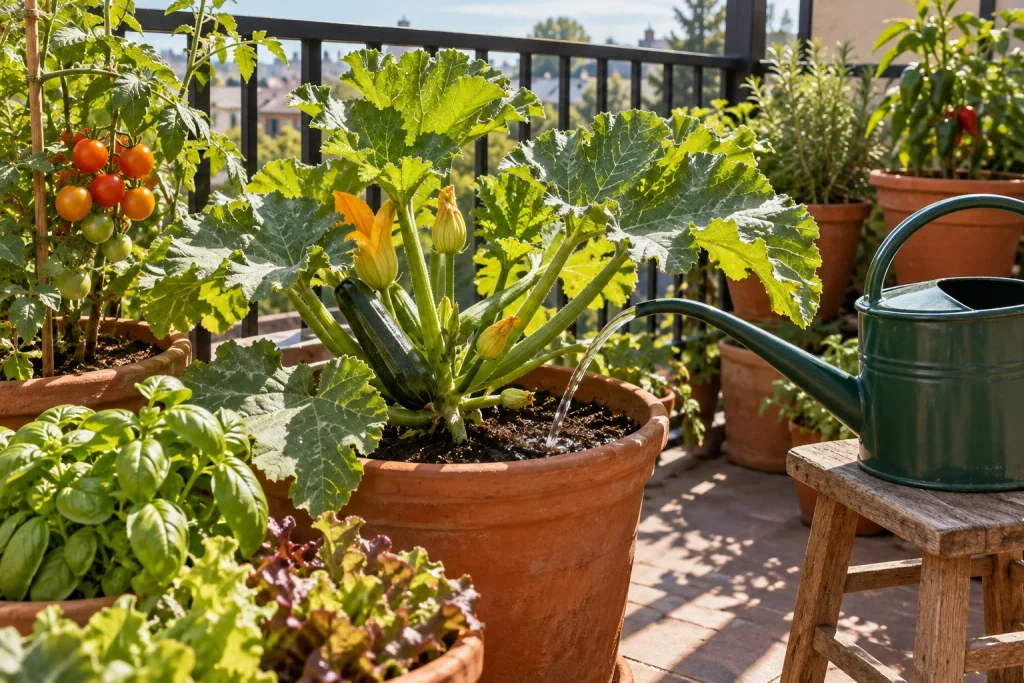
- Water at the soil line, not overhead, and do it in the morning. This keeps foliage dry overnight, which removes the window botrytis needs to establish, and dry morning sun evaporates any splash-back quickly instead of leaving it to sit through a humid afternoon.
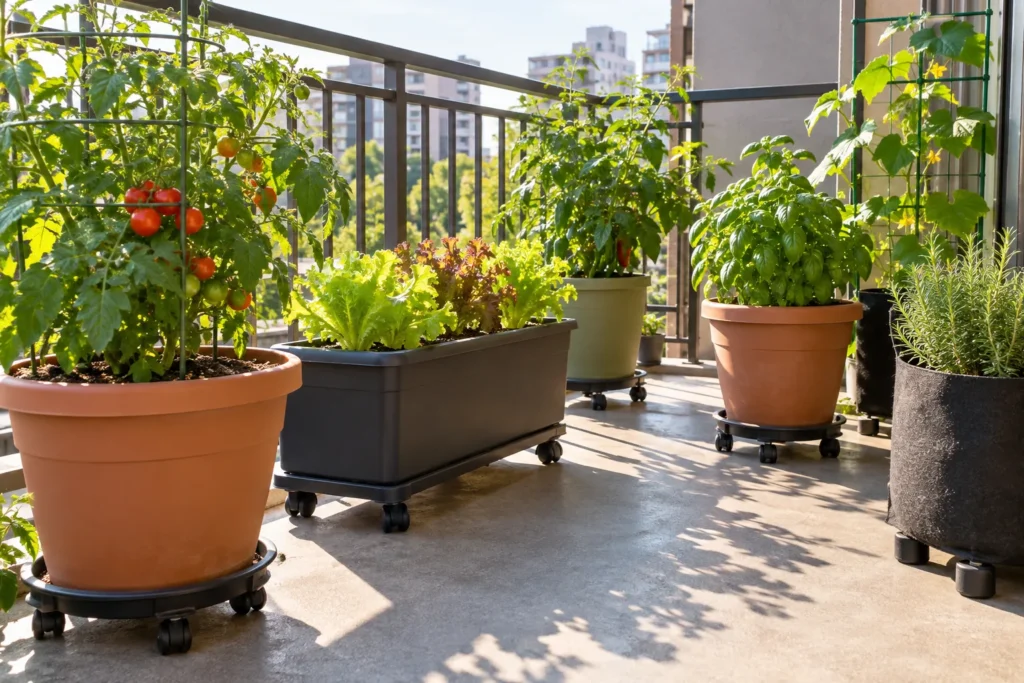
- Leave real gaps between containers. Even a few extra inches between pots lets air move around each plant instead of trapping humidity in a solid row pressed against a wall.
- Clear out plant debris at the end of the season, every time. UMD specifically calls out removing all plant debris as a management step, since powdery mildew overwinters as mycelium on leftover material. A pot that gets a fresh start with clean, discarded or refreshed soil each season carries less risk forward than one reused with the previous season’s dead leaves still at the base.
- Pick resistant varieties where they exist. Seed catalogs and plant tags increasingly list powdery mildew resistance directly on cucumbers, squash, and melons, which are the vegetables most prone to it on a balcony in the first place.
- Thin and prune for airflow before a problem starts, not after. Dense, bushy growth that looks lush is also growth that traps still, humid air at exactly the leaf level where these fungi establish.

When to pull the plant instead of treating it
Treatment is worth attempting when an infection is caught early and covers a small portion of the plant. It stops being worth the effort under a few specific conditions. If more than half the foliage is already affected late in the growing season, with only a few more weeks of useful production left anyway, pulling the plant and starting fresh next season uses your remaining time and container space better than nursing a mostly-lost plant along. If the same container has produced the same fungal problem on the same crop for two or more consecutive seasons despite cleaning the pot and refreshing the soil, the issue is more likely the variety or the container’s fixed position than anything you’re doing wrong season to season, and a different cultivar or a relocated container solves it faster than repeated treatment cycles. And if gray mold has reached the point of girdling a stem (a lesion that’s expanded all the way around the stem’s circumference) the tissue above that point is already cut off from water and nutrients regardless of any fungicide applied afterward, so removing that section, or the whole plant if the girdle is low, is the only step that still does anything useful.
Sources: University of Maryland Extension, “Powdery Mildew on Vegetables” (extension.umd.edu); Penn State Extension, “Addressing Downy Mildew and Powdery Mildew in the Home Garden” (extension.psu.edu); NC State Extension, “Botrytis Gray Mold of Tomato” (content.ces.ncsu.edu).