Faux outdoor plants have gotten good enough, and popular enough, that “just use real plants” isn’t the automatic right answer for every balcony spot anymore. There are genuine situations, a hard-to-reach high shelf, a spot with almost no usable light, a renter who travels constantly, where a well-chosen faux plant outperforms a real one on every practical measure. There are just as many situations, though, where faux plants fall flat, both visually and functionally, and choosing without weighing the two side by side usually means picking whichever one you already had a bias toward, instead of whichever one truly suits the specific spot. Here’s an honest look at where each one really wins.
Where real plants win
Anywhere you want to genuinely garden
This sounds obvious, but it’s worth stating plainly: if part of the appeal of a balcony garden is the actual gardening, watching something grow, harvesting herbs or vegetables, the seasonal rhythm of planting and tending, faux plants can’t deliver any of that no matter how realistic they look. They’re decor, not a hobby.
Up close, in good light
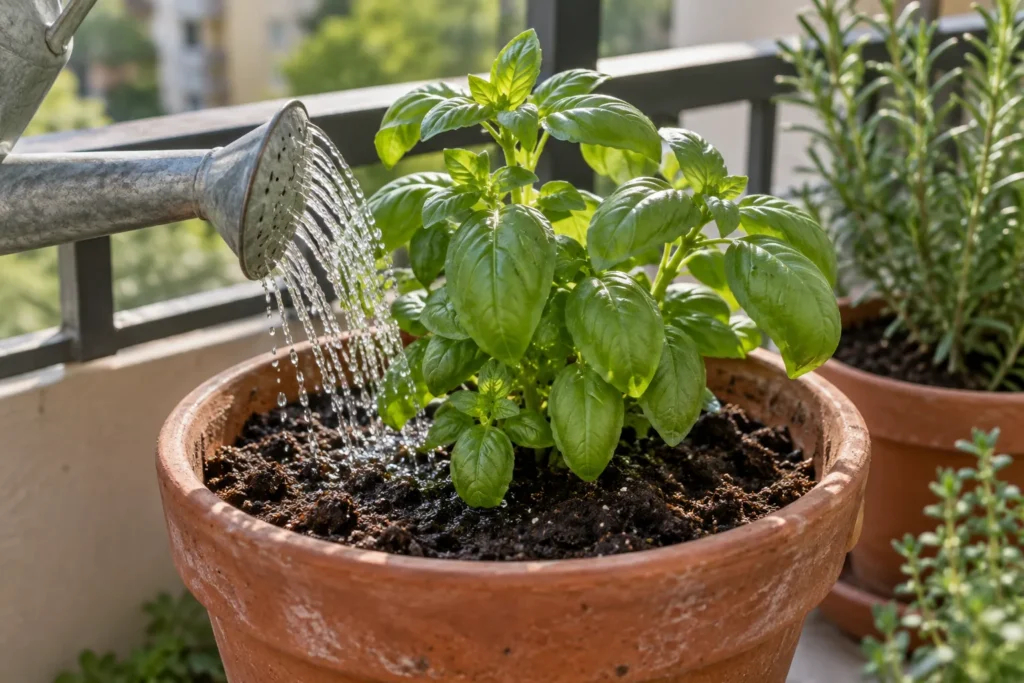
Faux plants photograph well and read fine from a normal viewing distance, but strong direct sunlight and close inspection are where they fall apart visually, uniform leaf shapes, unnaturally glossy or matte textures, and colors that don’t shift the way real foliage does in changing light. A balcony spot people sit close to and look at directly in full sun is where the illusion is hardest to maintain.
Where air quality or a living element truly matters to you
Whatever the exact scale of a houseplant’s air-purifying effect in a small, non-enclosed outdoor space (a claim that gets seriously overstated online), a real plant is a living, breathing thing responding to its environment, growing, sometimes struggling, occasionally surprising you. If that living, changing quality is part of what you really want from a balcony, no faux plant substitutes for it.
Where faux plants win
Properly poor light or extreme conditions
A shaded corner too dark for even the most shade-tolerant real plant, or a spot exposed to constant harsh wind and reflected heat, is exactly where faux plants outperform real ones without qualification. There’s no real plant care advice that fixes a spot with fundamentally unworkable conditions; a faux plant just doesn’t have that problem.
Extended absences
Frequent travelers, people with unpredictable schedules, or anyone who’s killed the same real plant more than once from simple neglect are all better served by faux plants in at least some spots. A faux plant left completely unattended for a month looks exactly the same when you get back; a real one usually doesn’t.
Hard-to-water, hard-to-reach spots
A high shelf, the top of a tall plant stand, or anywhere else that’s awkward to reach with a watering can regularly is a practical candidate for a faux plant, since the exact spots that are hardest to water are also the ones most likely to get neglected once the novelty wears off.
Filling in gaps in an off-season arrangement
Between a fading annual planting and whatever comes next, or through a properly dead-of-winter stretch, a faux plant or two can hold visual structure in a container arrangement without the seasonal replanting a real plant would need on the same timeline.
Side by side
| Real plants | Faux plants | |
|---|---|---|
| Upfront cost | Usually lower | Usually higher for quality ones |
| Ongoing cost | Water, soil, occasional replacement | None after purchase |
| Works in poor light | No | Yes |
| Survives neglect | No | Yes |
| Close-up realism | Perfect, by definition | Good to mediocre, distance-dependent |
| Seasonal change | Yes, naturally | Only if you swap them |
The real cost comparison over several years
A quality outdoor-rated faux plant typically costs more upfront than a comparable real plant, sometimes considerably more for a large or realistic one. Whether that’s really more expensive over time depends entirely on how long each side lasts. A real annual gets replaced every single year, so its yearly cost is really its full purchase price, repeated. A real perennial spreads its cost over however many years it survives, potentially very cheap per year if it thrives, effectively free after the first couple of seasons. A faux plant sits in between: no recurring purchase cost, but a real lifespan of its own, typically several years outdoors before UV exposure fades the color or makes the material brittle enough to need replacing. Over a five-year stretch, a faux plant and a well-chosen thriving perennial often land in a similar total cost range, while faux plants usually come out ahead of repeatedly replaced annuals or perennials that keep failing to survive winter.
Maintenance neither one fully escapes
“No maintenance” oversells faux plants somewhat. Outdoor faux foliage collects dust, pollen, and general grime just like anything else left outside, and it needs an occasional wipe-down or rinse with a hose to keep looking presentable, not dingy. It won’t need watering or feeding, but it’s not a permanently zero-effort object either, more accurately described as much lower maintenance than a real plant, not zero maintenance.
If pets or small children use the balcony
Faux plants sidestep an entire category of concern real plants carry: toxicity if chewed or eaten. Many common ornamental plants are mildly to seriously toxic to pets or small children if ingested, a real plant safety question you have to research species by species, while a faux plant carries no such risk from the plant material itself, only the usual small-parts and choking hazard considerations that already apply to any decorative object within a curious pet’s or child’s reach on a balcony. If a balcony gets used by a curious pet or toddler, that’s a genuine point in faux plants’ favor for anything within easy reach, even if you lean real everywhere else.
Buying faux plants that genuinely hold up outside
Not every faux plant is rated for outdoor use, and using an indoor-only one on a balcony is a common, avoidable mistake. Look specifically for “outdoor” or “UV-resistant” on the label; indoor faux plants use materials and dyes that fade, discolor, or become brittle within a single season of real sun and weather exposure, while outdoor-rated ones are built to handle it for years. Beyond that label check, a few things separate a convincing faux plant from an obviously fake one: varied leaf sizes and slightly irregular placement instead of a perfectly uniform, symmetrical shape, a matte instead of glossy finish, and a properly heavy, textured pot underneath it, since a cheap-looking, obviously lightweight container undercuts a good faux plant’s realism just as much as it would undercut a real one.
The environmental angle, honestly
Neither option is environmentally free, and it’s worth being honest about that instead of assuming real automatically wins. Faux plants are plastic products that eventually end up in landfill once they fade or degrade, with no biodegradable end of life. Real plants require ongoing water and, for many gardeners, fertilizer and pesticides with their own environmental footprint, along with the plastic nursery pots and shipping involved in buying them in the first place. Buying fewer, higher-quality faux plants meant to last years instead of a season, and properly caring for real plants well enough that they last instead of repeatedly dying and getting replaced, both do more for the environmental side of this than picking one category over the other on principle alone.
A mixed approach
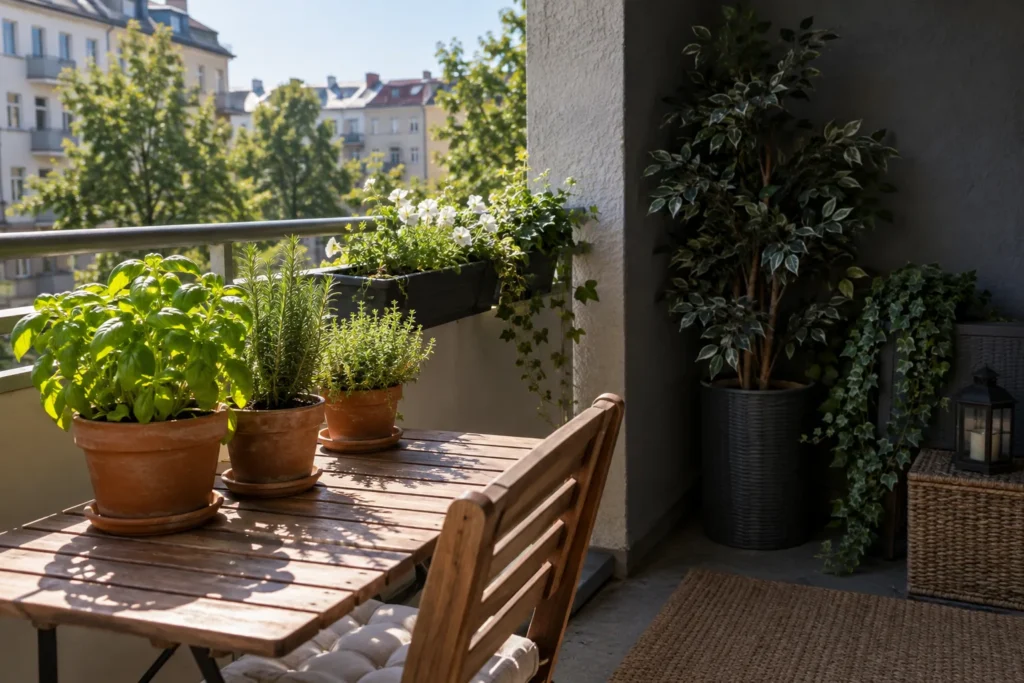
Most balconies that use faux plants well don’t use them exclusively. A common, effective pattern: real plants in every spot with workable light and easy access, where they’ll thrive and where the hands-on gardening is genuinely wanted, and faux plants reserved specifically for the problem spots, too dark, too high, too easy to forget. Used this way, faux plants solve a specific, narrow problem instead of replacing the whole garden, and the quality gap between real and faux is much less noticeable to a visitor when the two aren’t placed directly beside each other inviting a side-by-side comparison in the first place.
Common mistakes on both sides
- Buying indoor faux plants for outdoor use and watching them fade or degrade within one season of real sun exposure.
- Placing faux plants in the most visible, close-up spot on the balcony, exactly where their limitations are easiest to spot, instead of a harder-to-reach or lower-visibility spot where they’d do their best work.
- Forcing a real plant into a properly unworkable spot out of principle, then replacing it repeatedly instead of accepting that a faux plant is the more practical choice there.
- Mixing real and faux plants of noticeably different quality tiers right next to each other, which makes the faux plant read as fake by direct comparison even when it would pass fine on its own.
If you’re leaning real
For the spots where real plants are the right call, matching the plant to your balcony’s actual light and conditions matters more than almost anything else you’ll decide. Our guides to plants for hot, sunny balconies and plants for shady balconies cover that matching process for the two most common condition extremes.
Deciding where real and faux plants each belong is easier once you have an overall plan; see our guide to planning a balcony garden layout from scratch.