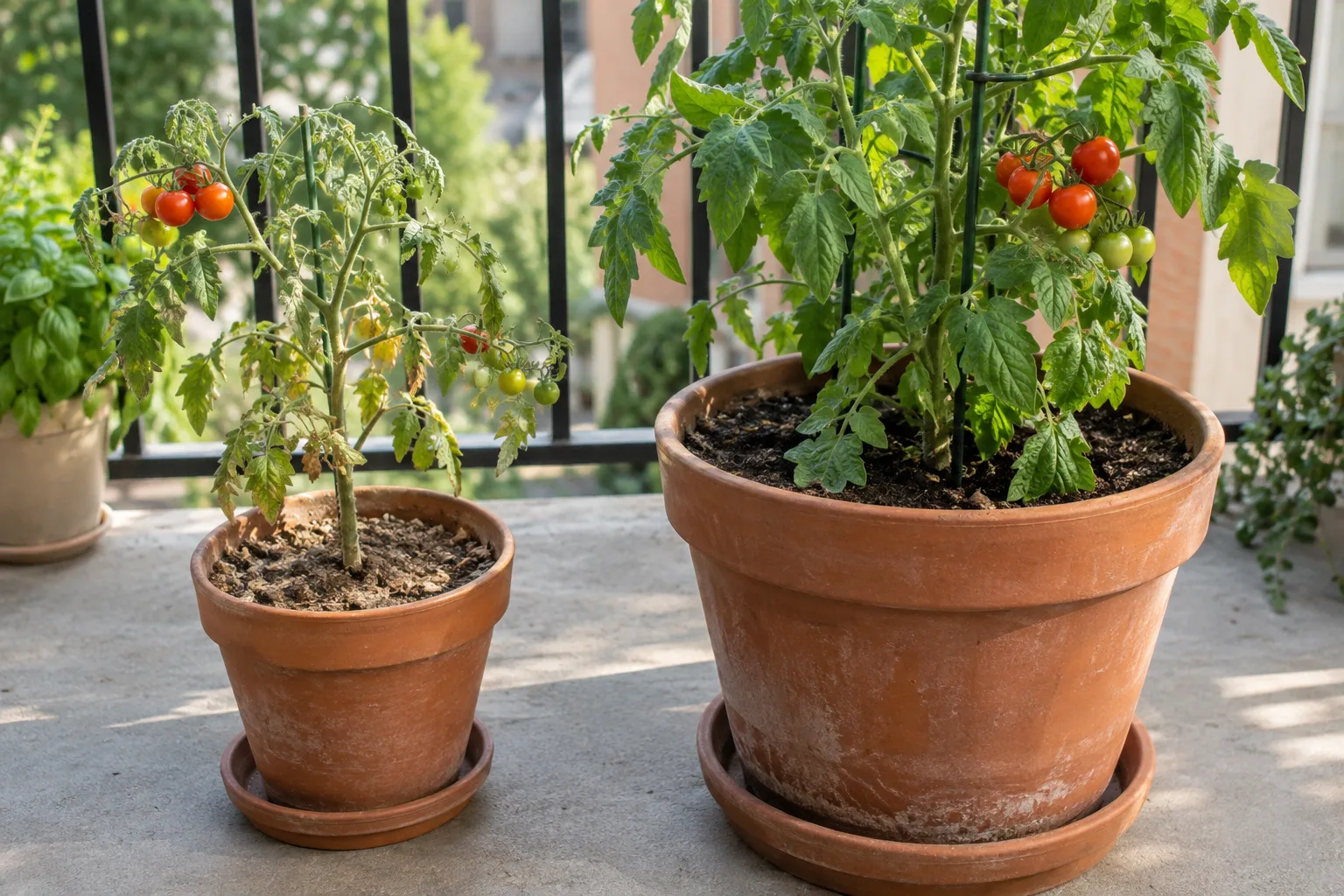
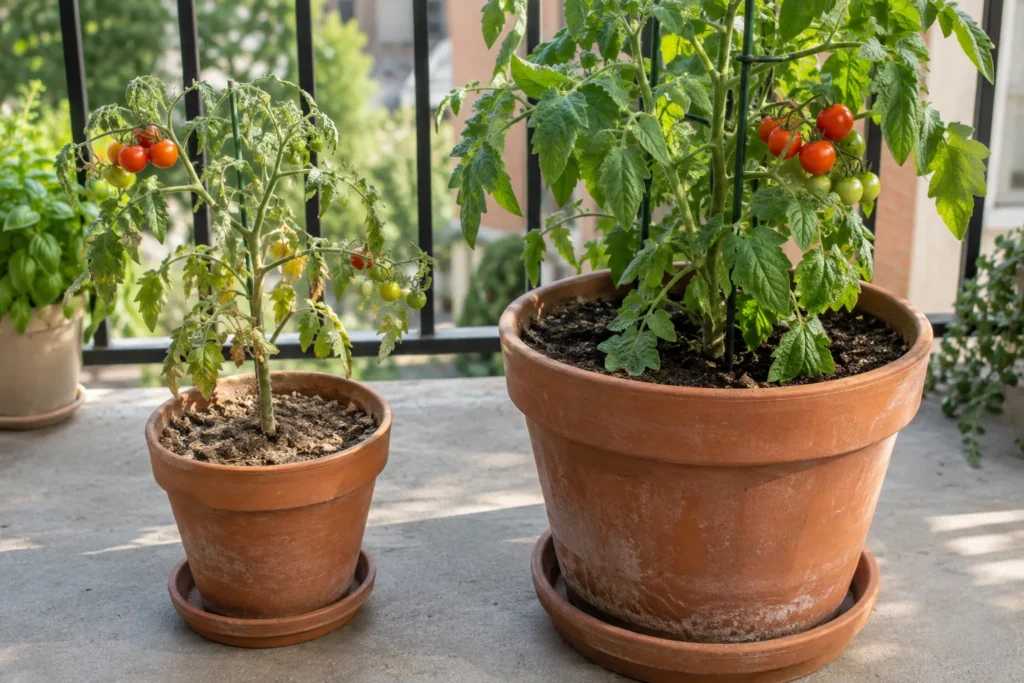
Two identical tomato plants, same variety, same balcony, can need watering on completely different schedules if one sits in a 6-inch pot and the other in an 18-inch one. That’s obvious enough once you see it happen, but the reason behind it, and the reason temperature, wind, and pot material push that schedule around even further, comes down to a genuinely simple piece of physics: the relationship between a container’s surface area and its volume.
Why small pots dry out faster: it’s a ratio, not just an amount
Virginia Cooperative Extension frames it with a simple comparison: a small puddle dries faster than a deep one, even though both are losing water to evaporation at a similar rate per unit of exposed surface. The deep puddle just has more volume in reserve behind that same exposed surface. A container works the same way. Evaporation happens at the exposed surface, the top of the soil, plus whatever moisture escapes through the container walls, but the water available to buffer against that loss scales with the entire volume of the pot. A small pot has a high surface-area-to-volume ratio: relatively more exposed surface for the amount of water actually stored. A large pot has a lower ratio: proportionally less surface losing water for every gallon held in reserve.
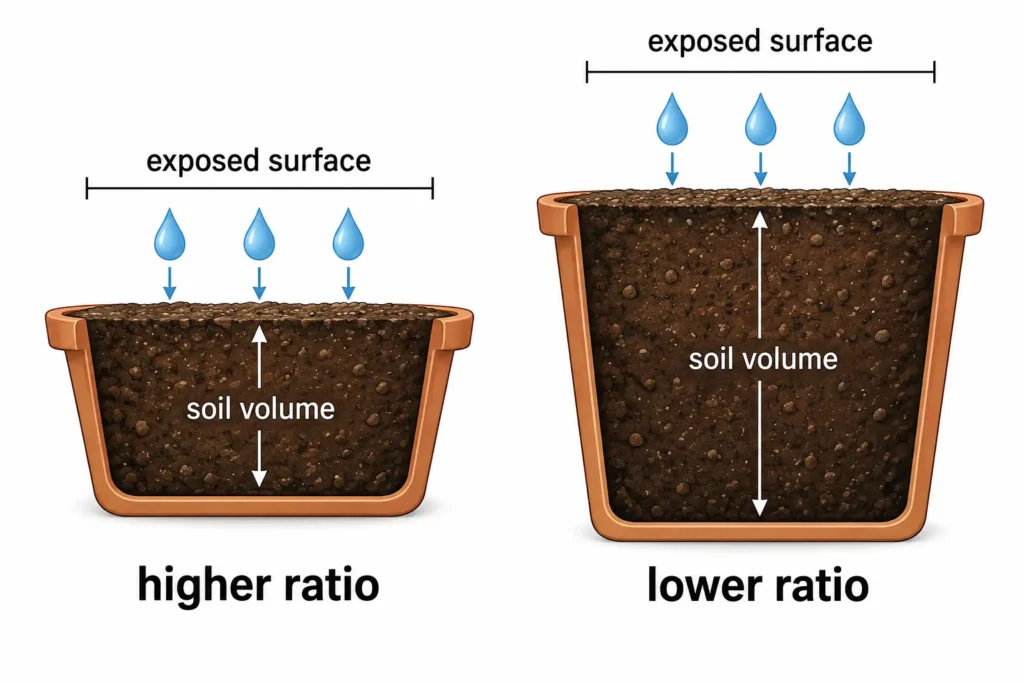
This is why doubling a pot’s diameter does more than double its water-holding buffer relative to its drying rate; volume increases with the cube of a linear dimension while the exposed soil surface only increases with the square, so a modestly bigger pot buys a disproportionately longer stretch between waterings. It’s also why root-bound plants, whose roots have displaced much of the usable soil volume, dry out faster even in a pot that was once perfectly sized: the effective water-holding volume shrank while the surface area losing moisture stayed the same.
What actually drives the evaporation rate itself
Volume determines the buffer; a separate set of factors determines how fast that buffer gets used up. Evaporation research generally models the rate as a function of exposed surface area, temperature, wind speed, and humidity, not container volume at all; a wide, shallow tray and a narrow, deep pot with the same exposed soil surface lose water to evaporation at a similar rate, even though the deep pot holds far more in reserve and will visibly dry out more slowly overall. Temperature raises the vapor pressure driving water out of the soil and out of leaf stomata; wind, as covered in more depth in our guide to how wind affects balcony plants, strips away the humid air sitting just above the soil and leaf surfaces, accelerating the same process. Humidity works in the opposite direction, slowing evaporation when the surrounding air is already close to saturated.
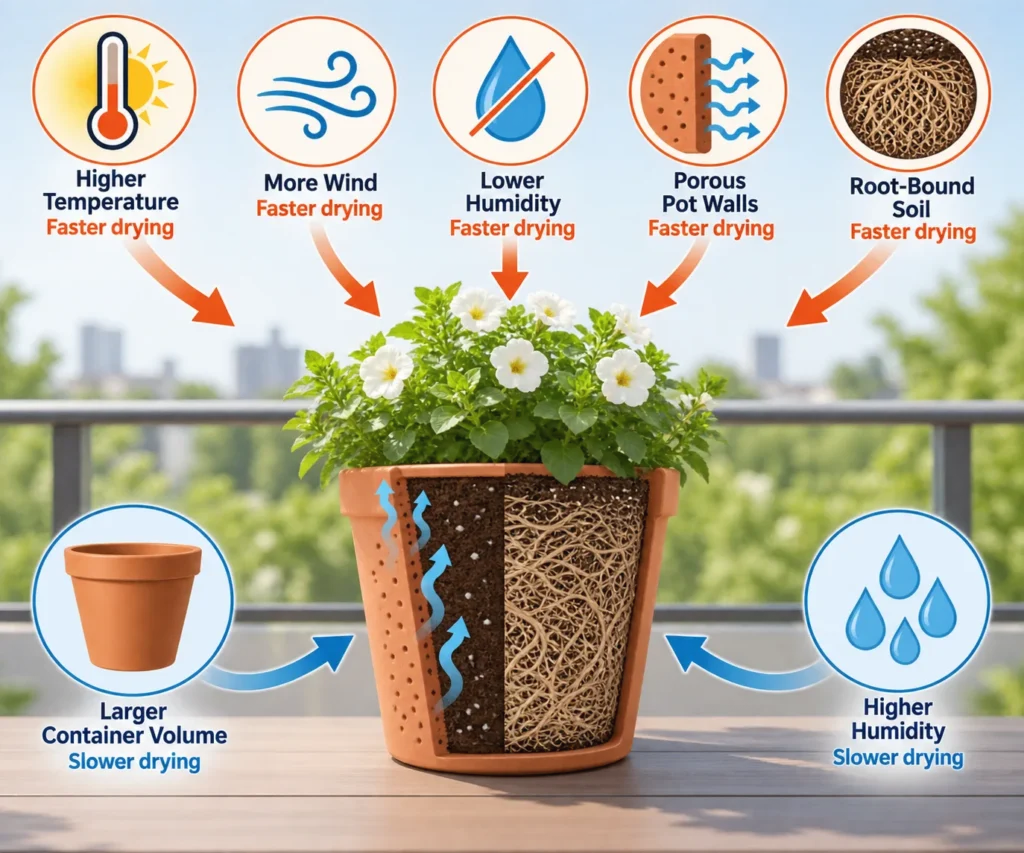
A hot, dry, windy day therefore compounds all three accelerants at once, which is exactly the combination that catches balcony gardeners off guard during a heatwave: a container that comfortably went two days between waterings in mild weather can need water daily, sometimes more, once heat and wind stack on top of each other.
Pot material changes the equation too
Volume and exposed surface aren’t the only variables; the container wall itself either adds a second evaporation surface or doesn’t. Virginia Cooperative Extension notes that porous materials, unglazed terracotta being the clearest example, lose water through the walls of the pot in addition to the exposed soil surface at the top, which is why the same volume of soil dries out faster in terracotta than in glazed ceramic or plastic, both of which are essentially sealed and lose water only from the top. That extra evaporation surface is also why terracotta feels noticeably cooler to the touch than a sealed plastic pot in full sun: the same evaporative cooling effect that makes a wet towel feel cool is happening continuously across the pot’s entire surface, not just at the soil line.
That tradeoff, faster drying in exchange for a cooler, more evenly aerated root zone, is a real one, not just folklore; it’s covered in more depth alongside the specific temperature research on pot material in our guide to whether pot color and material affect root temperature.
The potting mix itself changes the volume side of the ratio
Pot size and material both act on the container; the mix inside it acts on the same equation from the other direction. University of Maryland Extension notes that peat moss and coco coir hold water and release it gradually while perlite is added specifically to improve drainage and aeration, meaning it holds comparatively little. Two identical pots, same size, same material, can behave like they’re different volumes for watering purposes depending on what’s actually filling them: a perlite-heavy mix drains fast and effectively shrinks the usable water-holding buffer described earlier, while a mix weighted toward peat, coco coir, or added compost holds more water per unit of volume and stretches the interval between waterings.
This is a real, usable lever independent of pot size or material: a small or fast-drying container can be made to hold water longer by adjusting what’s in it, not just by upgrading to a bigger pot. It’s also why two people can both be “doing everything right” and still see very different watering needs from what looks like an identical setup, if one mix skews toward drainage and the other toward retention.
Putting the variables together
None of these factors act alone on a real balcony; they compound. A small terracotta pot in a hot, windy, west-facing spot combines the worst case of every variable at once: high surface-area-to-volume ratio, an extra evaporation surface through the porous walls, and high temperature and wind both accelerating the rate. The same plant in a large plastic or resin container in a more sheltered spot might go three or four times as long between waterings under otherwise similar conditions, not because the plant’s water needs changed, but because every physical variable governing water loss shifted in the more forgiving direction.
| Factor | Effect on drying speed | Why |
|---|---|---|
| Smaller pot | Faster | Higher surface-area-to-volume ratio; less buffer per unit of exposed surface |
| Porous material (terracotta, fabric) | Faster | Water evaporates through the walls, not just the soil surface |
| Higher temperature | Faster | Raises vapor pressure driving water out of soil and leaves |
| More wind | Faster | Strips humid air from soil and leaf surfaces, steepening the vapor gradient |
| Higher humidity | Slower | Reduces the vapor pressure gradient driving evaporation |
| Root-bound plant | Faster | Roots displace soil, shrinking the effective water-holding volume |
| Perlite-heavy mix | Faster | Improves drainage and aeration but holds comparatively little water |
| Peat, coco coir, or compost-heavy mix | Slower | Holds water and releases it gradually, increasing the usable buffer |
Why this argues for checking soil, not following a schedule
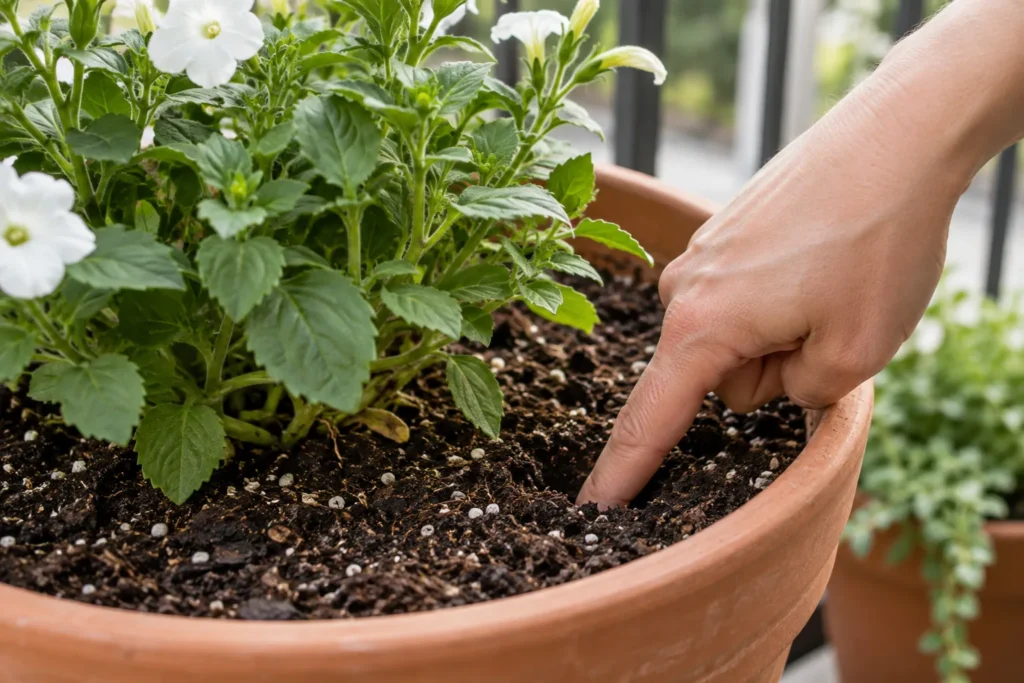
Because so many variables interact, a fixed watering schedule is really a guess about all of them holding steady, and on a balcony they rarely do. The same container that needs water every three days in spring can need it daily once summer heat and wind arrive, then drop back to twice a week as fall cools things down, all without you changing a single thing about the plant or the pot. Checking soil moisture directly, a finger pushed an inch or two into the mix, sidesteps the need to mentally track every variable at once; it measures the actual outcome of surface area, volume, material, temperature, wind, and humidity all acting together, which is far more reliable than reasoning through each one separately every time you’re deciding whether to water.
A second signal: the weight test
The finger test has one real limitation: it only tells you about the top inch or two, which can read dry even when a deep container still holds plenty of water lower down, or read misleadingly damp on a pot that’s bone-dry just below the surface. Lifting the container is a second, complementary check that reads the whole volume at once instead of one depth: a container that feels distinctly lighter than it does right after a thorough watering needs water, regardless of what the surface looks or feels like. This works especially well for the exact pots this article’s physics points to as fast-drying, small containers, fabric grow bags, and terracotta, since lightweight material makes the wet-versus-dry weight difference easy to feel by hand. It’s less useful for large, heavy glazed or resin containers, where the pot’s own weight swamps the difference the soil’s water content makes.
Neither test needs to be exact. The finger test and the weight test are checking the same underlying thing, actual water content, from two different angles, and using them together catches what either one misses alone: a top-dry, bottom-wet pot that the finger test would flag too early, or a deceptively dry deep container that the finger test alone might miss.
The science in practical terms
- Bigger pots buy disproportionately more time between waterings, not just a little more, since volume grows faster than surface area as a container gets larger.
- Porous materials add a second evaporation surface through the pot walls, trading faster drying for a cooler, better-aerated root zone.
- Heat, wind, and low humidity compound each other; a hot, dry, windy day can multiply a container’s drying rate compared to a mild one.
- A root-bound plant dries faster even in the same pot, because roots have quietly shrunk the soil’s water-holding volume.
- Potting mix composition adjusts the same ratio from the inside: perlite-heavy mixes drain fast and hold less, while peat, coco coir, or compost-heavy mixes hold more water per unit of volume.
- Check the soil, not the calendar. A physical measurement accounts for every variable at once; a fixed schedule accounts for none of them reliably.
- Combine the finger test with the weight test for small or lightweight containers, since lifting reads the whole pot’s water content, not just the top inch or two.
Sources
- Virginia Cooperative Extension: Properly watering container houseplants
- University of Maryland Extension: Maintaining container-grown vegetables
- Ask Extension: Best methods for checking houseplant soil moisture
- University of Maryland Extension: Growing media (potting soil) for containers
Exact drying times vary with climate, plant species, and potting mix composition. Treat the physical relationships here as a way to understand your own balcony’s patterns, not a fixed watering calendar.