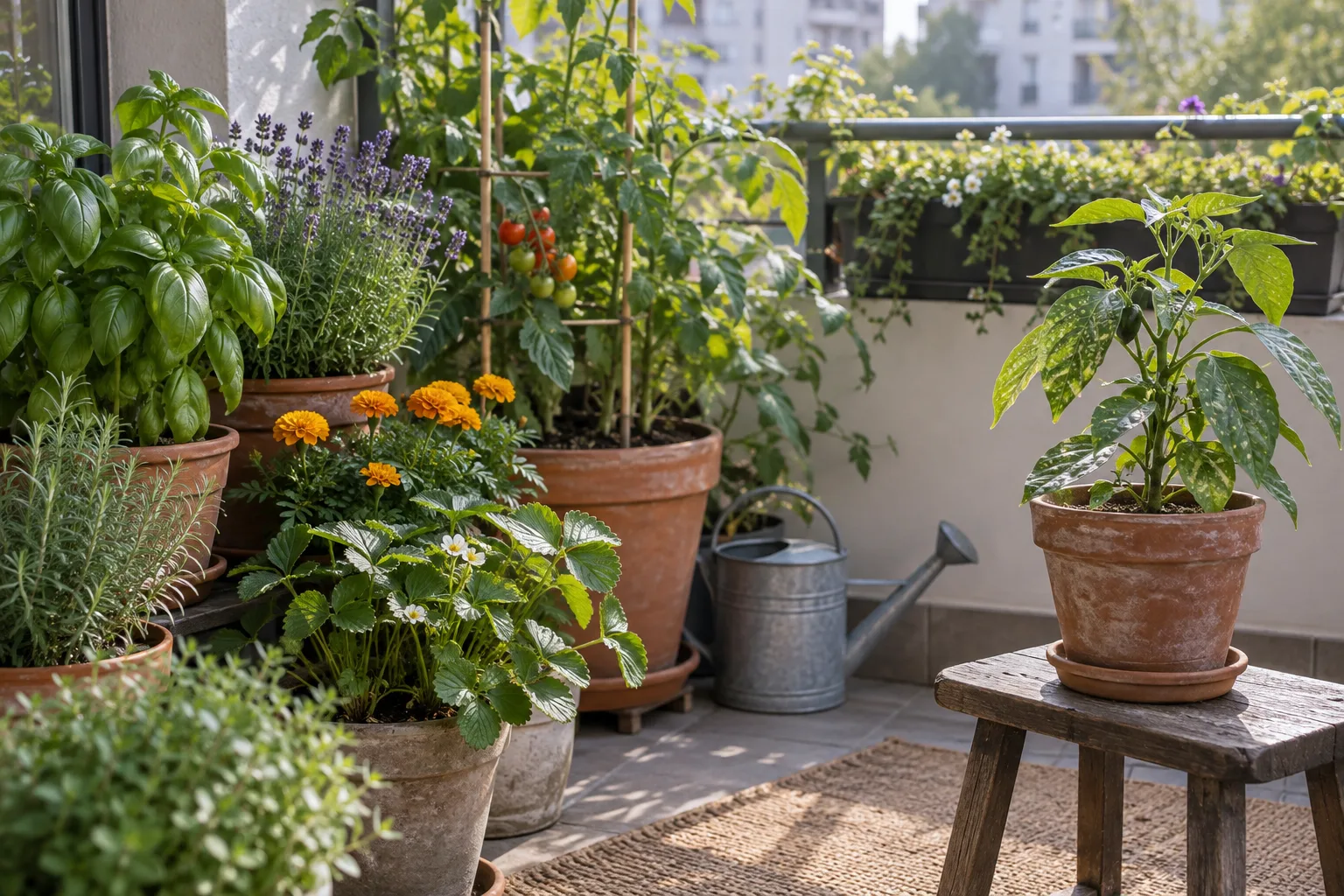
Aphids get most of the attention, but they are not the only thing that shows up on a balcony full of potted plants. If your aphid treatment worked and something is still wrong, or the insects you’re looking at don’t match the aphid description at all, there’s a good chance you’re dealing with spider mites, thrips, whiteflies, mealybugs, scale, or fungus gnats instead. Each one looks different, spreads differently, and needs a different response.
This guide walks through the six other pests balcony gardeners run into most, how to tell them apart, and what works in a container garden where you can’t just spray and walk away for a week.
Quick identification, side by side
- Spider mites: nearly invisible; look for pale speckled leaves and fine webbing at leaf joints.
- Thrips: slender, rice-shaped insects rarely longer than 2mm; cause silvery stippling similar to spider mites, but leave small, dark, tar-like specks of frass on the leaf.
- Whiteflies: small white insects that fly up in a cloud when the plant is disturbed.
- Mealybugs: white, cottony clumps wedged into leaf joints and along stems; barely move.
- Scale: small brown, tan, or gray bumps stuck to stems and leaf midribs; look more like a growth than an insect.
- Fungus gnats: tiny flies hovering at the soil surface, not on the leaves at all.
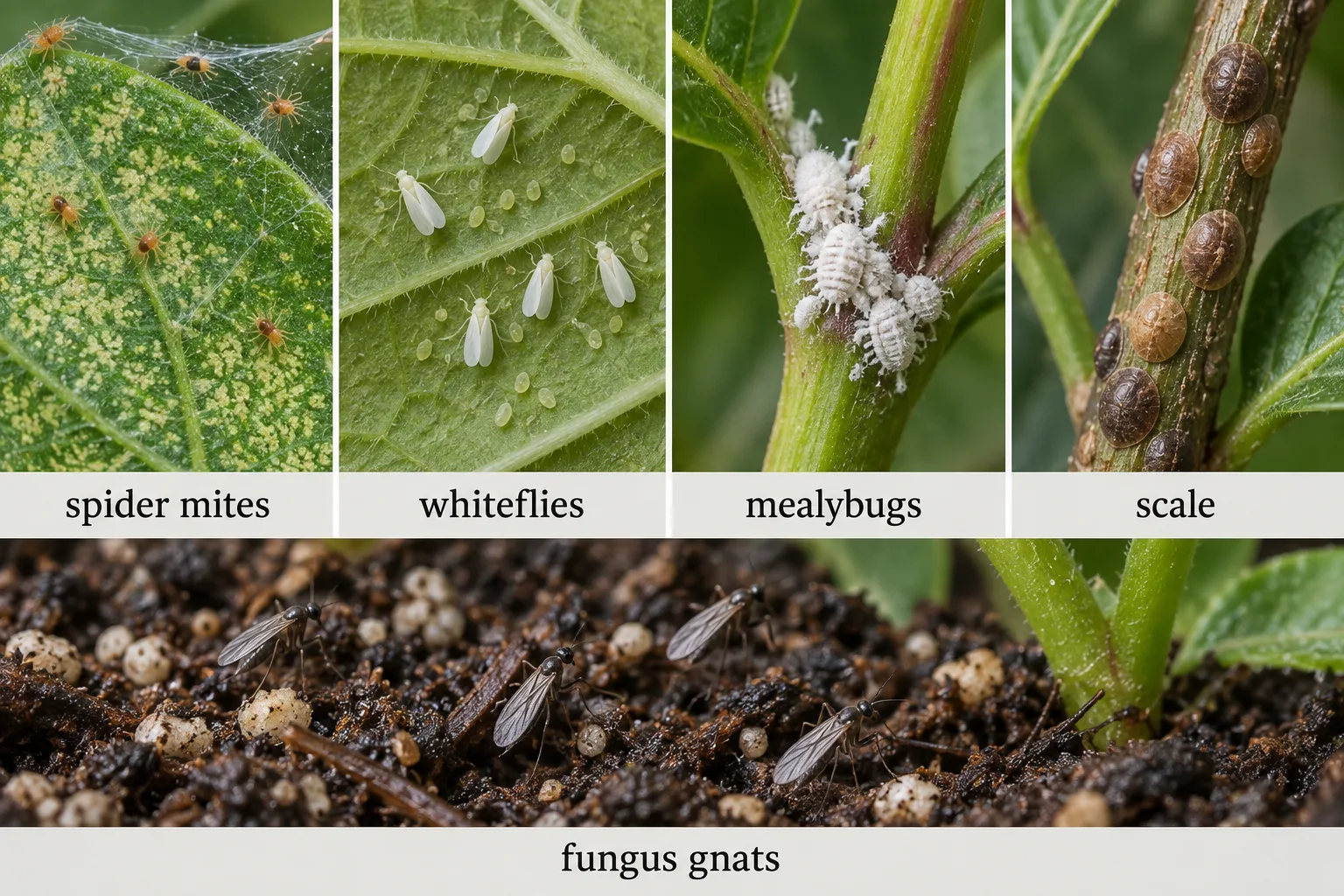
If your plant is sticky to the touch, or has a dark, sooty coating on the leaves, you’re likely dealing with a sap-feeder: aphids, whiteflies, mealybugs, or scale. Fungus gnats and spider mites don’t produce honeydew, so a dry, non-sticky plant with either speckled leaves or gnats near the soil points to one of those two instead. Thrips are the exception among the sap feeders: they also feed on plant tissue but skip the sticky residue, so a dry plant with silvery stippling could be either spider mites or thrips — check for small, dark, tar-like frass specks on the leaf surface, which spider mites don’t leave behind.
Spider mites: fine webbing and stippled leaves
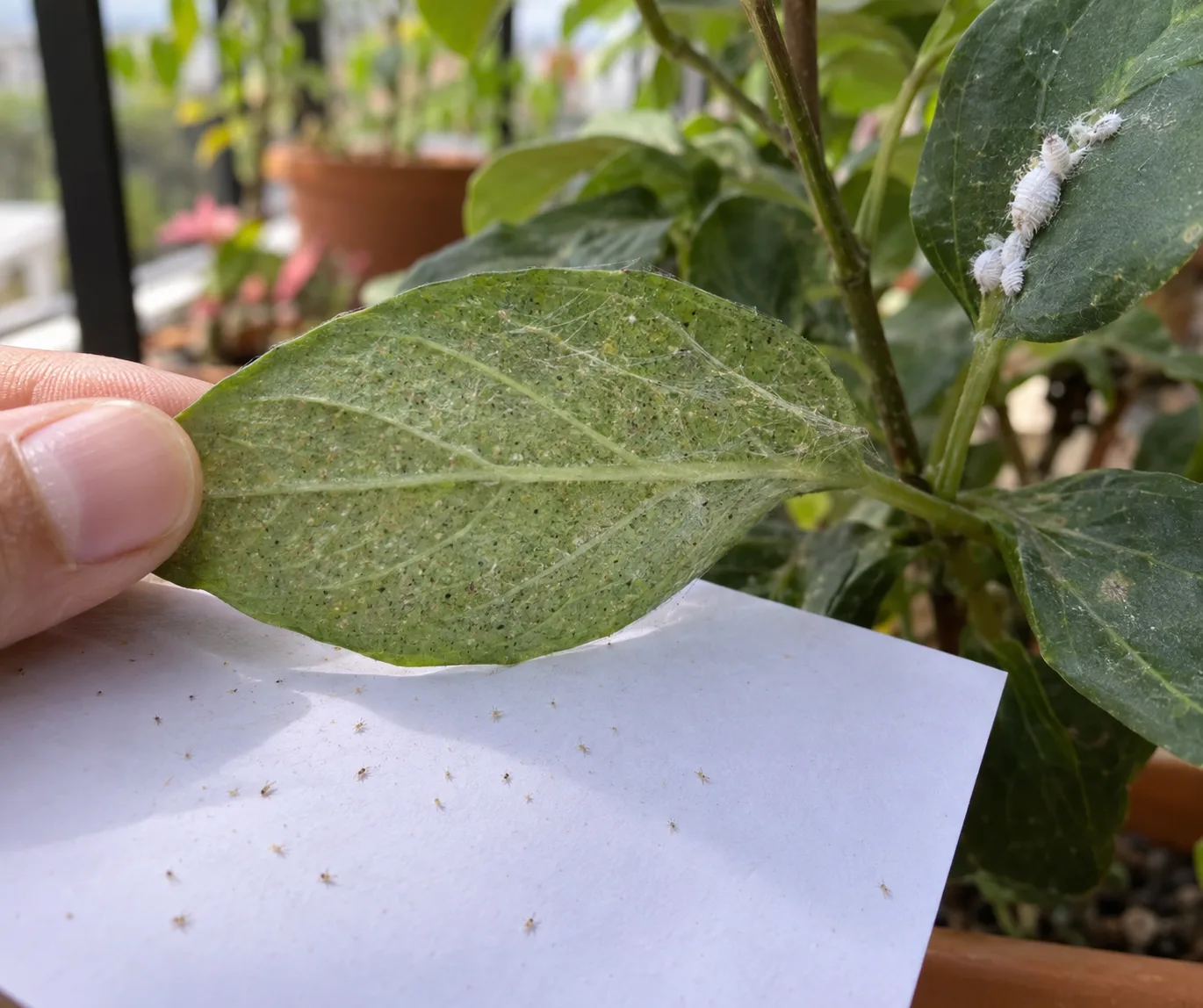
Spider mites are barely visible without a hand lens, but the damage is easy to spot. Leaves develop tiny pale or yellow speckles (stippling) from mites feeding on the underside, and in a bad infestation you’ll see fine webbing across leaf joints and new growth. They tend to show up in hot, dry conditions, which makes a sun-baked balcony in late summer a likely spot for them.
- Check for them: hold a sheet of white paper under a leaf and tap the stem. Mites look like moving specks of pepper on the paper.
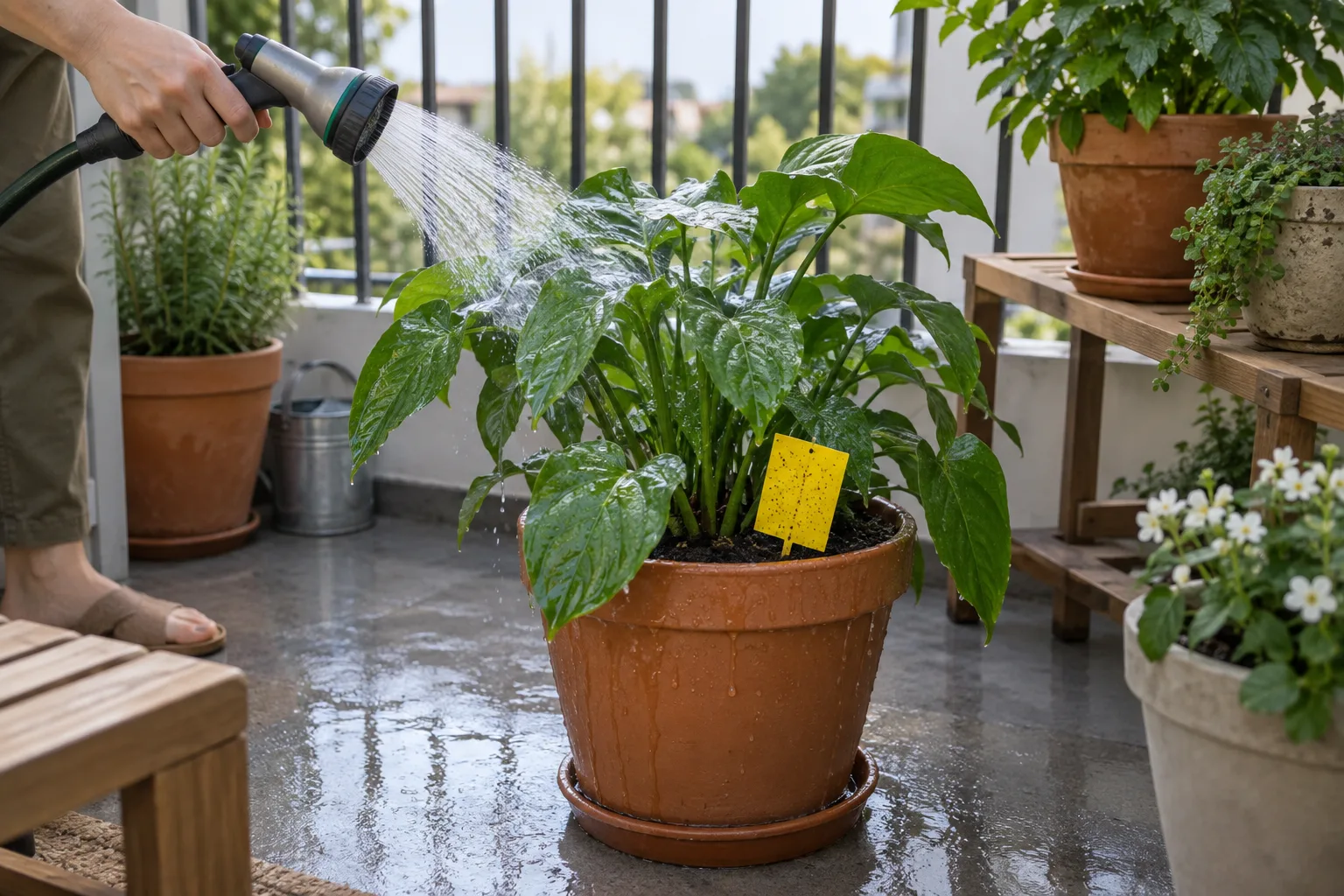
- First response: a strong, direct spray of water on the leaf undersides, repeated every few days, knocks down populations without any product.
- If that’s not enough: insecticidal soap or horticultural oil, applied to the point of runoff on leaf undersides, where the mites live.
- Prevention: mites thrive on stressed, dry plants, so consistent watering matters more here than for almost any other pest on this list.
Thrips: stippling that looks like spider mites, but isn’t
Thrips are slender, rice-shaped insects rarely longer than 2mm and easy to miss without a hand lens. Adults can be yellow, brown, or a glossy black depending on the species, while the young stages are wingless and often pale or near-white. Feeding damage looks almost identical to spider mites at first glance, with pale, silvery stippling that can spread into larger bleached patches as the population grows. The real tell is what they leave behind rather than what they look like: small, dark, tar-like specks of frass glued to the leaf where spider mites leave none.
- Check for them: look closely at young leaves, leaf margins, and along the main vein for stippling paired with dark frass specks; thrips also gather inside flower buds and blooms, feeding on pollen.
- First response: a strong, direct jet of water from a hose or sink sprayer knocks adults and larvae off the plant, the same low-effort first step as spider mites.
- Treatment: insecticidal soap or horticultural oil, repeated on a short cycle, since thrips reproduce quickly and a single application rarely catches every generation.
- Prevention: thrips are drawn to stressed plants and to excess nitrogen fertilizer, so a balcony plant getting more feeding than it needs is more likely to attract them than one on a normal schedule.
Whiteflies: they scatter when you disturb the plant
Whiteflies are the easiest of these six to confirm on sight: brush against an infested plant and a small cloud of tiny white insects lifts off and resettles seconds later. They cluster on the undersides of leaves, feed on sap, and leave the same sticky honeydew residue aphids do, which can lead to sooty mold on the leaves below.
- Check for them: gently shake or tap a suspect plant and watch for the telltale scatter-and-resettle pattern.
- First response: yellow sticky traps placed just above the foliage catch adults and give you a read on how bad the population is.
- Treatment: insecticidal soap or horticultural oil on the leaf undersides, repeated on a 5 to 7 day cycle since whitefly eggs hatch in stages, not all at once.
- Isolate the plant while treating; whiteflies move fast between containers set close together.
Mealybugs: white, cottony, and slow to move
Mealybugs look like small tufts of cotton wedged into leaf joints, along stems, and at the base of leaves. Unlike whiteflies, they barely move, which makes them one of the more manageable pests here once you’ve found them. They’re also sap feeders, so expect the same sticky honeydew and possible sooty mold as aphids and whiteflies.
- Check for them: look closely at leaf joints and the crown of the plant, where they tend to cluster and hide.
- First response: a cotton swab dipped in isopropyl alcohol, touched directly to each visible mealybug, kills them on contact without any spraying.
- For heavier infestations: insecticidal soap or horticultural oil, since hand-removal alone won’t keep up once the colony has spread.
- Watch the roots too: some mealybugs live in the soil around roots, so a plant that keeps coming back after leaf treatment may need to be repotted into fresh soil.
Scale: small, shell-like bumps that don’t look alive
Scale insects are the pest most likely to be mistaken for a plant disease or just a weird bump, because once they settle they stop moving and grow a waxy shell over themselves. You’ll find them lined up along stems and the midribs of leaves, and they can be brown, tan, or gray depending on the species.
- Check for them: try to flick or scrape one off with a fingernail. If it comes off and the plant is sticky underneath, it’s scale.
- First response: for a light infestation, scrape the scale off by hand with a fingernail or soft brush.
- For more coverage: horticultural oil is more effective than soap here, since it smothers the insects under their protective shell.
- Be patient: the waxy covering makes scale slower to respond to treatment than soft-bodied pests, so expect to repeat treatment over a few weeks.
Fungus gnats: the ones that come from the soil, not the leaves
Fungus gnats are the pest most directly tied to how you water. The adults look like tiny mosquitoes hovering around the soil surface or drifting up when you disturb a pot, and they’re mostly a nuisance. The larvae, living in the top inch or two of wet potting mix, are the actual problem: they feed on organic matter and fungi in damp soil, and in soggy containers they can damage fine roots and seedlings.
- Check for them: water the plant and watch the soil surface. Gnats that were hiding in the mix will rise and fly briefly.
- The real fix is watering, not spraying: let the top inch or two of soil dry out between waterings. Fungus gnats can’t establish in soil that isn’t consistently wet.
- Speed it up: a thin layer of horticultural sand or fine gravel on top of the soil dries out faster than bare potting mix and makes it harder for adults to lay eggs there.
- To catch the adults while the soil dries out, yellow sticky traps placed at soil level work well and double as an early-warning system for other flying pests.
Mistakes that make these worse, not better
- Reaching for dish soap instead of insecticidal soap. Household dish soap isn’t formulated for plants and can strip the waxy coating off leaves, causing burn. A labeled insecticidal soap is a different product.
- Spraying oil or soap in full midday sun. Both can scorch leaves when applied in direct heat. Treat in the early morning or evening instead, which also matters more on a south-facing balcony than in a shaded backyard bed.
- Treating once and assuming it’s done. Whitefly and scale eggs hatch in waves, so a single application often misses the next generation. Plan on repeat treatments a week or so apart.
- Ignoring the pot itself. Eggs and overwintering pests can sit in the rim, drainage holes, or saucer, not just on the plant. Wipe down the container while you’re treating the leaves.
Why healthy plants get fewer of these in the first place
Every pest on this list takes hold faster on a plant that’s already stressed. Underwatered plants are more attractive to spider mites, overwatered ones invite fungus gnats, and a plant struggling in the wrong amount of light has less energy to resist any of the sap-feeders. Matching a plant to the light and water it needs does more long-term pest prevention than any spray. Checking new plants closely before they join the rest of your balcony, and giving them a week or two on their own first, catches most infestations before they ever spread.
A few rules that apply across all six
Correct identification matters more than speed. Treating scale like it’s spider mites, or spraying for whiteflies when the real problem is overwatering and fungus gnats, wastes time and can stress a plant that’s already struggling. When in doubt, use a hand lens, check both sides of several leaves, and confirm what you’re looking at before treating.
Isolating an affected container is worth doing for all six of these, since balconies put pots close enough together that pests move from one to the next within days. And with any pesticide, including insecticidal soap and horticultural oil, read the label for the specific plant you’re treating. Some plants are sensitive to oil sprays in full sun or high heat, which matters a lot on a balcony that gets hours of direct afternoon light.
Sources
University of Minnesota Extension: Managing insects on indoor plants