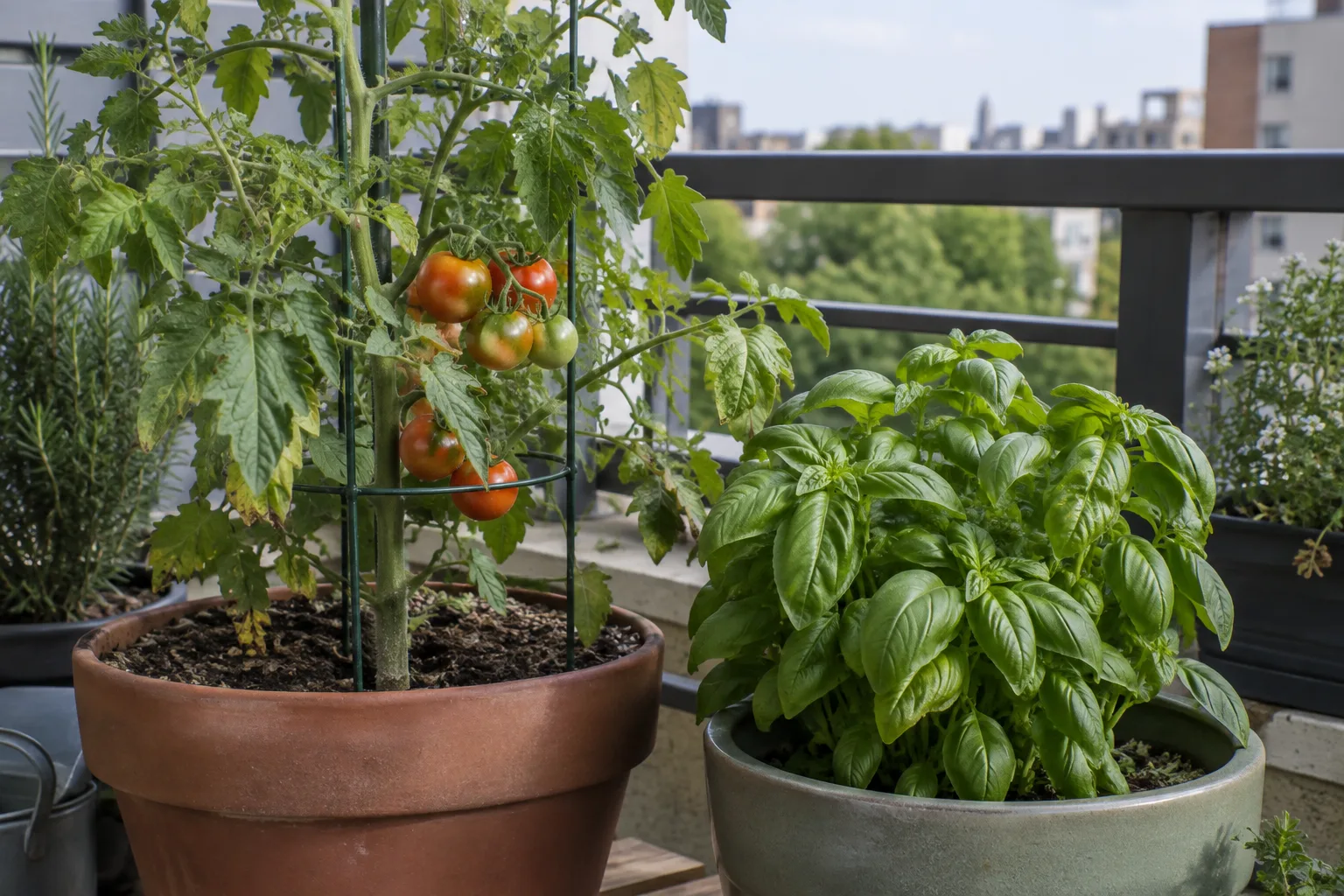
Here’s a claim you’ll find on almost every companion planting chart: plant basil next to your tomatoes and its scent will hide them from pests. Cooperative Extension researchers have specifically tested that idea, and it doesn’t hold up; aromatic herbs don’t mask a vegetable’s scent from insects. That doesn’t mean companion planting is useless, it means the real reasons it works have nothing to do with smell. Mixed plantings make it visually and chemically harder for a pest to zero in on a monoculture of its favorite plant, legumes like beans really do add nitrogen to the soil, and pairing plants with different root depths and growth habits lets a single balcony container do more with the same amount of soil.
On a balcony, where every container is already competing hard for a small footprint, that real version of companion planting is worth using. This guide covers the pairings backed by an actual mechanism, the ones to avoid, and the popular claims still floating around that don’t survive scrutiny.
Pairings worth using on a balcony
Tomatoes and basil
The classic pairing works on a balcony for a practical reason as much as any pest benefit: basil is shallow-rooted and low-growing, while a tomato’s roots go deeper, so the two aren’t competing hard for the same soil volume in one large container. Basil also appreciates the light shade a tomato plant casts as it fills out, and there’s a small everyday joy in snipping both from the same pot for the same dinner.
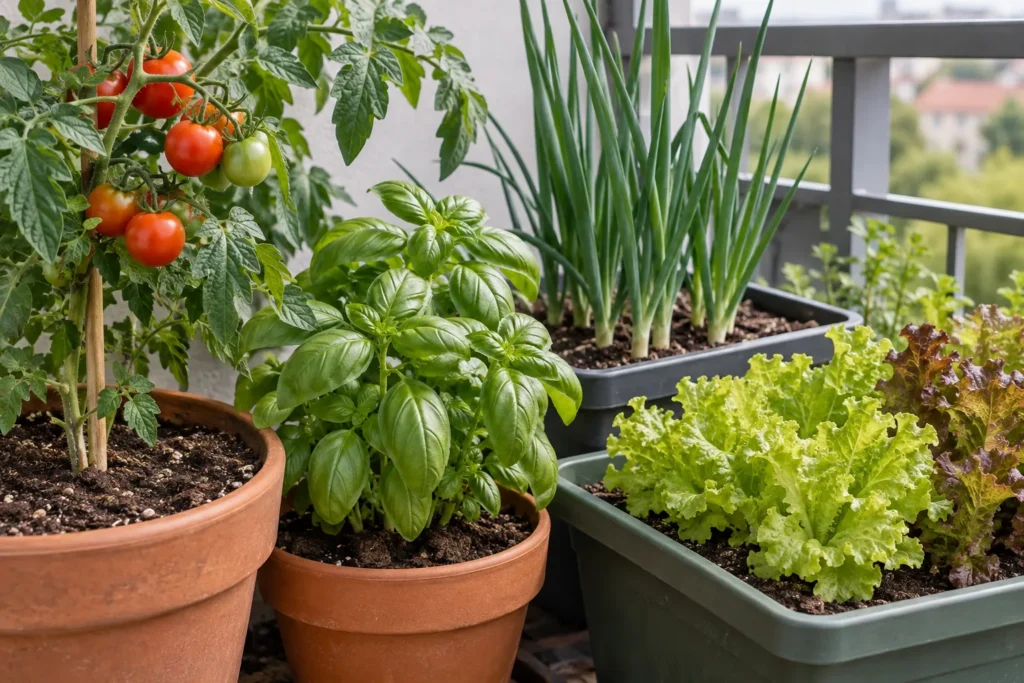
Beans or peas with a heavy feeder
Beans and peas host bacteria on their roots that convert atmospheric nitrogen into a form plants can use, gradually enriching the soil around them. Pairing a bean or pea plant in the same container, or in rotation in the same pot the following season, with a heavy nitrogen feeder like a leafy green benefits the heavier feeder without any added fertilizer, which is a small but real saving over a full growing season. On a balcony, a trellised pea or bean also uses vertical space efficiently, which pairs well with the container-space theme running through most balcony growing advice.
Carrots and radishes
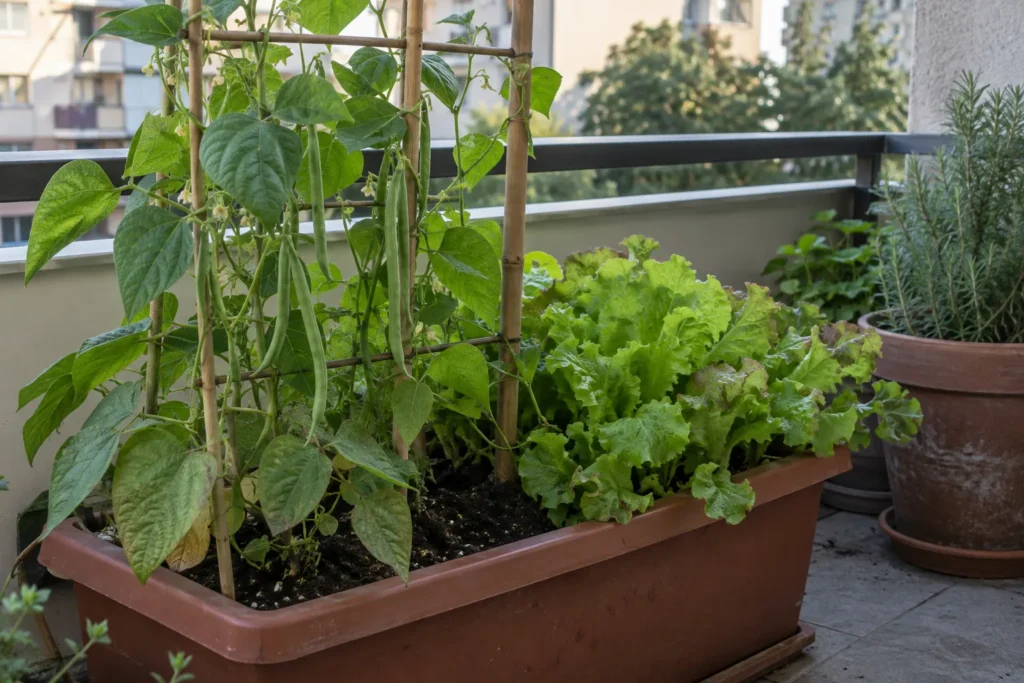
Radishes germinate and mature quickly, while carrots are slow to get going. Sown together in the same deep container, the radishes mark the row, get harvested first, and their foliage briefly shades and keeps the soil cool for the carrots germinating alongside them. By the time the carrots need the full container to themselves, the radishes are already out of the ground and on their way to the kitchen.
Squash or cucumbers with nasturtiums
Nasturtiums are fast, sprawling, and edible, and they’re commonly used as a trap crop, a plant that pests like aphids preferentially target, drawing pressure away from a more valuable neighboring crop. On a balcony, a nasturtium trailing from the same large container as a squash or cucumber, or from an adjacent pot, adds low-maintenance color while doing that job, and unlike many trap crop arrangements it doesn’t ask you to sacrifice a plant you were hoping to harvest.
Lettuce or spinach under taller crops
Shade isn’t only a limitation on a balcony, it’s occasionally an asset. Lettuce and spinach both bolt faster in full, hot summer sun, so tucking a few of either into the partial shade cast by a taller plant like a trellised pea or a caged tomato can extend their productive window by keeping the soil around them a little cooler than it would be in full exposure.
Popular claims that don’t hold up
Not every widely repeated companion planting claim survives scrutiny, and it’s worth knowing which ones so you don’t design a container planting around a myth.
- “Aromatic herbs mask the scent of vegetables from pests.” Extension research specifically contradicts this. Mixed plantings can still reduce pest pressure, but through visual disruption and making a host plant harder to locate, not through one plant’s smell hiding another’s.
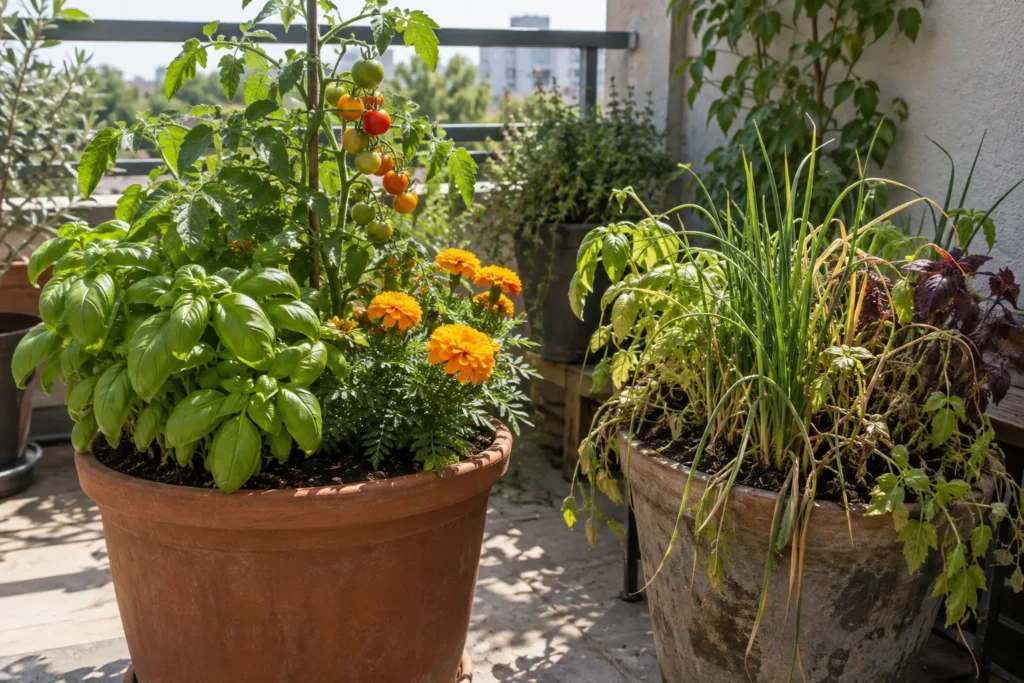
- “Marigolds repel all garden pests.” Marigolds have real, specific benefits against certain soil nematodes when grown as a dedicated cover crop over a full season, but the common claim that a few marigolds scattered through a container will broadly repel insects above ground is overstated.
- “Any two plants that are ‘friends’ can share a pot regardless of size.” A companion planting chart’s pairing advice doesn’t override basic root competition. Two plants with large, competing root systems will still stunt each other in one container, whatever the chart says about their relationship.
Pairings to avoid in one container
Some plants are commonly listed as poor companions, usually because they compete heavily for the same resources or because one releases compounds that suppress the other’s growth. On a balcony, where pots are already resource-limited, these conflicts show up faster than they would in an open garden bed.
- Fennel with almost anything. Fennel releases compounds that inhibit the growth of many neighboring plants and is best grown alone in its own dedicated container, regardless of what else you’re already growing nearby.
- Two heavy feeders of a similar root depth. Pairing two large tomatoes, or a tomato and a pepper, in one container that’s only sized for one plant leads to both competing hard for the same water and nutrients.
- Mint with almost anything it can spread into. Mint’s aggressively spreading roots will crowd out a shared container’s other occupants within a season; give mint its own pot, ideally one it can’t spread out of, instead of pairing it with anything you’d rather keep intact.
Flowers as companions, not just decoration
Flowering companions earn their space in a vegetable container by drawing in pollinators and predatory insects, not by repelling pests directly. Calendula and alyssum both attract hoverflies and parasitic wasps, insects whose larvae feed on aphids, so a small pot of either near a vegetable prone to aphids adds a layer of pest management that isn’t about scent at all. Borage is a similar case: bees favor it strongly, and a borage plant near flowering vegetables like squash or cucumbers can improve pollination in a spot with otherwise light bee traffic, which matters more on a balcony several floors up, further from the wider mix of flowering plants a bee would encounter at ground level, than it does in an open garden bed.
The four table entries below are worth committing to memory even if you skip everything else in this guide, since they cover most of what a balcony container can realistically pair well.
Balcony pairings at a glance
| Pairing | Why it works | Container note |
|---|---|---|
| Tomato + basil | Different root depths, shared light needs | Needs a large pot, 14 in (35 cm)+ |
| Beans/peas + leafy green | Nitrogen fixing benefits the heavy feeder | Trellis the beans/peas vertically |
| Carrots + radishes | Radishes mark rows and harvest first | Needs a deep pot, 12 in (30 cm)+ |
| Squash/cucumber + nasturtium | Nasturtium acts as an aphid trap crop | Let nasturtium trail over the pot edge |
Designing a paired container step by step
Instead of starting from a companion planting chart, it’s more reliable on a balcony to start from the container itself and work backward.
- Pick your main plant first and size the container to it using our container size guide, since the pairing has to fit whatever room is left over in that container, not the other way around.
- Check the main plant’s root depth and spread. A deep-rooted plant like a tomato or carrot leaves the most unused space in the upper, shallower part of the soil.
- Choose a companion with a different root profile to fill that unused space, a shallow herb for a deep vegetable, or a low spreader for an upright one.
- Confirm both plants want the same light and water. A shade-tolerant companion paired with a full-sun vegetable will struggle even if the root pairing is sound.
- Leave room to separate them later if one outgrows the container faster than expected; a companion planting isn’t permanent if it stops working.
Most companion planting guidance was written with garden beds in mind, where nearby plants might sit a few feet apart instead of sharing one pot. On a balcony, the practical takeaway is to think in terms of root depth and growth habit before anything else: pair a deep-rooted plant with a shallow-rooted one, a tall upright plant with a low spreader, and a nitrogen-fixer with a feeder that benefits from it, instead of working strictly off pairing charts built for open ground where space was never the real constraint. If a pairing looks good on paper but both plants have large, similar root systems, they’ll compete in a shared container even if the chart calls them friends.
For the container sizes each plant type really needs before you start pairing them, see our balcony container size guide. And if you’re building a themed container around a specific cuisine instead of just one pairing, our container plan for a balcony salsa garden is a worked example of several compatible plants sharing a growing space.