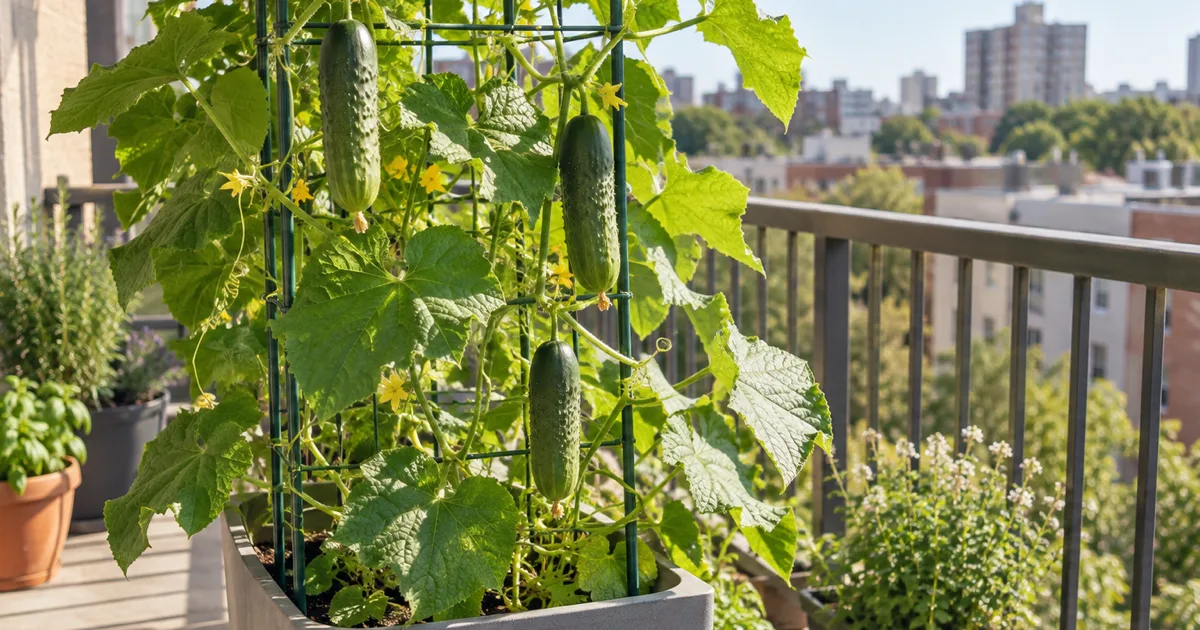
Cucumbers grow fast and reward a balcony gardener quickly, often producing usable fruit within two months of planting, but they ask for two things most balcony vegetables don’t: a genuine trellis and, sometimes, a hand-pollinating assist that a ground-level garden rarely needs. Neither is difficult once you know they’re coming.
This guide covers what’s specific to growing cucumbers in a balcony container: picking a variety that won’t outgrow the space, how big that container actually needs to be, setting up support before the vine needs it, and the two problems, bitterness and poor fruit set, that show up more on a balcony than in an open garden.
Which cucumber type fits a balcony container?
Cucumbers split into bush and vining growth habits, and the difference matters more here than it does for tomatoes. Bush varieties, sometimes labeled compact or patio types, stay relatively contained and produce their fruit over a shorter, more concentrated window; they’re the easier choice for a small container and a small balcony, since they don’t need the same commitment to trellis height. Vining varieties keep climbing for the whole season and produce more total fruit, but only if they have somewhere real to climb; left to sprawl across a small balcony floor, a vining cucumber turns into a tangled mess that’s genuinely hard to manage.
For a first balcony crop, a bush or compact variety is the more forgiving pick. If you already know you want a trellis set up and you’d rather have the bigger harvest a vining type offers, that’s a reasonable choice too, as long as the support goes in before the vine needs it, covered below.
How big a container do cucumbers need?
Five gallons is the minimum container size for cucumbers. That’s enough for a compact bush variety; a vining type climbing a full trellis does better with more, since a bigger root system underground supports a bigger plant on top, and a wider or heavier base also helps keep a tall, trellised plant from tipping in wind. Whatever the size, drainage holes are non-negotiable, and a lighter-colored or fabric container helps keep roots cooler through summer than a dark plastic one sitting in full sun.
Our container size guide covers weight ranges by container size if you’re combining a large cucumber container with other big pots on the same balcony; a full 5-gallon-plus container with a trellis and a mature vine is enough combined weight and wind-catching surface area to think about placement against a wall rather than out on an open railing.
Set up the trellis before the vine needs it
Cucumbers are one of the vegetables extension guidance specifically calls out as benefiting from vertical support, and the timing matters: install the stake, cage, or trellis when you plant, not once the vine is already sprawling and tangled. A young vine trains onto a support easily; an established one that’s already flopped over itself is a genuine fight to untangle and redirect.
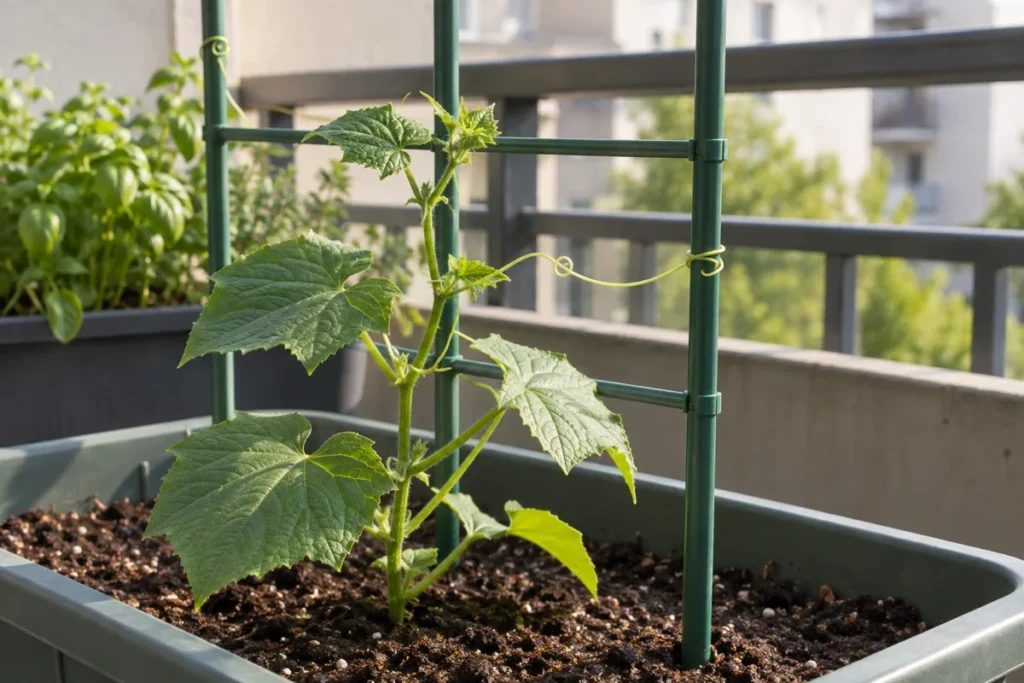
A trellis also solves a problem specific to containers: vining cucumbers left to sprawl across a small balcony floor take up far more usable space than the same plant trained vertically, and fruit resting directly on a hot balcony floor is more likely to develop soft spots than fruit hanging clear in the air. Any sturdy vertical structure works, a tomato cage, a purpose-built trellis, or netting stretched between two anchored points; the plant will find it and start climbing on its own once the support is within reach.
Watering and bitter cucumbers
Cucumbers want consistently moist soil and don’t tolerate a dry stretch the way a tomato can shrug one off. The direct consequence of letting a container dry out, especially during a hot spell, is bitterness: a compound called cucurbitacin, which is naturally present in the leaves and stems, moves into the fruit under heat, drought, or general plant stress and concentrates just under the skin and near the stem end. Watering consistently through a heat wave is the actual fix; peeling a bitter cucumber and trimming the stem end can salvage fruit that’s already affected, but it doesn’t prevent the next one from having the same problem if the underlying water stress continues.
A container dries out faster than garden soil to begin with, so a cucumber in a pot is more exposed to this kind of stress than one in the ground, not less; check the soil daily during hot weather instead of assuming a container crop needs less frequent attention.
Why aren’t my cucumber flowers turning into fruit?
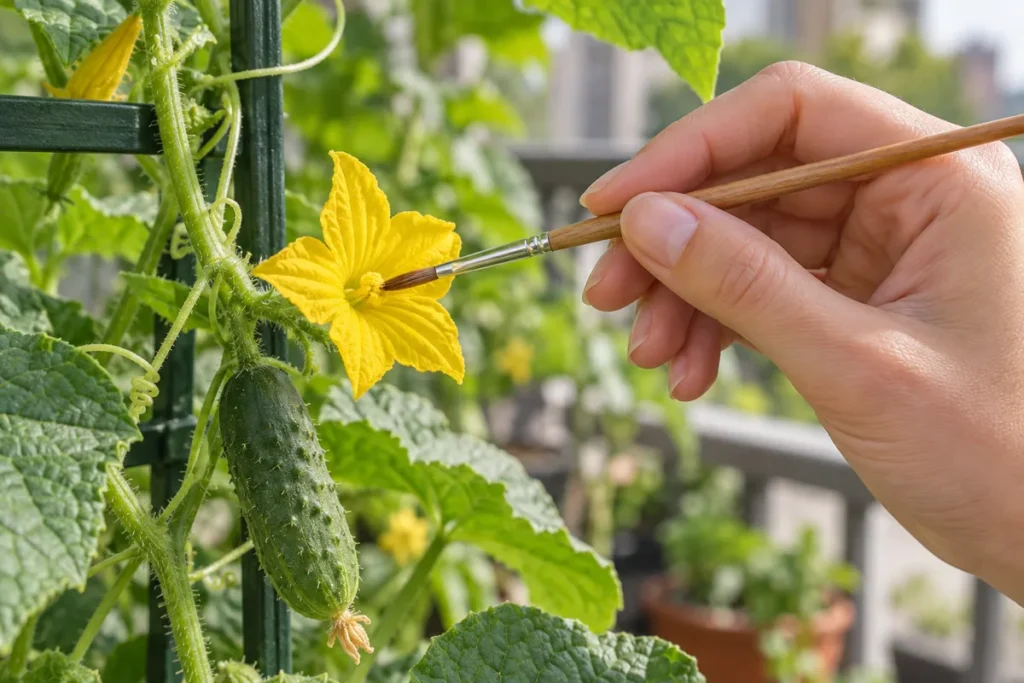
Cucumber plants produce separate male and female flowers on the same vine; male flowers open first and supply pollen, and a pollinator, usually a bee, has to physically carry that pollen to a female flower, identifiable by a tiny cucumber-shaped swelling at its base, before it can develop into fruit. No pollinator visit means no fruit, no matter how healthy the plant looks otherwise.
This is a genuinely balcony-specific problem. A ground-level garden bed usually gets steady bee traffic; a balcony, especially several floors up, sees a lot less of it, and a plant covered in flowers with nothing setting fruit is one of the more common frustrations balcony cucumber growers run into. If you’re a few weeks into flowering with no fruit forming, hand pollination is a reliable fix: use a small, clean paintbrush to transfer pollen from an open male flower’s center directly onto the center of an open female flower, ideally in the morning when flowers are freshly open. It takes a few seconds per flower and removes the guesswork of waiting for a bee that may never show up at your particular height and location.
Common balcony cucumber problems
- Bitter fruit traces back to heat or drought stress; keep the container consistently watered through hot stretches rather than letting it swing dry.
- Flowers dropping or shriveling without setting fruit usually means no pollinator visited; hand-pollinate if this continues past the first couple of weeks of flowering.
- Misshapen or curved fruit is most often a sign of inconsistent watering during fruit development rather than anything wrong with the variety itself.
- A tangled, sprawling vine is a support problem, not a pruning problem; add or redirect onto a trellis instead of repeatedly cutting the plant back.
When to harvest
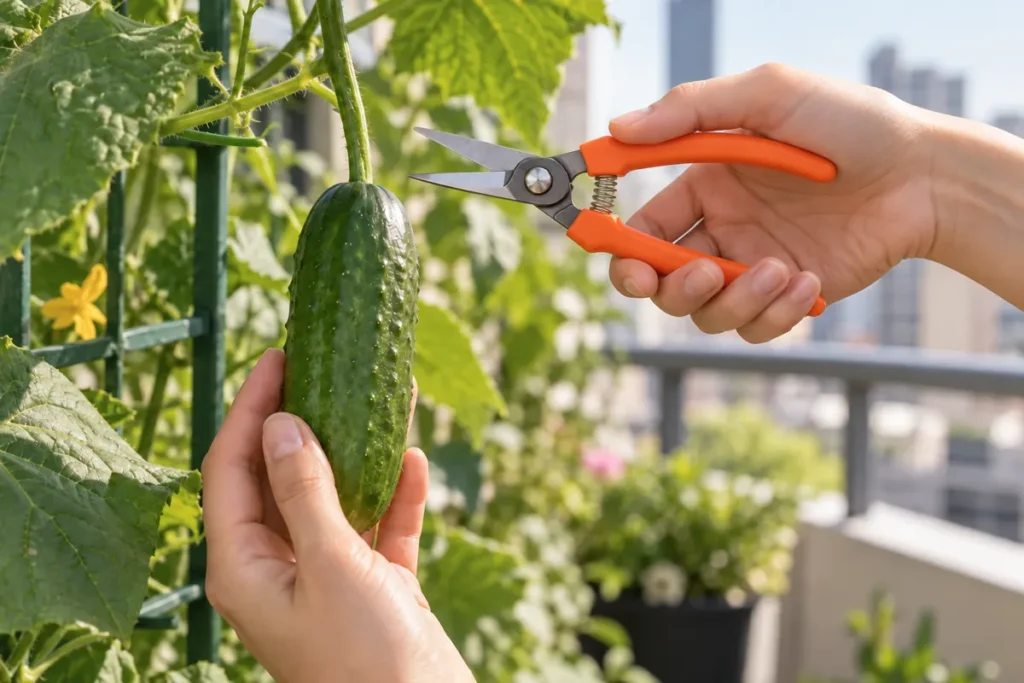
Pick cucumbers while they’re still firm, uniformly green, and smaller than the fully mature size shown on the seed packet; an oversized cucumber left on the vine too long turns seedy, dull in flavor, and tells the plant to stop producing new fruit. Check the plant every day or two once it starts flowering, since a fast-growing cucumber can go from ready to overripe in just a couple of days, and harvesting regularly is itself what keeps a productive vine producing through the rest of the season.
A healthy bush cucumber in a 5-gallon container can keep producing for several weeks once it gets going, and a well-supported vining variety, kept picked and watered through the season, can go even longer. Once the plant does finally slow down and stop setting new fruit, the spent vine comes off the trellis easily and the container is ready to refresh with fresh potting mix for a fall crop or the following spring; cucumbers don’t carry the same soil-disease carryover concern that makes reusing a potato container risky, so there’s no need to fully discard the old mix, just refresh it with compost before planting again.