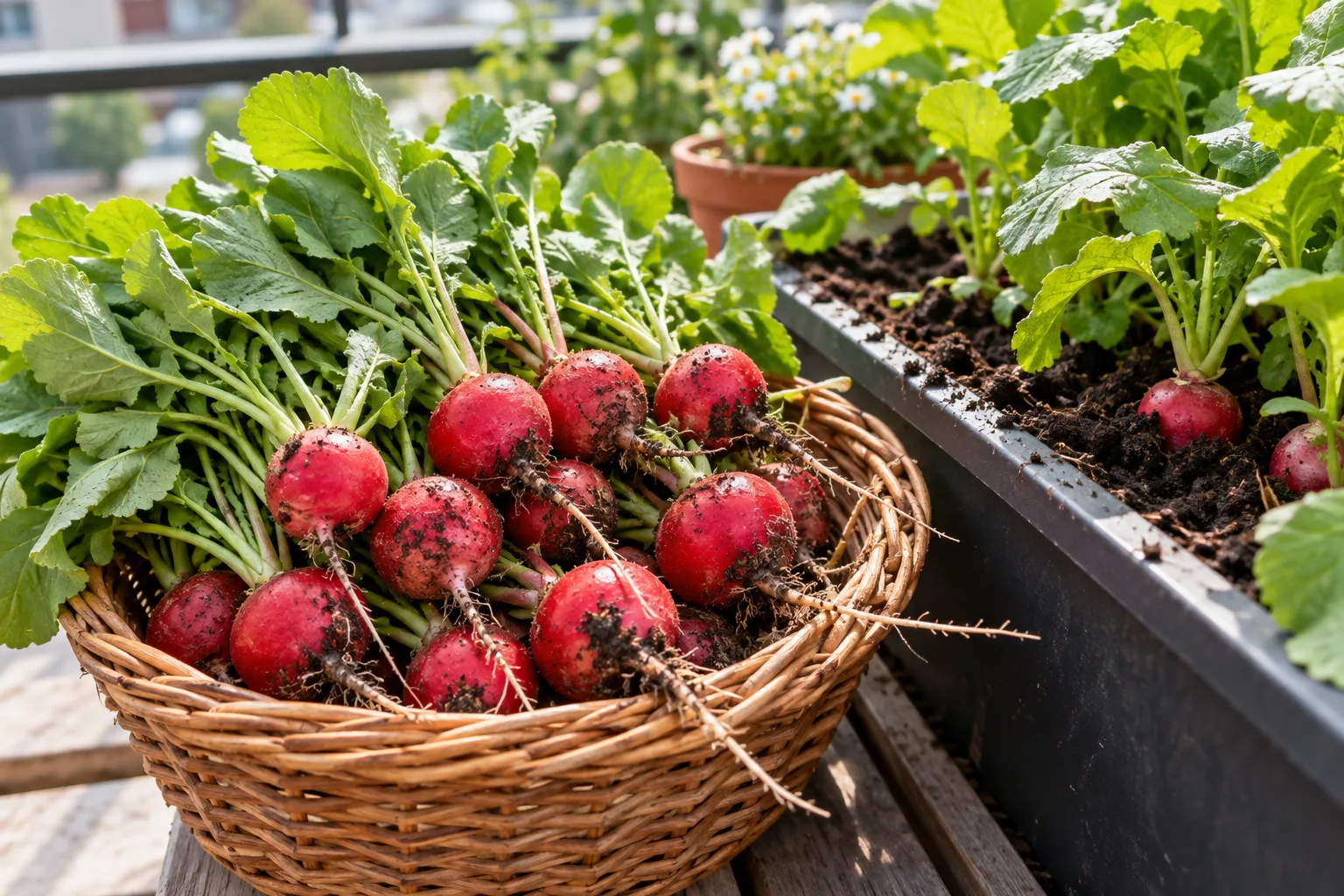
Radishes are the fastest vegetable you can realistically grow in a container, and that speed makes them useful for more than a quick harvest. Because a radish goes from seed to root in three to four weeks, it tells you whether your balcony’s light, soil, and watering routine can support something before you sink three months into a pepper or tomato plant that might fail for the exact same reasons. If you’ve never grown food in a pot before, radishes are the cheapest way to find out what your space can support.
They also solve a real space problem. A radish root rarely needs more than 6 inches (15 cm) of soil depth, so it fits in containers too shallow for almost anything else edible: a window box, a half-filled storage bin, the gap at the end of a railing planter. By author Maya’s background in horticulture and time spent at a garden center, radishes come up constantly as the plant recommended to first-time container growers who want to see results fast, and the plant itself backs that reputation up with real numbers.
Why Radishes Make Sense in Small Containers
Clemson University’s Home and Garden Information Center lists radishes as maturing in 21 to 30 days from seeding, with warmer soil speeding things along and cooler soil slowing them down (source cited below). That maturity window is short enough that you can run two or three full crops in the same container between early spring and the start of summer heat, something no other balcony vegetable offers. Compare that to the two to three months most tomatoes and peppers need before first harvest, and the appeal is obvious for anyone gardening in a space with limited pots.
Radishes also tolerate root restriction better than most root vegetables. Carrots and parsnips need 10 to 12 inches (25 to 30 cm) of loose soil to form straight roots, but a globe-type radish like Cherry Belle will size up properly in half that depth. This is why radishes consistently outperform other root crops in narrow balcony planters: the plant’s genetics match the limitation of the space.
Choosing and Setting Up the Container
Depth matters more than width for radishes, but width determines how many you can grow at once. For round, globe-shaped varieties (Cherry Belle, Easter Egg, Champion), a container 6 to 8 inches (15 to 20 cm) deep is sufficient. For longer, cylindrical varieties (French Breakfast, White Icicle), give the roots 8 to 10 inches (20 to 25 cm) so the tip doesn’t hit the container bottom and fork. Daikon-type radishes need 12 inches (30 cm) or more and are a poor match for most balcony setups; skip them unless you have an unusually deep planter box. For a full breakdown of what depth and width different crops need, BalconySprout’s container size guide is worth checking before you buy pots.

Drainage holes are non-negotiable here. Radishes split and crack when soil moisture swings between soaked and dry, and a container without drainage holds water at the bottom long after the surface looks dry, which sets up exactly that swing. If you’re reusing a container that wasn’t built for plants, drill at least three or four holes of 1/4 inch (6 mm) or larger before filling it.
Material changes how often you’ll need to water, which matters for a crop this sensitive to moisture swings. Glazed ceramic and plastic containers hold moisture longest and suit growers who can’t check on plants daily. Unglazed terracotta is porous and breathes, which helps prevent waterlogging in a rainy stretch, but it also dries out noticeably faster in direct sun, sometimes within a single hot afternoon. Fabric grow bags dry fastest of all three, which can work against a crop that wants even moisture, so if you’re using one, plan on checking it daily instead of every other day.
Soil and Starting pH
Radishes need loose, friable soil free of rocks, clumps, and chunks of unfinished compost. Anything that blocks the root’s downward growth causes forking or a stubby, twisted shape instead of a clean globe or cylinder. A bagged potting mix, not garden soil dug from the ground, is the right base for this reason: garden soil compacts in containers and develops exactly the kind of resistance that deforms a radish root. BalconySprout covers the difference between potting mix and garden soil in more detail in its potting mix comparison if you’re unsure what’s already in your containers.
Clemson’s root crop guidance recommends a soil pH between 6.0 and 6.5 for root vegetables generally, radishes included. Most bagged potting mixes land in that range already, so unless you’re amending with wood ash, lime, or a strongly acidic compost, you likely don’t need to test or adjust it for a radish crop specifically.
Planting Depth, Spacing, and Thinning
Sow seeds 1/2 inch (1.3 cm) deep. Any shallower and they dry out before germinating; any deeper and the seed uses up its stored energy before reaching the surface. Space seeds roughly 1 inch (2.5 cm) apart across the container, then thin seedlings to 2 to 3 inches (5 to 7.5 cm) apart once they reach the one or two true-leaf stage, when they’re about 2 inches (5 cm) tall.
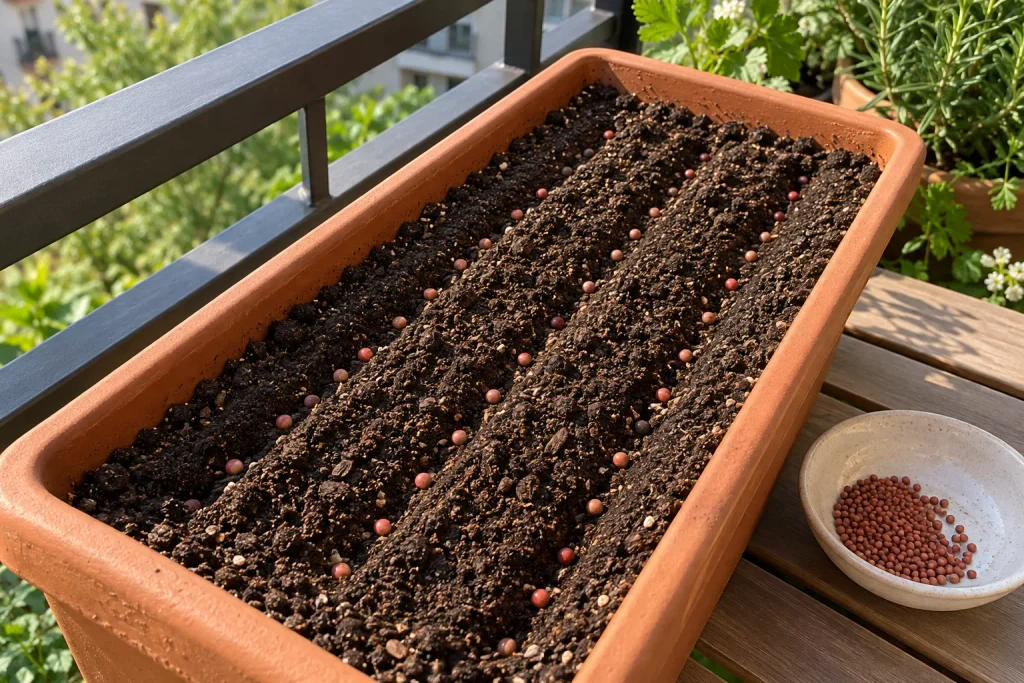
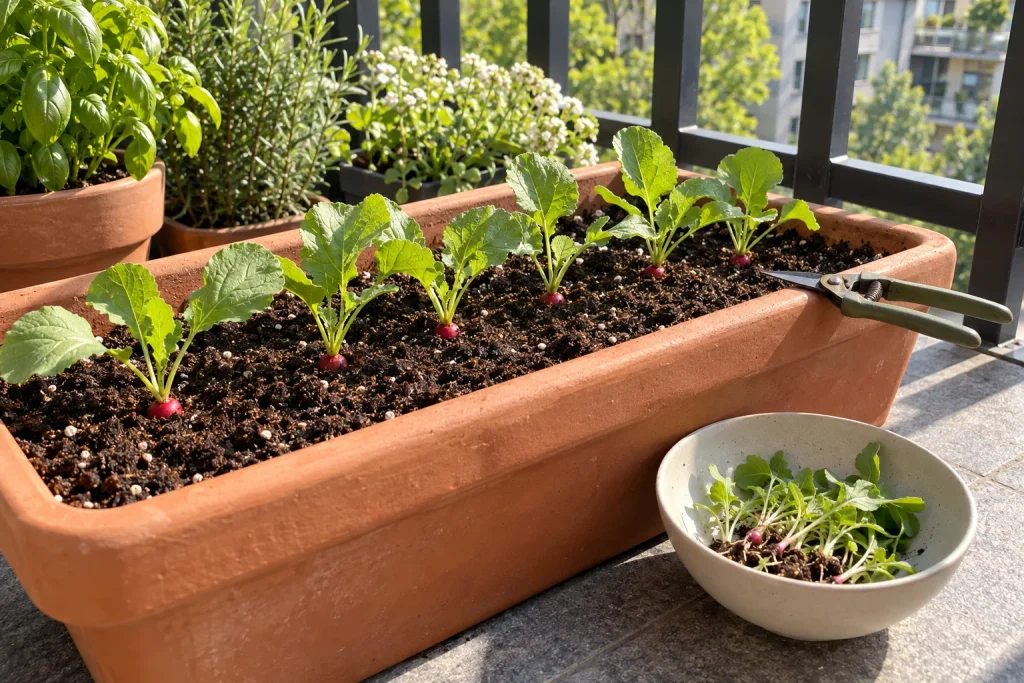
Thinning is the step people skip because it feels wasteful, but it’s the difference between a harvest of real radishes and a harvest of pencil-thin roots fighting each other for space. If a radish doesn’t get 2 inches of clearance on every side, the root simply won’t bulk up, no matter how long you leave it in the ground. Pull the weakest seedlings, not the strongest, and use the thinnings in a salad instead of composting them.
Light and Water
Radishes want at least 6 hours of direct sun a day for a proper root to form. They’ll survive on less, but the yield drops and the roots stay small. If your balcony only gets four hours of morning sun, you can still grow radishes, just expect smaller harvests and plan accordingly instead of waiting on roots that won’t size up.
Consistency in watering matters more than volume. Radishes grown in soil that alternates between bone-dry and saturated develop cracked skins, hollow centers, and a stronger, almost peppery bite than the variety is supposed to have. Check the top inch of soil daily in warm weather; water when it’s dry to the touch, and aim for evenly moist, not wet, soil at all times. A container that dries out completely by midafternoon in summer heat is a container that needs either a bigger reservoir or a move to a spot with some afternoon shade.

Succession Planting for a Continuous Harvest
Because radishes mature so quickly, one planting gives you one harvest window, and then the container sits empty or bolts into unusable growth if left too long. Clemson recommends resowing every 7 to 10 days through the cool growing season to keep a steady supply coming. On a balcony, this works well as a rotation system: use two or three smaller containers instead of one large one, stagger sowing dates by a week between them, and you’ll have a container at harvest stage roughly every week instead of one big glut followed by nothing.
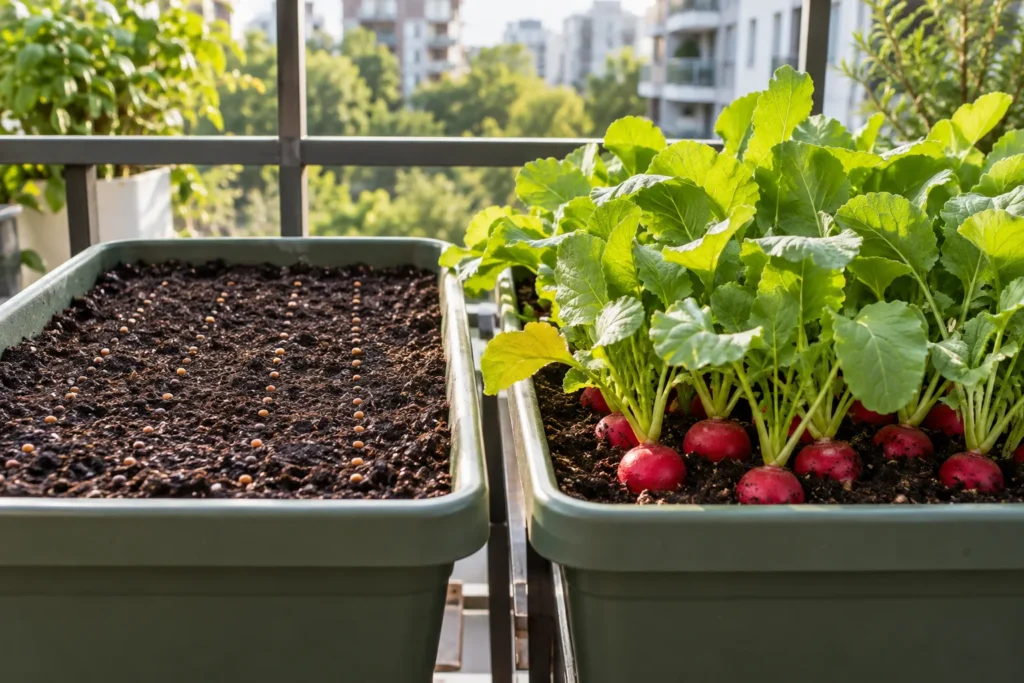
The cool growing season for radishes runs in two separate windows on most of the balconies BalconySprout hears from: a spring run from as soon as the soil can be worked through late spring, and a second fall run once daytime highs drop back under the mid-70s°F (low-to-mid 20s°C). Many growers skip the fall window entirely because they associate radishes with spring, but the roots turn out sweeter and crisper in the cooler, shorter days of fall, since the same heat that causes pithiness and splitting in late spring simply isn’t a factor. If your summer is too hot for a continuous radish rotation, stop sowing in early summer and pick the rotation back up once temperatures ease off in September instead of fighting the heat with extra water.
Common Problems and What’s Causing Them
Three issues account for most radish complaints, and each traces back to one specific, identifiable cause, not a vague “something’s wrong.”
Flea Beetles
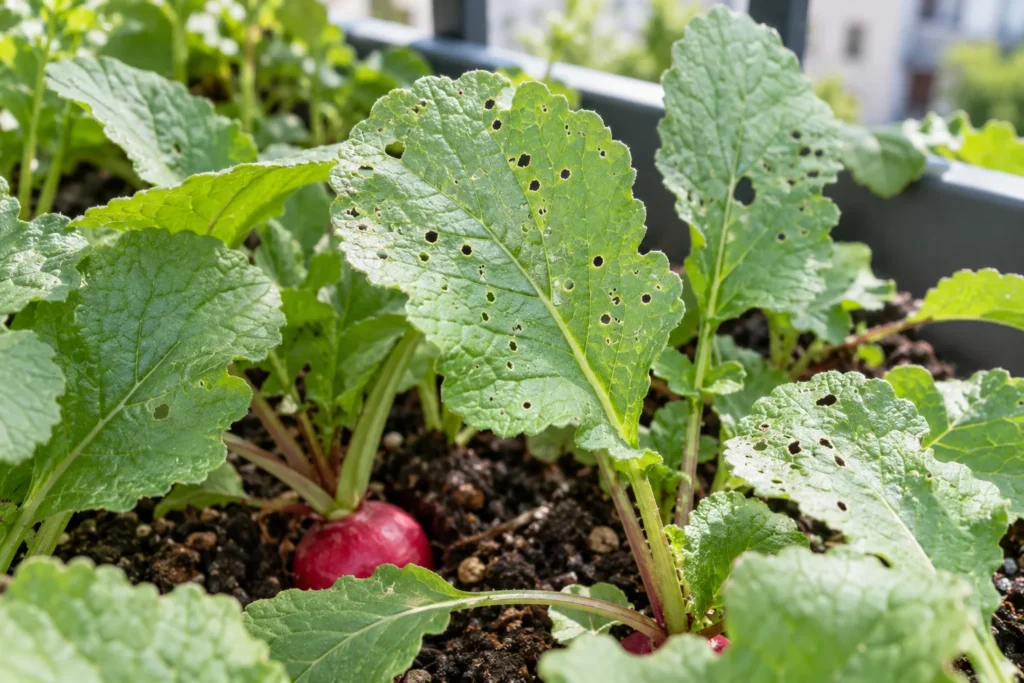
Small, dark, metallic beetles about 1/8 inch (3 mm) long that jump when disturbed and leave shallow, round shotholes in the leaves. Utah State University Extension notes that seedlings are the most vulnerable stage, and recommends checking plants at least twice a week until they pass the four to five true-leaf stage, treating if you’re seeing 1 to 5 beetles per plant during that window. On a balcony, a lightweight floating row cover over the container during the seedling stage is usually enough to keep them off without needing any spray, since there’s rarely a large outdoor population to begin with in an elevated, enclosed space.
Forked or Hairy Roots
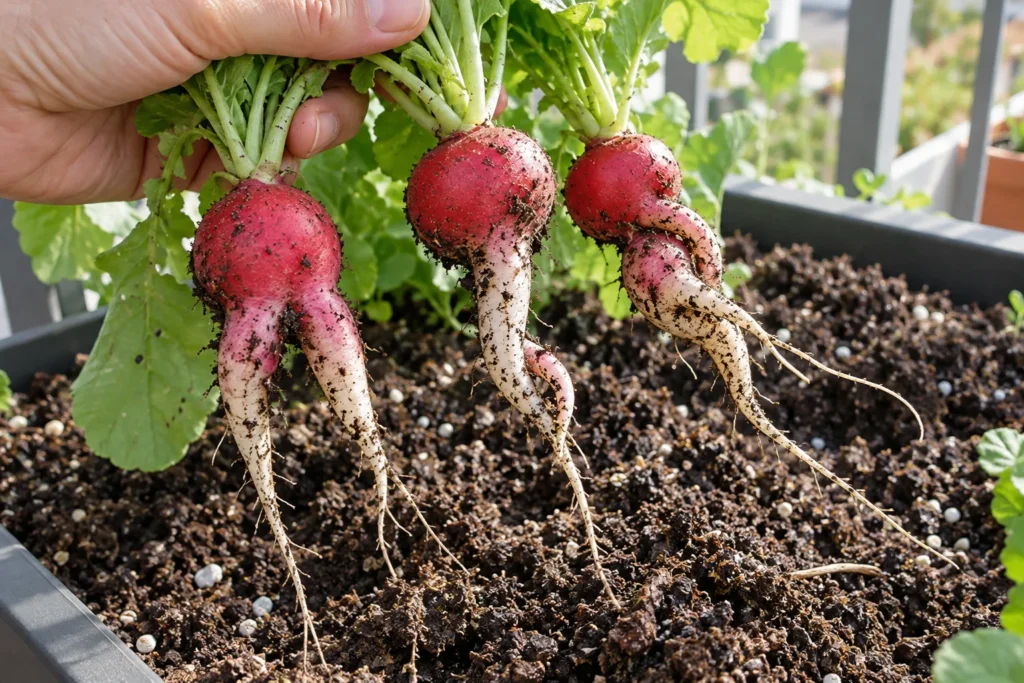
This comes from physical obstruction underground: rocks, unbroken clumps of compost, or compacted soil the root can’t push through cleanly. It’s a soil problem, not a seed or variety problem, and sifting your potting mix before filling the container fixes it for every planting after this one.
Pithy, Cracked, or Overly Hot-Tasting Roots
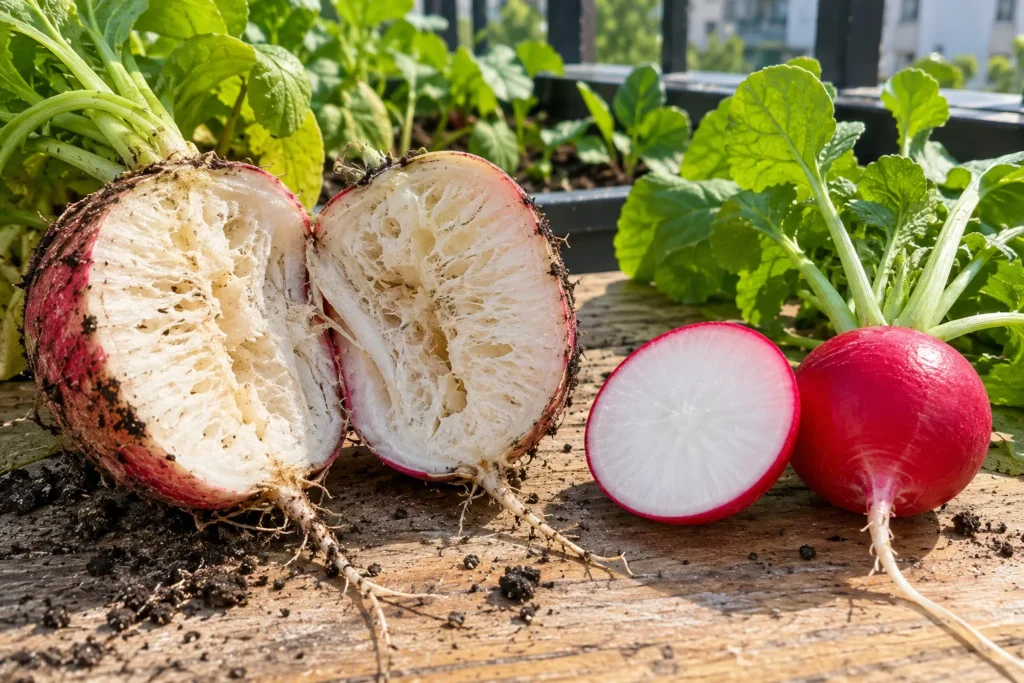
Clemson’s data is specific here: cooler temperatures produce milder radishes, while sustained heat causes the roots to crack, turn pithy (spongy and hollow), and develop a much stronger flavor than the variety is bred for. Seed germination itself stops entirely above 95°F (35°C) soil temperature. If your balcony bakes in direct afternoon sun through late spring, radishes planted too late in the season will struggle regardless of how well you water them. This is a seasonal timing problem, not a technique problem, and the fix is planting earlier or later in the year instead of trying to push a cool-season crop through a heat wave.
Using Radishes to Protect Slower Crops
Radishes have a second job beyond producing a root you eat: Utah State Extension’s flea beetle guidance specifically names radish as a favored trap crop, meaning flea beetles will often go for a radish planting over a nearby brassica or leafy green if given the choice. On a balcony where you’re growing kale, broccoli seedlings, or another flea-beetle target in a separate container, a pot of radishes placed between that container and the open railing can pull beetle pressure away from the crop you most want to protect.
This works as intercropping too, not just as a decoy. Because radishes finish in three to four weeks and pull completely out of the soil at harvest, you can sow them into the same container as a slower crop like carrots, parsnips, or young lettuce that hasn’t filled in yet. The radishes mature and get harvested before the slower plant needs the extra root space, so you get two harvests out of soil that would otherwise sit half-empty for weeks while the slow crop gets established. Space the radish seeds between the slower seedlings instead of in a separate row, and pull them the moment they’re ready so they don’t start competing for light once the other crop fills in.
Harvesting at the Right Size
Pull red, globe-type varieties once they reach about 1 inch (2.5 cm) in diameter; white varieties are best pulled slightly smaller, around 3/4 inch (2 cm), since they turn pithy faster once mature. Don’t judge size by the leaves, which can look full well before the root underneath is ready, or well after it’s already overgrown. If you’re not sure, pull one test radish from the container and check; the rest will be close behind it in size.
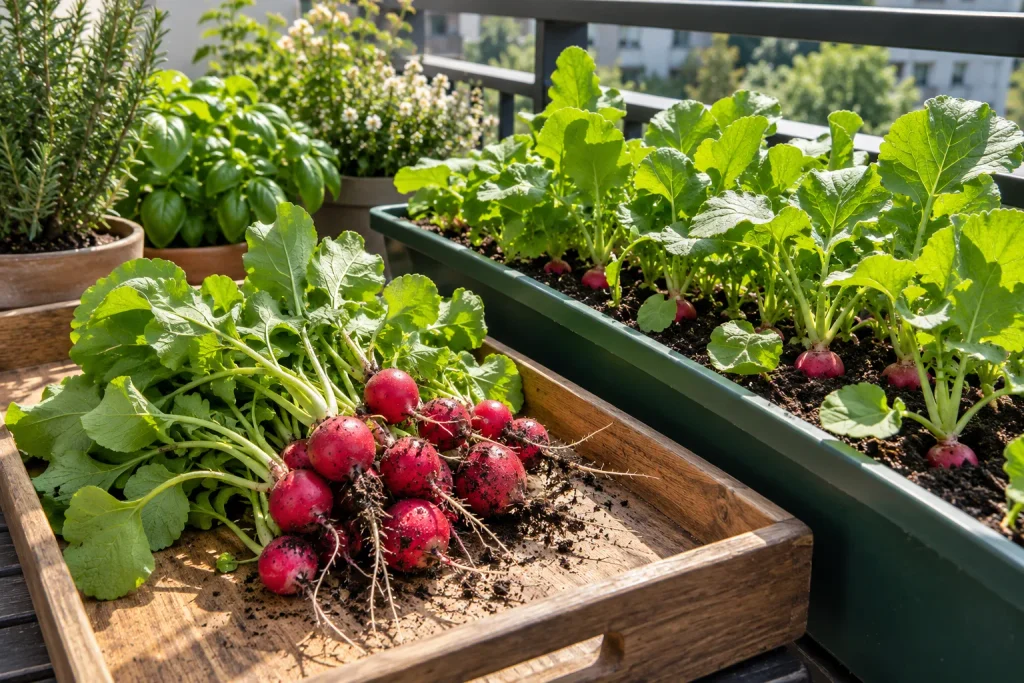
Leaving mature radishes in the soil “just in case” is the single most common way to ruin a harvest. Once a radish reaches its mature size, every extra day in warm soil pushes it further toward cracking, going pithy, or bolting to flower. Pull on time, even if that means harvesting a little earlier than you’d prefer.
Variety Choices Worth Growing in a Container
- Cherry Belle, ready in about 22 to 24 days, round and red, the standard fast-crop choice for a first container planting.
- French Breakfast, 25 to 30 days, elongated red-and-white roots that hold their crispness a few days longer in the ground than round varieties.
- Easter Egg (a mixed-color blend of purple, pink, and white roots), similar timing to Cherry Belle, useful if you want visual variety from a single seed packet.
- White Icicle, a longer white root that needs the deeper end of the container range (8 to 10 inches) but has a milder flavor than most red varieties.
Stick to globe or short-cylinder types for anything shallower than 8 inches of soil. Daikon and other long Asian radish types need more depth than most balcony containers can offer and will simply stop lengthening once the root hits the container bottom, producing a stunted, forked result instead of the long clean root the variety is supposed to produce.
Once you’ve got a radish rotation going, it pairs naturally with a light feeding schedule between plantings since a fast-growing root crop draws down a container’s nutrients quickly over repeated sowings; BalconySprout’s guide on fertilizing balcony container plants covers how to time that without overfeeding a crop you’re going to pull in three weeks anyway.
Sources: Clemson Cooperative Extension Home & Garden Information Center, “Carrot, Beet, Radish & Parsnip” (hgic.clemson.edu); Utah State University Extension, “Flea Beetles on Vegetables” (extension.usu.edu).