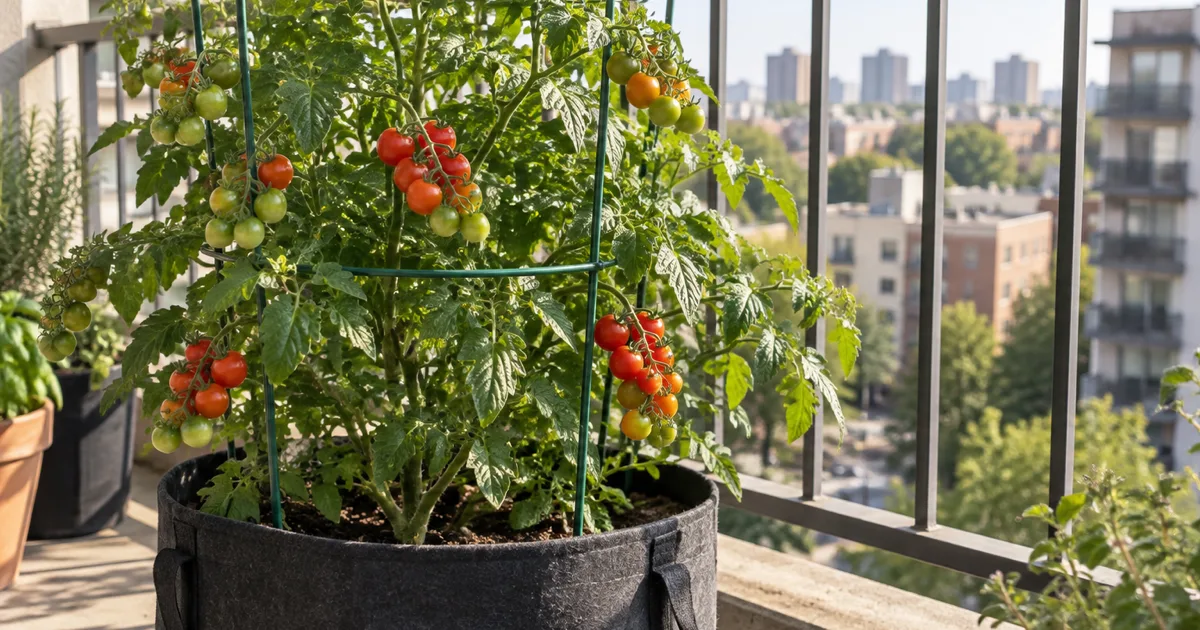
Tomatoes are the vegetable most people picture first when they imagine a balcony garden, and also the one most likely to disappoint a first-time grower who picked the wrong variety or too small a pot. The plant itself isn’t fussy; it wants a container with real room, steady water, strong sun, and support before it starts leaning on the railing. Get those four things right and even a modest balcony can produce a real harvest through summer.
This guide covers what’s specific to a balcony: which tomato type fits a container, how big that container needs to be, the one planting technique tomatoes benefit from that most vegetables don’t, and how to catch the handful of problems that show up most often in a pot.
Which tomato type fits a balcony container?
Tomato varieties split into two growth habits, and the difference matters more in a container than it does in a garden bed. Determinate varieties grow to a set size, produce most of their fruit over a shorter window, and stop getting taller once they’ve set their final flush of flowers, which makes them noticeably easier to keep upright and watered in a pot. Indeterminate varieties keep growing and producing until frost kills them, which can work in a large container but demands taller support and more ongoing pruning than most balconies have patience for.
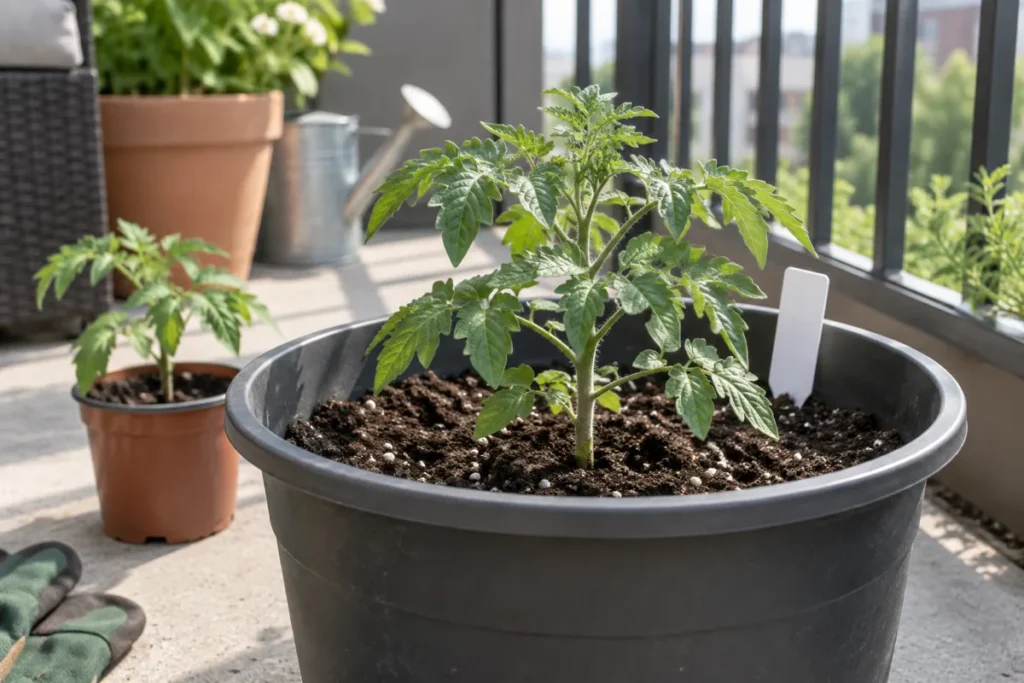
For a first balcony crop, a determinate, dwarf, or “patio” variety, all commonly labeled as such on the seed packet or plant tag, is the more forgiving choice. Cherry tomato varieties are especially easygoing: they ripen faster than full-size slicers and produce many small fruit instead of asking the plant to support a few heavy ones, which matters on a balcony where wind and limited root room already work against a top-heavy plant.
Should I start from seed or buy a nursery transplant?
Either works, and the choice comes down to timing and variety selection more than difficulty. Starting from seed needs a 6 to 8 week head start indoors before it’s warm enough to plant outside, covered in our guide to starting seeds on a balcony, but opens up far more variety options than what a garden center happens to be stocking that week. A nursery transplant skips that indoor head start entirely and gets a plant into a container the same day, which suits anyone starting their balcony garden later in the season or who’d rather not manage seed trays at all. Neither approach affects how the plant performs once it’s in its container; a healthy transplant and a healthy seed-started plant end up in the same place a few weeks apart.
How big a container do tomatoes actually need?
Cherry tomatoes need at least a 2-gallon container, roughly 10 inches across; standard determinate varieties need at least 4 gallons, roughly 12 to 14 inches across. Those are minimums, not ideals: a tomato’s root system tends to spread wider than it grows deep, and in a container the roots run out of room to spread before the plant runs out of reasons to keep growing. Sizing up from the minimum, especially on a hot or windy balcony, buys a real moisture buffer and means the difference between watering once a day and twice.
Drainage holes aren’t optional; tomatoes sitting in waterlogged soil develop root problems fast. And as with any large, well-watered container, check what it weighs once it’s full and soaked before committing to a spot; our container size guide has weight ranges by container size, and a full 4-gallon-plus tomato pot lands solidly in the range worth placing near a load-bearing wall instead of out on an open railing.
Why plant tomatoes deeper than other vegetables?
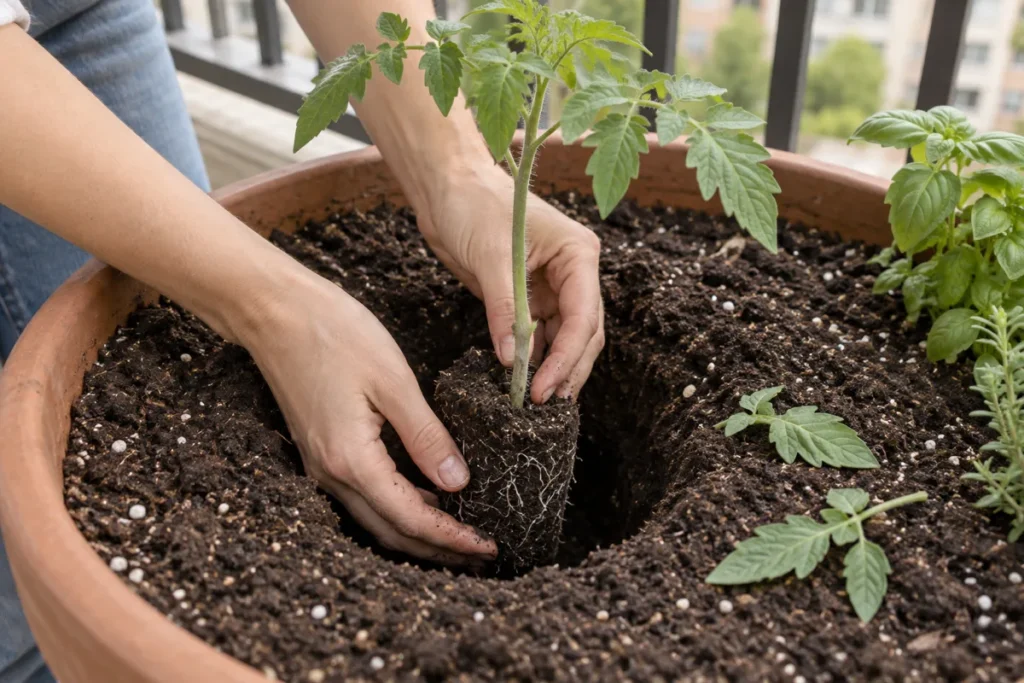
Tomatoes have a trait most balcony vegetables don’t: their stems can grow roots anywhere they’re in contact with moist soil, not just from the original root ball. These are called adventitious roots, and they’re the reason tomato transplants specifically benefit from being planted deeper than they sat in their nursery pot, unlike most vegetable seedlings, which do better planted at the same depth they were growing at before.
When transplanting, strip off the lowest set or two of leaves and bury the stem up to the next set of healthy leaves, so a larger share of stem ends up underground than looks intuitive the first time you do it. That buried stem develops additional roots over the following weeks, giving the plant a noticeably larger root system than it would have had from the original root ball alone, which matters even more in a container than in open ground, since container roots have less total soil volume to work with regardless.
Sun and support
Tomatoes want six to eight hours of direct sun; less than six produces a noticeably smaller harvest, though the plant won’t outright fail. On a balcony specifically, it’s worth double-checking where the sun really lands instead of assuming a bright-feeling spot gets direct sun for hours at a stretch, since railings, overhangs, and neighboring buildings can all cut real sun hours down without the space looking obviously shaded.
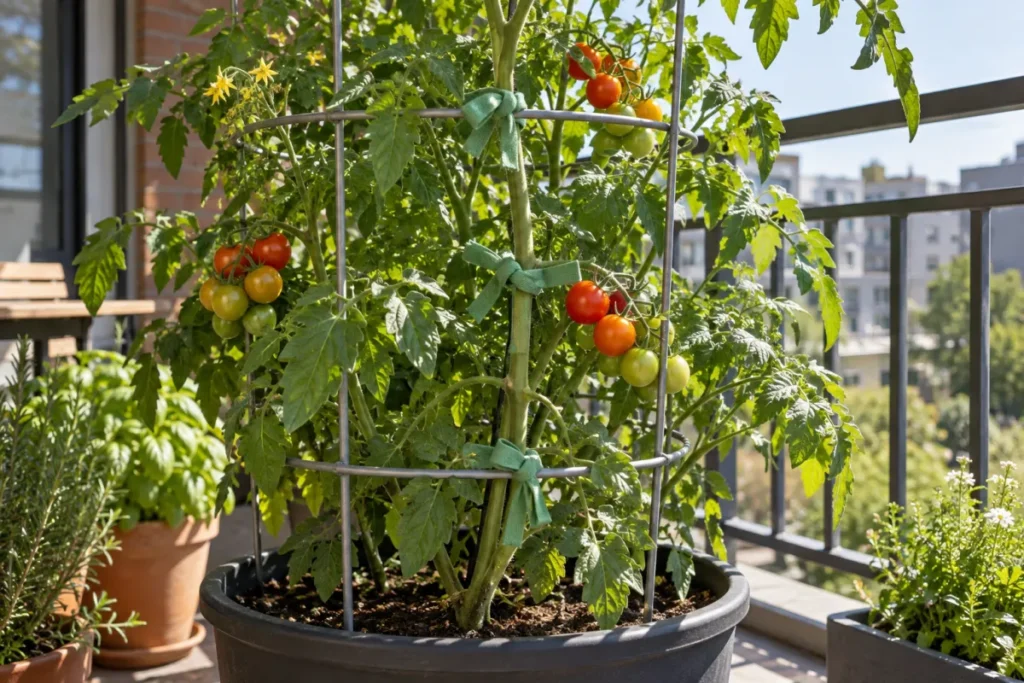
Add support at planting time, not after the plant is already flopping over the railing; roots establish around a stake or cage far more easily before they’ve spread than after. A sturdy cage, at least 24 inches across so there’s room to reach in and harvest, suits most determinate and patio varieties; taller indeterminate types need a stake or trellis rated for real height. Tie the main stem loosely as it grows, since a tight tie cuts into the stem as it thickens over the season.
Watering and blossom end rot
Container tomatoes dry out faster than almost anything else on a balcony; in hot weather, a well-sized pot can need water daily, and a smaller or wind-exposed one can need it twice a day. Check by feel an inch down rather than going by a fixed schedule, and water thoroughly enough that it runs from the drainage holes, not just enough to wet the surface.
Inconsistent watering is the direct cause of the most common tomato problem in containers: blossom end rot, the dark, sunken, leathery patch that shows up on the bottom of otherwise healthy-looking fruit. It’s caused by a calcium deficiency in the developing fruit, but in most cases the soil already has enough calcium; the real problem is that a plant swinging between too dry and freshly watered can’t take up and move that calcium consistently. Keeping the soil evenly moist, not letting it dry out completely between waterings, is the actual fix far more often than adding a calcium supplement is.
Common balcony tomato problems
- Wilting usually means the plant is thirsty, though a wilting plant in already-wet soil points to root stress from poor drainage or heat instead; check the soil before assuming it needs more water.
- Widespread yellowing, beyond a few normal lower leaves as the plant matures, usually traces back to inconsistent watering or a container that’s simply too small for how much the plant has grown.
- Cracked fruit happens when a dry stretch is followed by a heavy watering or rain; the fruit swells faster than the skin can stretch. Even watering reduces it, though it rarely eliminates it entirely after a real weather swing.
- Blossom end rot, covered above, is a watering-consistency problem in the vast majority of container cases, not a soil-quality one.
When are balcony tomatoes ready to pick?
Pick tomatoes once they’re fully colored and give slightly under gentle pressure; that’s when flavor peaks. It’s also fine to pick fruit as it just starts to turn color and let it finish ripening indoors at room temperature, which is a reasonable move if birds, wind damage, or an incoming heat wave make waiting on the plant riskier than finishing the last stretch inside. Either way, skip the refrigerator for fresh tomatoes unless they’re already cut; cold temperatures dull both the flavor and the texture.