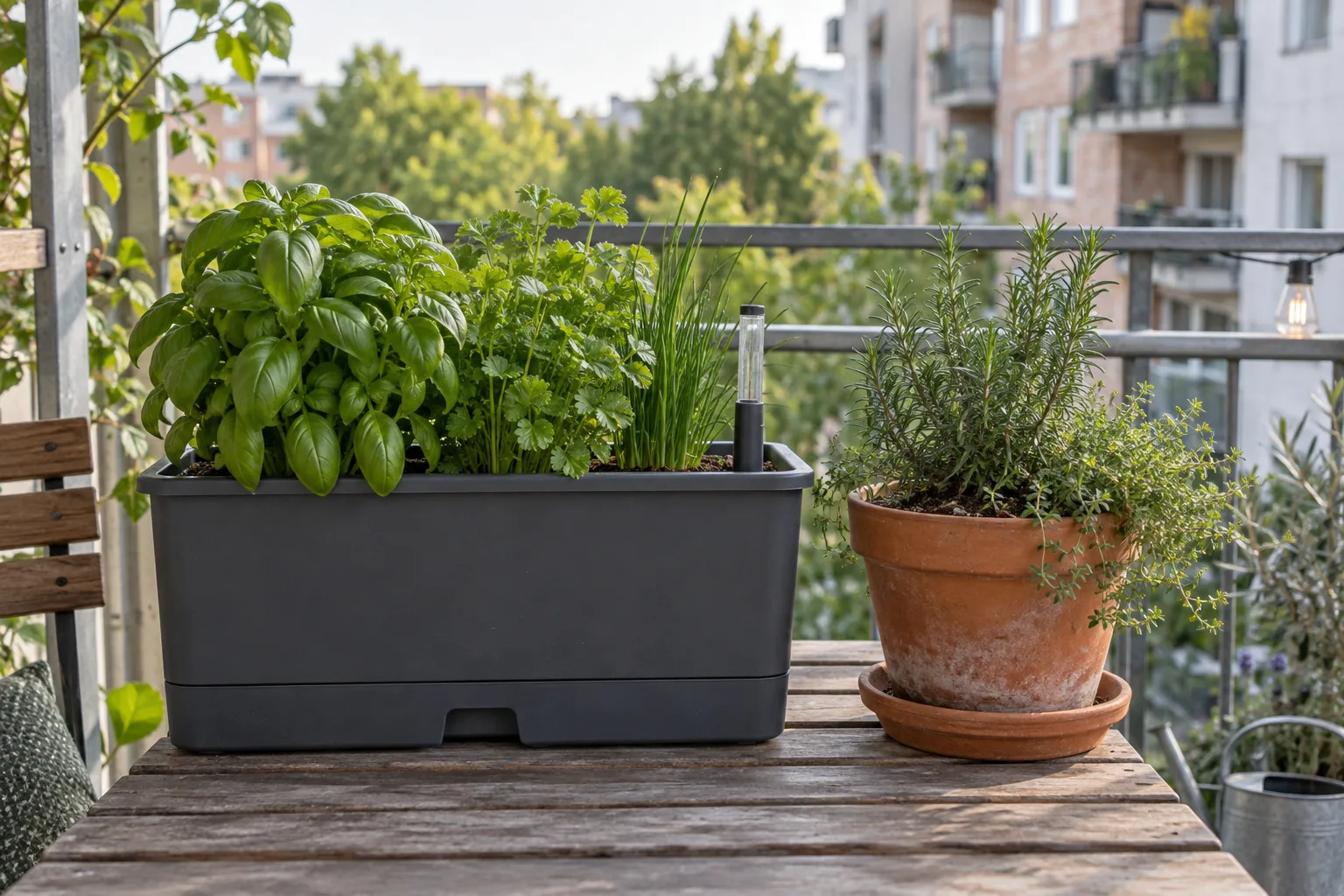
A self-watering planter costs more than an equivalent traditional pot, sometimes two or three times as much, and asks you to trust a mechanism instead of your own daily judgment about whether a plant needs water. Whether that trade is truly worth it depends less on the specific plant and more on you as the gardener: your schedule, how forgetful you tend to be about watering, and how hot or exposed your balcony really runs during the peak of summer. Here’s the honest tradeoff, not just the sales pitch for the upgrade, from someone who’s watched both a neglected traditional pot and a clogged reservoir go wrong in their own way. For the underlying capillary-action and root-oxygen research, see do self-watering planters actually work?
What you’re really paying for
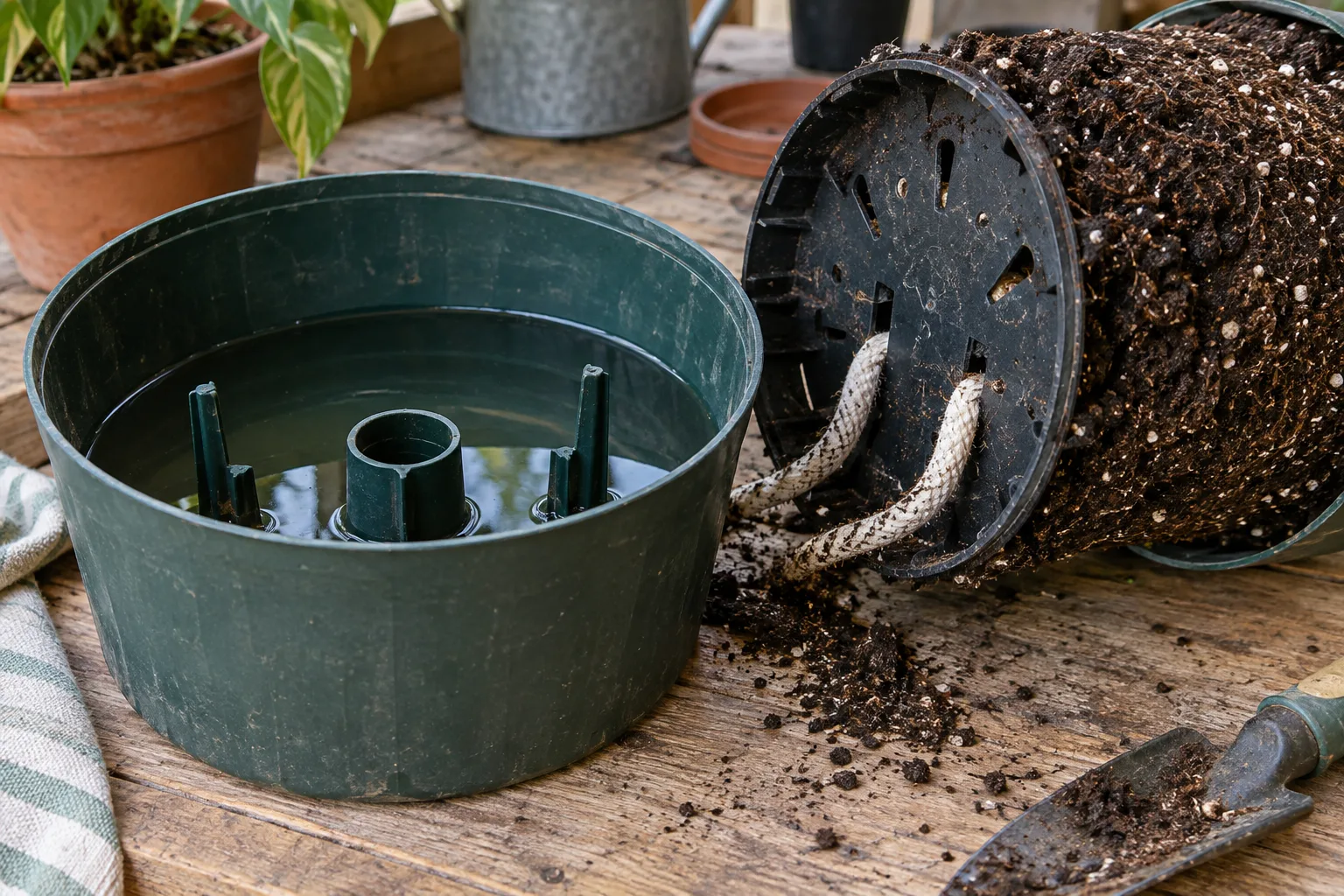
A self-watering planter adds a water reservoir beneath the potting mix, a wicking mechanism that draws moisture up into the root zone as needed, and an overflow outlet that prevents the reservoir from rising into and drowning the roots. That extra engineering, plus generally sturdier construction needed to hold the added water weight without cracking or warping over time, is what accounts for the higher price over a simple pot with nothing more than a drainage hole in the bottom, which is really just a container and nothing else.
Where self-watering earns its cost
- Hot, exposed, or windy spots where a traditional pot dries out once or even twice a day in peak summer. A reservoir buys real buffer time on exactly the containers most likely to be neglected on a bad day.
- Thirsty plants, tomatoes, peppers, and leafy greens especially, that suffer visibly from the inconsistent watering a busy schedule tends to produce in a traditional pot.
- Anyone who travels often or has an unpredictable schedule that makes daily watering unreliable, since a full reservoir can cover several days to over a week depending on the plant and conditions.
- Gardeners who’ve killed more than one plant through inconsistent watering specifically, as opposed to other causes like poor light or the wrong plant for the spot, since a reservoir directly solves that one particular failure mode.
Where a traditional pot is the better call
- Plants that actively dislike consistently moist soil, Mediterranean herbs, succulents, and anything drought-adapted. A self-watering planter’s whole design works against what these plants really want.
- A tight budget or a lot of containers to fill. The price difference adds up fast across a dozen pots, and that money often goes further spent on more plants or better soil than on upgraded containers across the board.
- Someone who enjoys the daily or every-other-day watering routine as part of the appeal of gardening, not a chore to engineer away.
- Very small pots, where there simply isn’t room for a meaningful reservoir alongside enough soil volume to matter, making the self-watering benefit marginal at best.
Side by side
| Traditional pot | Self-watering planter | |
|---|---|---|
| Upfront cost | Lower | Higher |
| Watering frequency needed | Daily to every few days | Every several days to over a week |
| Risk of overwatering | User error possible | Lower, if overflow works properly |
| Suits drought-tolerant plants | Yes | No, generally a poor fit |
| Weight (filled) | Lighter | Heavier, due to reservoir water |
| Complexity | None | Moving parts that can clog or fail |
Does the math really work out?
The upgrade pays for itself in a fairly direct way: fewer dead or stressed plants from missed watering days. A single tomato plant lost to a week of inconsistent watering while you were busy or traveling, replacement cost plus a real chunk of a season’s harvest gone with it, often exceeds the entire price difference between a traditional pot and a self-watering one for that same container, sometimes several times over once you account for what a mid-season loss really costs you in lost produce. The math tilts hardest in favor of self-watering on your most expensive or highest-value plants, an established perennial, a productive vegetable mid-season, and tilts hardest against it on cheap, easily replaced annuals where losing one to a missed watering isn’t a significant loss either way.
A quick way to decide
If most of the following describe your situation, self-watering is likely worth the extra cost: you’ve lost a plant to a missed watering day in the past year, your balcony gets hot afternoon sun and pots noticeably dry out fast, you travel or have an unpredictable schedule more than occasionally, and you’re growing at least one properly thirsty plant like a tomato or leafy green. If instead most of your containers hold Mediterranean herbs or other drought-tolerant plants, your schedule is consistent enough that daily watering isn’t a real burden, and budget is a real constraint right now, traditional pots are the more sensible default across the board, and a self-watering upgrade would mostly be solving a problem your balcony doesn’t truly have.
The failure modes each one has
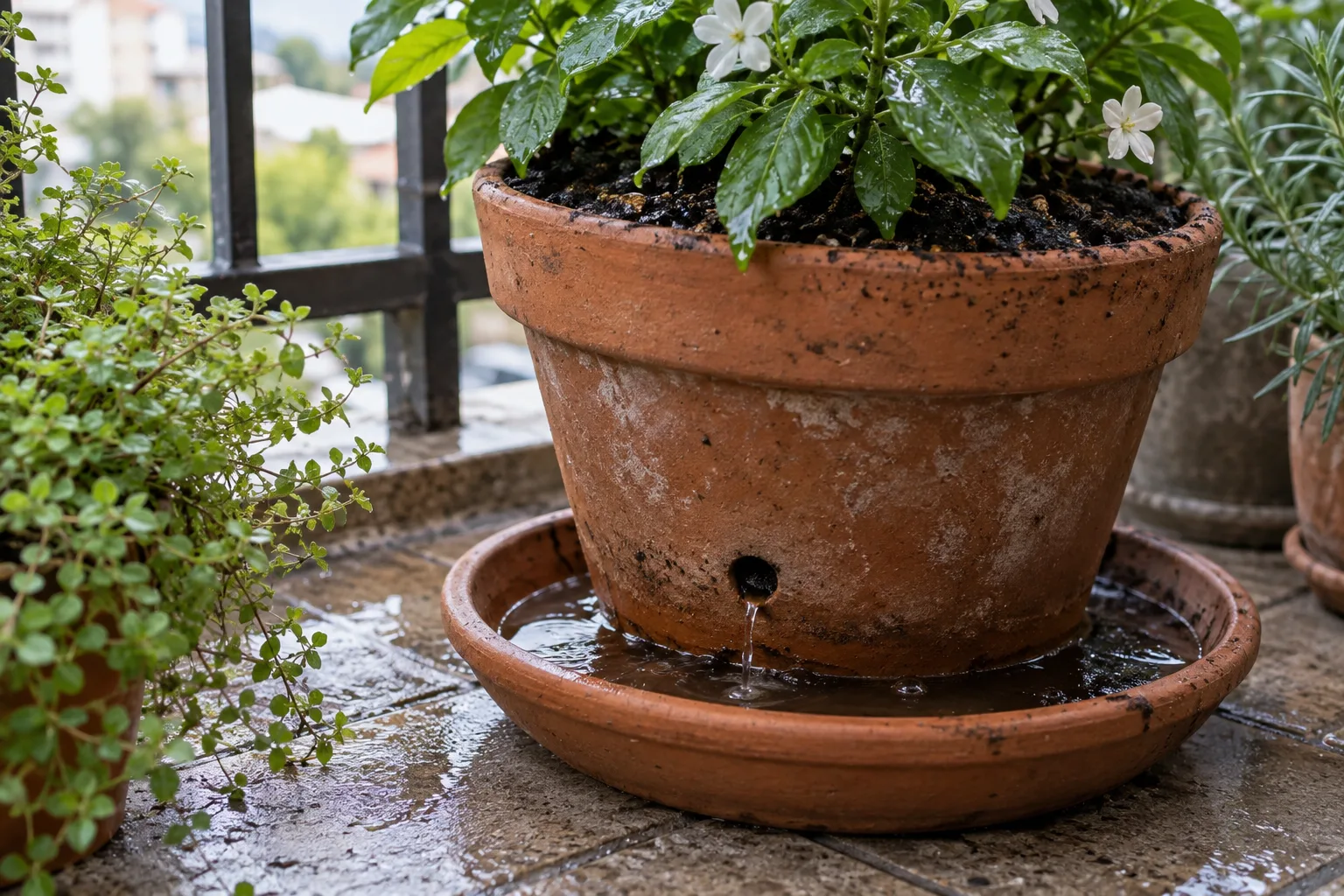
Neither option is foolproof. A traditional pot’s main failure mode is straightforward: it dries out if nobody waters it, or gets overwatered if someone’s overly generous with a watering can. A self-watering planter’s failure modes are less obvious and, in some ways, harder to catch early: an overflow outlet that gets blocked by roots or debris can let the reservoir rise into the root zone and drown the plant slowly, and a wicking mechanism can clog or dry out entirely without any obvious external sign until the plant is already stressed. In practice, this means a self-watering planter needs the reservoir and overflow checked periodically as actual maintenance, not just refilled and forgotten, whereas a traditional pot’s condition is visible at a glance every single time you happen to look at it.
A middle option: DIY self-watering setups
If you’re not ready to commit to buying dedicated self-watering planters across the board, a simple homemade reservoir using a cut plastic bottle, covered in our guide to DIY balcony planters from budget materials, gives you a rough version of the same wicking principle for a fraction of the cost. It’s a cruder mechanism with a shorter buffer time than a properly engineered commercial planter, but it’s a reasonable way to test whether the self-watering approach really suits your routine before investing in the real thing across an entire balcony’s worth of containers.
Weight is the tradeoff nobody mentions upfront
A full self-watering reservoir adds real, ongoing weight on top of the soil and plant, sometimes several extra pounds depending on the reservoir’s size and design, and that added weight sits at the bottom of the container permanently, not only during and right after watering, the way excess moisture briefly does in a traditional pot before it drains or evaporates away. On a weight-limited balcony floor, or anywhere you’re moving pots around seasonally, this is worth factoring in alongside the purchase price; a large self-watering planter filled and reservoired can be noticeably heavier to lift and relocate than the equivalent traditional pot, even before accounting for the plant and soil it holds.
How long each one actually lasts outdoors
The upfront price difference isn’t the whole cost picture; how long each option survives a balcony’s real weather matters just as much over several seasons. Most self-watering planters are molded from a lighter-gauge plastic than a heavy-duty traditional pot needs, since the reservoir and wicking mechanism already add bulk and cost without needing thick walls on top of that. Years of direct UV exposure gradually makes that plastic more brittle, and it’s usually the moving or load-bearing parts, the wicking column, the overflow fitting, a snap-together reservoir seam, that fail first, well before the pot itself visibly cracks. A traditional pot has no such mechanism to fail: a quality glazed ceramic or heavy plastic pot can outlast several self-watering planters bought at the same time, simply because there’s nothing inside it to degrade beyond the container material itself.
This doesn’t make self-watering a bad long-term investment, but it does mean the honest cost comparison isn’t just sticker price versus sticker price once. A self-watering planter that needs its wicking column or reservoir seal replaced, or gets swapped out entirely, every three to five seasons on a full-sun balcony should be weighed against a traditional pot that, aside from a terracotta pot’s separate winter-freeze risk covered elsewhere on this site, often just keeps working. Buying from a manufacturer that sells replacement wicking inserts separately, rather than treating the whole planter as disposable once one part fails, is worth checking before buying if longevity matters to you as much as the initial price does.
Converting an existing traditional pot
You don’t necessarily need to buy new containers to get some of the self-watering benefit. Self-watering insert kits, essentially a false bottom and wicking column designed to retrofit into an existing pot, are sold separately from complete planters and let you convert a favorite traditional pot instead of replacing it outright. They’re not a perfect substitute for a planter engineered as a single unit from the start, drainage and overflow tend to be less refined in a retrofit kit, but they’re a genuinely reasonable middle path if you already own pots you like the look of and just want to test the reservoir concept on one or two of them before deciding whether to invest further in dedicated planters.
A mixed strategy, realistically
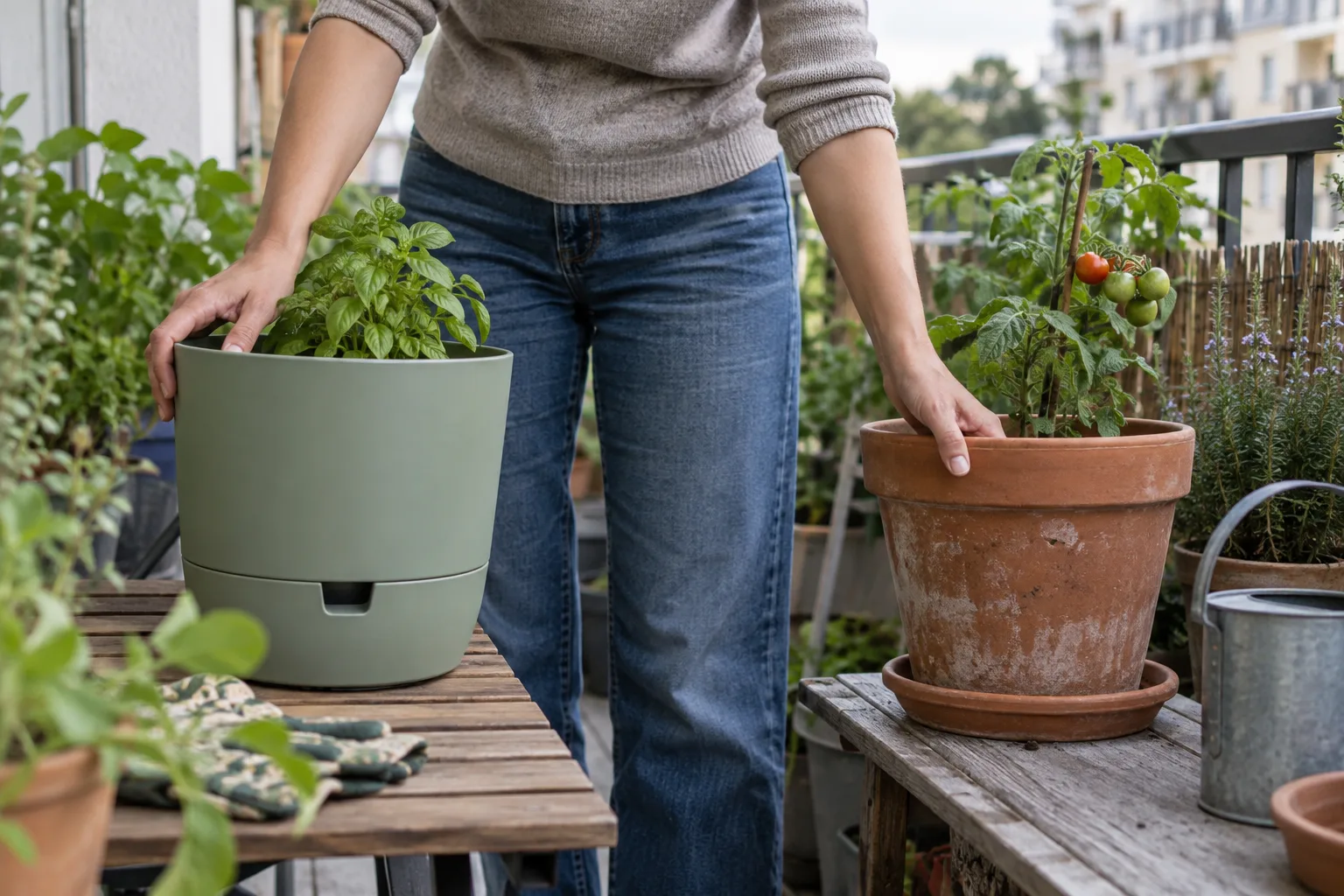
Most balconies don’t need to pick one system exclusively. A practical, common approach: self-watering planters for the thirstiest, most exposed, or most travel-vulnerable containers, tomatoes in full sun, anything on a hot west-facing rail, and traditional pots for everything else, herbs that prefer it drier, smaller containers where a reservoir doesn’t add much, and anything you enjoy checking on daily anyway. That split gets you the real benefit of the upgrade exactly where it matters most, without paying the premium across every container on the balcony, including the ones that wouldn’t especially benefit from it in the first place. Revisit the split each season too; a container that struggled with watering last summer because of an unusually hot stretch or a busier-than-normal travel schedule might not need the same treatment this year, and vice versa.
If you’re leaning self-watering
Our guide to self-watering balcony planters: setup and care covers the mechanics in more depth, how the reservoir, wick, and overflow really work together, and the specific maintenance habits that prevent the clogging and overflow failures described above from turning a helpful upgrade into a slow, hard-to-notice way of drowning a plant instead.