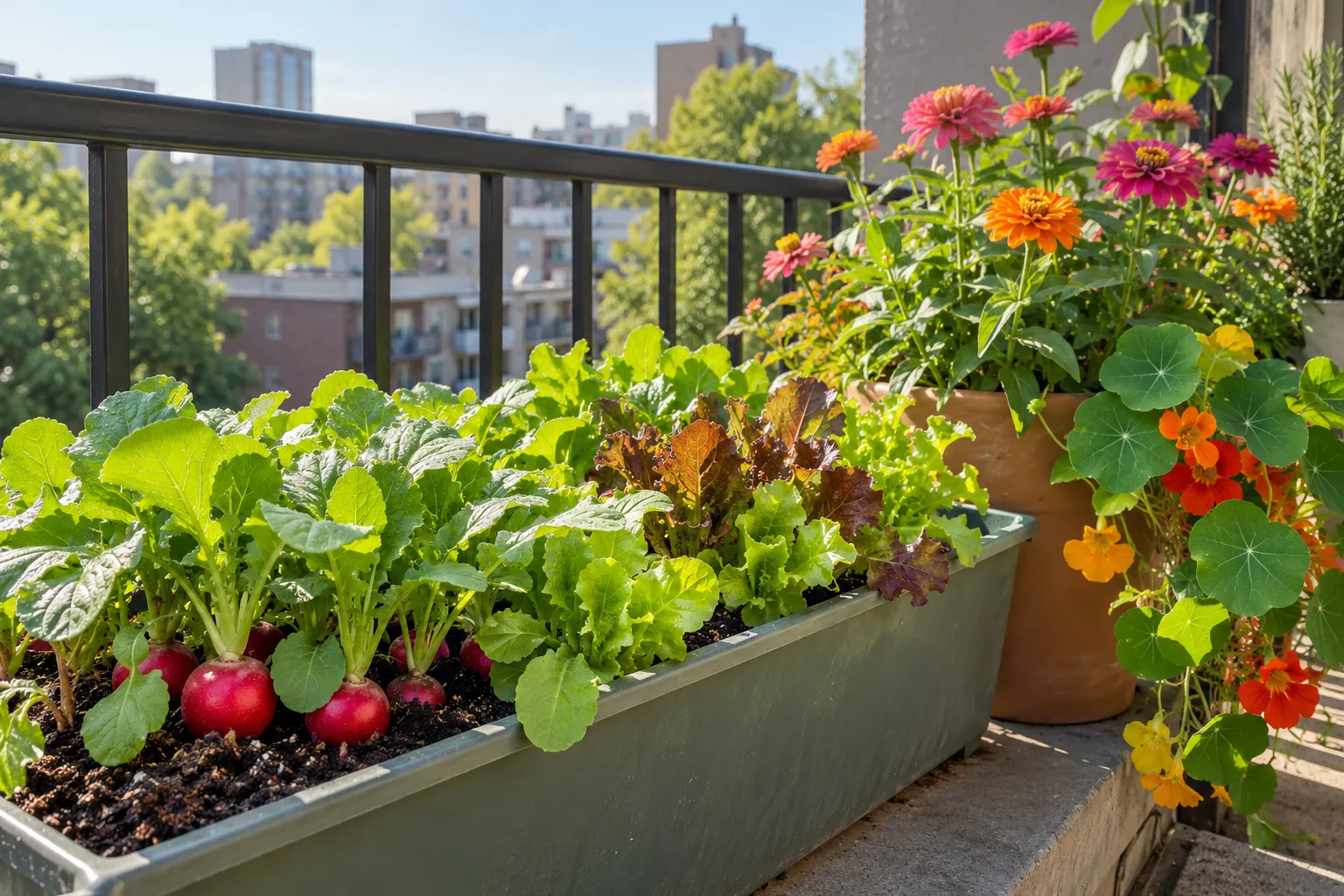
New balcony gardeners usually want one of two things first: something that survives, or something that shows up fast. This guide is for the second group, the ones who planted a pot last weekend and are already checking it every morning. The plants below are grouped by roughly how long they take to go from seed or small start to something worth looking at, since “fast-growing” covers a wider range than most lists admit, from a radish ready in three weeks to a vine that needs a full season to cover a railing.
Three weeks: the first results
This tier is mostly about seeing visible change within days of sowing, which matters more than most gardening advice acknowledges when you’re trying to keep momentum on a new hobby.
- Radishes. The fastest common vegetable by a wide margin. Clemson Cooperative Extension states radishes “mature anywhere from 21 to 30 days from seeding, depending on soil and air temperatures,” and the planting itself is simple: seed placed about ½ inch (1.3 cm) deep. A pot just 6 to 8 inches (15 to 20 cm) deep is plenty, since radish roots stay shallow and compact. Sow a new short row every week or two for a rolling harvest instead of one glut.
- Leaf lettuce and baby salad greens. You don’t need to wait for a full head. Snipping outer leaves as a cut-and-come-again crop gets you a first harvest within about three to four weeks of sowing, well before Clemson Extension’s stated 75 days to full leaf-lettuce maturity, and the plant keeps producing new leaves from the center for weeks afterward. A pot 6 to 8 inches (15 to 20 cm) deep with drainage holes is all it needs.


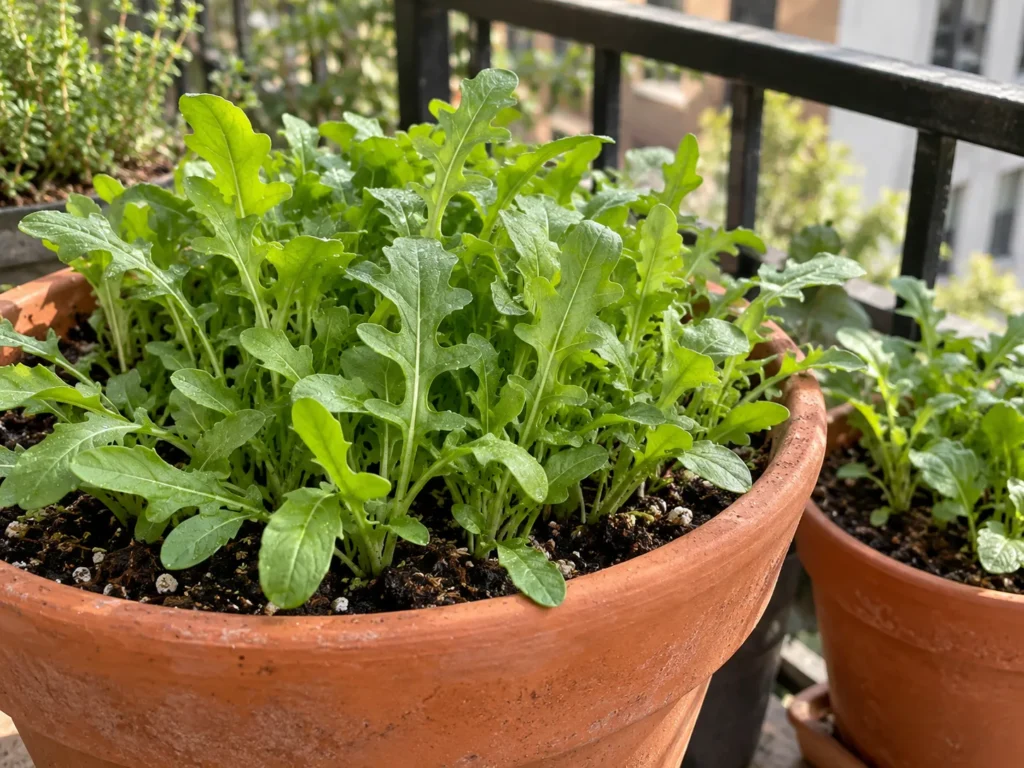
- Arugula. Peppery, fast, and more heat-tolerant once established than lettuce.
- Clemson Extension lists arugula as reaching maturity “about 45 to 60 days after sowing” for a full crop, but like lettuce it’s edible as baby leaves well before that point, often within two to three weeks of germination.
Six to eight weeks: the first real harvest or display
This tier rewards a bit more patience with something substantial, a full bean harvest or a pot of open flowers, not just a handful of baby leaves.

- Bush beans. Clemson Cooperative Extension states that “generally, snap beans will be ready to harvest 55 days after planting, depending on the variety selected,” with seed planted 1 inch (2.5 cm) deep. In a container, space seeds 2 to 4 inches (5 to 10 cm) apart in a pot at least 12 inches (30 cm) across and 10 to 12 inches (25 to 30 cm) deep, since bush beans develop a more substantial root system than the leafy crops above.
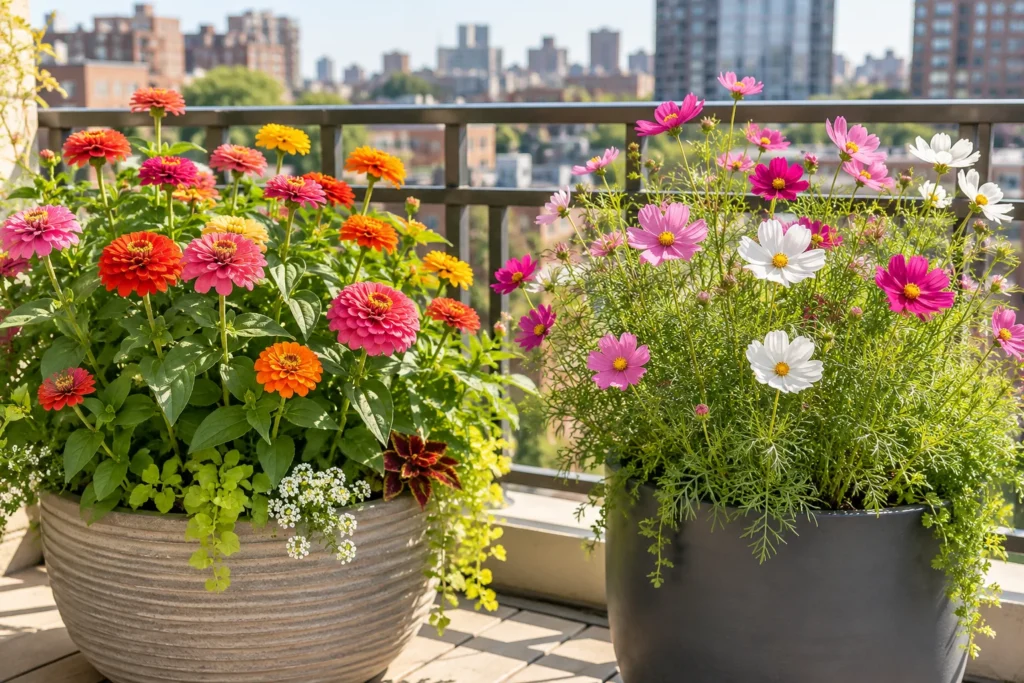
- Zinnias. One of the fastest annual flowers from seed to bloom. NC State Extension lists zinnia’s growth rate as “Rapid” and notes it can be sown “directly in the ground after the last frost date,” needing nothing more complicated than full sun and a pot at least 8 to 10 inches (20 to 25 cm) across. Expect the first flowers within six to eight weeks of sowing, with continuous blooms after that through the first frost.
- Cosmos. Another rapid grower per NC State Extension, which also notes seed
- should go in once “the soil has warmed to at least 65 degrees” Fahrenheit (18°C). Cosmos grows tall and airy quickly, often reaching 3 feet (90 cm) or more in a single season, and tolerates the drought stress that comes with a smaller pot better than most fast annuals, making it a reasonable choice if watering isn’t going to be perfectly consistent.
Eight to twelve weeks: fast coverage, not just fast growth
These plants are chosen less for an early harvest and more for how quickly they fill a space, whether that’s a bare trellis, a gap in a planting, or an empty stretch of railing.
- Morning glory. NC State Extension describes common morning glory as “a twining annual vine that can reach 6 to 10 feet (1.8 to 3 meters) tall and 3 to 6 feet (0.9 to 1.8 meters) wide in one season,” growing in “full sun in most moderately fertile, moist but well-drained soils.” Given a trellis or a string trained up the railing, it’s one of the fastest ways to turn bare structure into a wall of leaves and flowers by midsummer. A pot at least 12 inches (30 cm) across gives the root system enough room to support that much top growth.
- Nasturtium. NC State Extension rates nasturtium’s growth as “Rapid” and notes it “grows best in poor to average, well-drained soil,” which means it doesn’t need rich soil or heavy feeding to take off quickly, an unusual trait among fast growers. Trailing and semi-trailing types fill a rail box or spill out of a pot within weeks, and every part of the plant above the root is edible with a peppery, spicy flavor.
- Sweet alyssum. NC State Extension rates its growth as “Medium” rather than rapid,


- but it earns a place here for a different reason: it’s typically “used as an edging plant where lots of flowers are needed,” and a few plants fill in a border or the front of a container with a dense carpet of small, fragrant flowers faster than almost any other edging annual, even without rapid stem growth driving that spread. It tolerates “drought and dry soil,” per the same extension listing, which makes it forgiving while it fills in.
Days to maturity, side by side
| Plant | Time to first results | Container depth |
|---|---|---|
| Radish | 21 to 30 days | 6 to 8 in (15 to 20 cm) |
| Leaf lettuce (baby leaves) | About 3 to 4 weeks | 6 to 8 in (15 to 20 cm) |
| Arugula (baby leaves) | About 2 to 3 weeks | 6 to 8 in (15 to 20 cm) |
| Bush beans | About 55 days | 10 to 12 in (25 to 30 cm) |
| Zinnia | 6 to 8 weeks to bloom | 8 to 10 in (20 to 25 cm) |
| Cosmos | 6 to 8 weeks to bloom | 8 to 10 in (20 to 25 cm) |
| Morning glory | Full coverage by midsummer | 12 in (30 cm)+ |
| Nasturtium | A few weeks to fill in | 8 to 10 in (20 to 25 cm) |
What actually makes a plant grow fast
It helps to know why these particular plants outpace a pepper or a rose, since the reasons point directly at how to keep them growing quickly instead of stalling out.
- A short genetic program. Radishes, lettuce, and arugula are bred and selected to complete their edible stage before they ever flower or set seed; speed is the entire point of the plant from a breeding perspective, not a side effect.
- Annual life cycle under pressure. Zinnias, cosmos, morning glory, and nasturtium are all annuals that complete germination, growth, flowering, and seed set within a single season, which selects for plants that grow and flower quickly instead of investing years in woody structure the way a shrub does.
- Low soil and nutrient demands. Several of the fastest growers here, nasturtium and sweet alyssum especially, actively prefer leaner soil. Rich, heavily fertilized soil pushes these particular plants toward soft, lush leaf growth at the expense of the flowers or compact habit you actually want, which slows down the visible result even as the plant technically grows.
That third point matters more than it sounds like it should. The instinct with a slow-looking pot is almost always to add more fertilizer, but for nasturtium and sweet alyssum specifically, that instinct backfires: the plant puts its energy into leaves instead of flowers, and the display you were hoping to speed up ends up delayed instead.
Getting the fastest possible start
- Start with transplants for anything you want blooming within weeks. A small zinnia or cosmos start from a nursery is already six to eight weeks ahead of a seed, which matters if the goal is a fast result rather than the cheapest one.
- Direct-sow radish, lettuce, arugula, beans, and nasturtium instead. These crops dislike having their roots disturbed by transplanting and actually grow faster and more reliably sown straight into their final container.
- Warm the soil before sowing heat-loving fast growers. Cosmos, morning glory, and beans germinate poorly in cold soil regardless of air temperature; waiting until the soil itself has warmed, not just the calendar date of the last frost, shortens the time to visible growth.
- Keep the pot appropriately sized, not oversized. A tiny seedling in a huge pot often grows roots into the excess soil before it puts energy into top growth, which can actually slow the visible result. Match the container to the plant’s near-term size and pot up later if needed.
- Check the seed packet’s date, not just the plant’s reputation. Old seed germinates more slowly and less reliably even for a naturally fast species, which can

- turn a three-week radish into a five-week disappointment before you’ve done
- anything else wrong.
Common slowdowns and how to clear them
- Seeds that haven’t emerged after the expected time. Cold soil is the most frequent cause for the heat-loving fast growers (cosmos, morning glory, beans). Check the soil temperature itself, not just the air temperature, and hold off another week or two if it’s still cool.
- Leafy growth with no flowers from nasturtium or sweet alyssum. Almost always overfeeding or soil that’s richer than these plants want. Stop fertilizing and let the soil’s fertility run down before expecting flowers.
- Radishes that are all leaf and no root, or a woody, hot-tasting root. Usually a sign they sat in the ground too long past their short maturity window, often from crowding that slowed early growth. Thin seedlings early so each root has room, and harvest on the earlier side of the maturity window.
- A vine like morning glory climbing slowly at first, then taking off. This is normal. These vines build a root system for the first few weeks before top growth accelerates, so a slow start isn’t a sign of failure.
When fast growth becomes a problem of its own
Speed cuts both ways in a shared container, and a few of the plants above are fast enough to cause trouble if you don’t plan around it.
- Morning glory and nasturtium will outcompete slower neighbors. Both grow fast enough to shade out a slower-growing companion planted in the same pot before that companion gets established. Give either one its own container, or pair it only with something equally vigorous.
- Nasturtium self-seeds readily. Left to set seed at the end of the season, nasturtium often comes back the following year from seed that dropped into the pot, which is either a pleasant surprise or an unwanted volunteer depending on what you planned to grow there next.
- Zinnias and cosmos both stop flowering if seed pods are left on the plant. The plant’s fast cycle runs toward seed production once pollinated flowers are left alone, and regular deadheading is what keeps it producing new blooms instead of finishing its life cycle early in the season.
- A fast-filling rail box can block light to anything planted behind it. Morning glory and nasturtium both reach a fair amount of leaf coverage within weeks, which is the goal on an open railing but a problem if there’s a slower, light-hungry plant positioned behind it.
Pairing quick wins with a slower centerpiece
Fast growers are excellent for instant gratification, but a balcony planted with nothing else tends to look busy and then bare once the quick crops finish their season. Pairing a fast-growing edge crop, radish, lettuce, or a trailing nasturtium, in front of a slower, longer-lived centerpiece gives you something to look at in week two and something that’s still there in month six. A compact tomato or a perennial herb works well as that anchor, with the fast growers filling the space around its base while it establishes. By the time the radishes or lettuce are done and pulled, the centerpiece has usually grown enough to fill the gap on its own, and the pot never goes through the bare, half-empty stage that a container planted with only quick crops tends to hit partway through the season.

Keeping the momentum going
Once the first fast crop proves out, succession sowing keeps the quick results coming instead of a single burst followed by a bare pot. Reseed radishes, lettuce, and arugula every week or two through their growing season, and deadhead zinnias and cosmos regularly to keep them producing new flowers instead of setting seed and slowing down. For a wider sense of how to lay out a balcony that mixes these quick wins with slower, longer-term plants, our guide to small balcony garden layouts for renters is a useful next step, and starting seeds for a balcony garden covers the sowing details this guide assumes. If the vegetables here go well and you want to build out a full container harvest, vegetables that grow well in balcony containers covers the slower crops this list deliberately left out.
Sources
- Clemson Cooperative Extension: Carrot, Beet, Radish and Parsnip
- Clemson Cooperative Extension: Lettuce
- Clemson Cooperative Extension: Arugula, Kale, Mesclun, Mustard, and Swiss Chard
- Clemson Cooperative Extension: Bush and Pole-Type Snap Beans
- NC State Extension: Zinnia elegans
- NC State Extension: Cosmos bipinnatus
- NC State Extension: Ipomoea purpurea (Common Morning Glory)
- NC State Extension: Tropaeolum majus (Nasturtium)