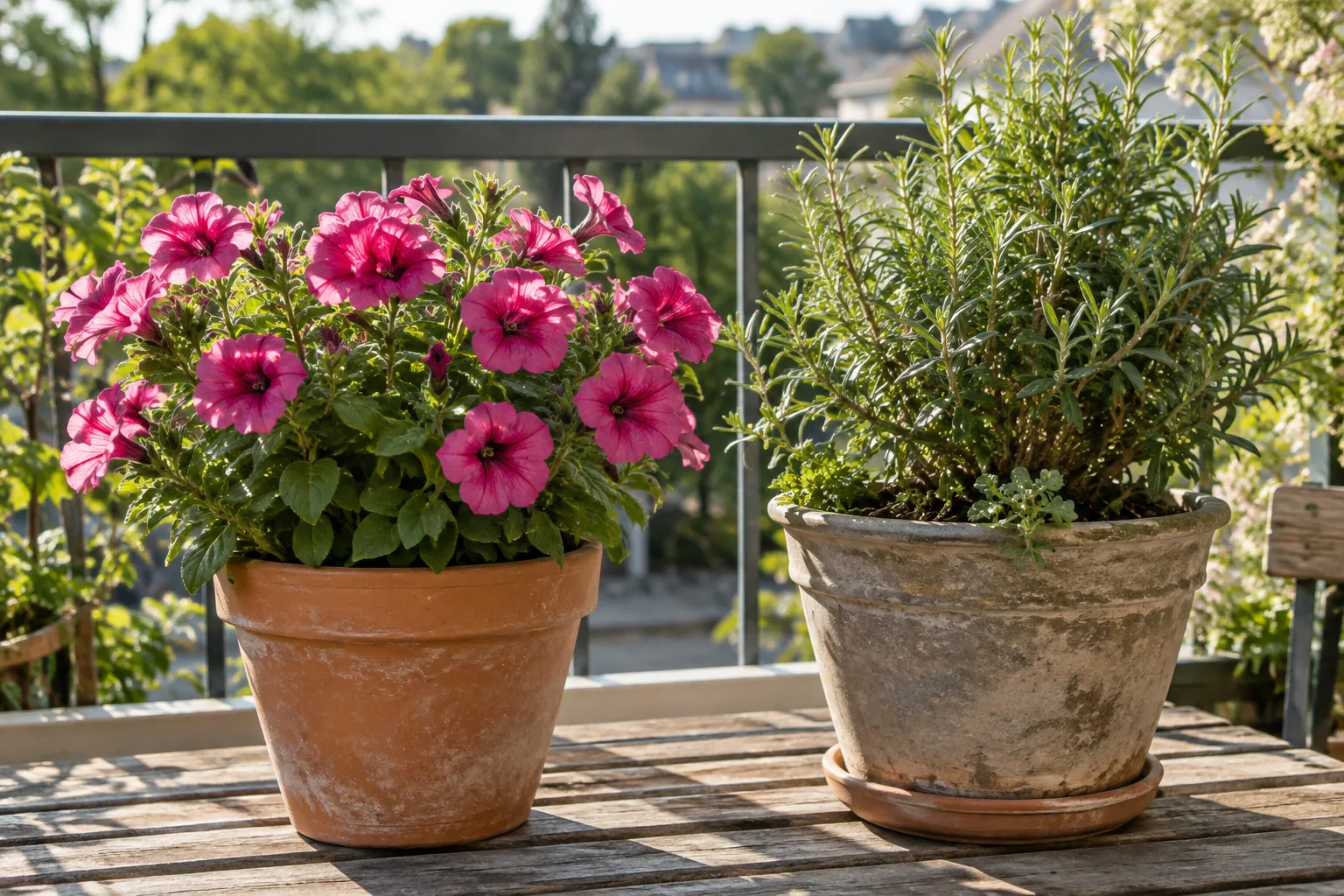
Every plant tag at the garden center is quietly making a promise: this one gives you a season, or this one sticks around for years. Annuals complete their whole life cycle, sprout, grow, flower, set seed, die, in a single growing season and need replacing every year. Perennials survive from year to year, dying back in cold climates and regrowing from the same roots, or staying evergreen where winters are mild. On a balcony, that difference plays out in cost, container commitment, and how much a plant needs from you across an entire winter, not just from planting to first bloom.
Neither is objectively better. The right choice depends on what you really want from a container: nonstop color for one season, or a plant you get to watch settle in and mature over several years, which has its own kind of pleasure. Here’s how they compare on a balcony specifically, category by category, instead of one single blanket recommendation.
Side by side
| Annuals | Perennials | |
|---|---|---|
| Lifespan | One season | Multiple years |
| Bloom pattern | Continuous through the season | Shorter, defined window |
| Yearly cost | Repurchased annually | One-time cost, spread over years |
| Winter care | None needed | Requires protection or indoor overwintering |
| Repotting | Rarely needed | Eventually needed as roots grow |
| Design flexibility | Easy to redesign yearly | Built around as a long-term anchor |
Bloom time and intensity
Annuals win here, decisively. Because an annual’s entire biological purpose is to flower and set seed within one season, generations of breeding have pushed most popular annuals, petunias, marigolds, calibrachoa, toward blooming continuously and heavily from the moment they’re planted right up until frost. Perennials, by contrast, typically have a defined bloom window, often just a few weeks, and put a good portion of their energy into root and structural growth instead of nonstop flowering, since they’re playing a multi-year game, not a one-season sprint.
Cost over time
Perennials win here, if you keep them going. An annual is a yearly repurchase, new plants, sometimes new soil, every spring. A perennial is a bigger upfront cost, often literally, perennial starts tend to be pricier than annual six-packs, but that cost is spread across however many years the plant survives in its container. The math flips against perennials, though, if a plant doesn’t survive your winter or gets replaced anyway after a couple of underwhelming seasons; a perennial that dies in its first winter was, in practice, just an unusually expensive annual.
Winter commitment
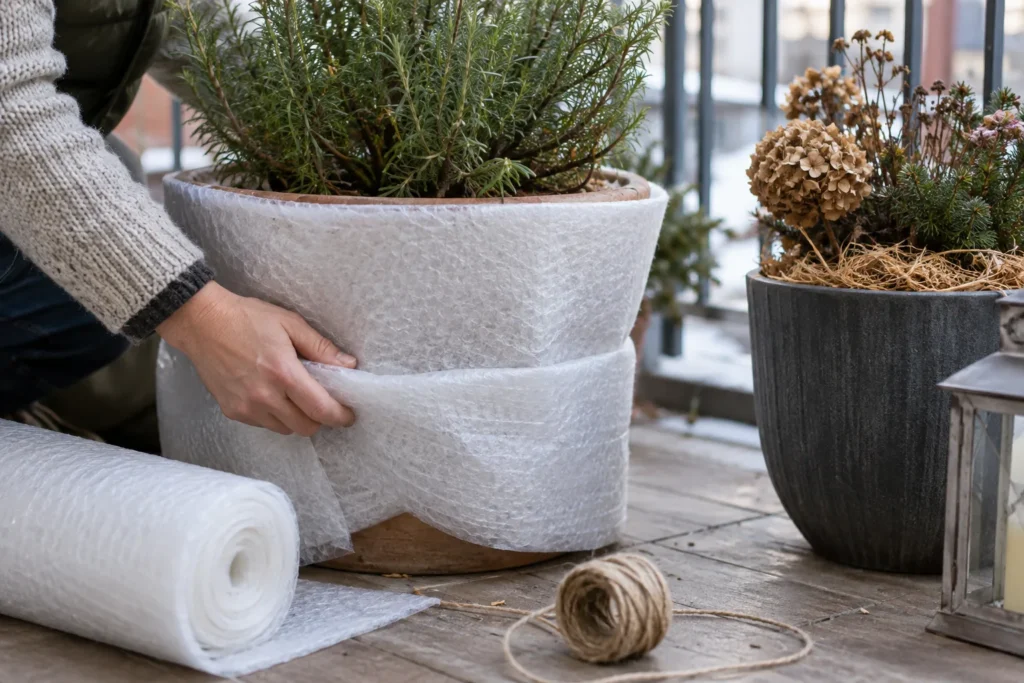
Annuals win here, by simply not asking anything of you. An annual finishes its life cycle and gets composted at the end of the season; there’s nothing to protect, insulate, or bring indoors. A perennial you want to keep requires exactly the kind of planning covered in our guide to prepping a balcony garden for winter, since a containerized perennial’s roots are more exposed to cold than the same plant would be in the ground. If you’re not interested in winter plant-protection logistics at all, annuals sidestep that whole question entirely, every single year, without exception.
Container commitment and root growth
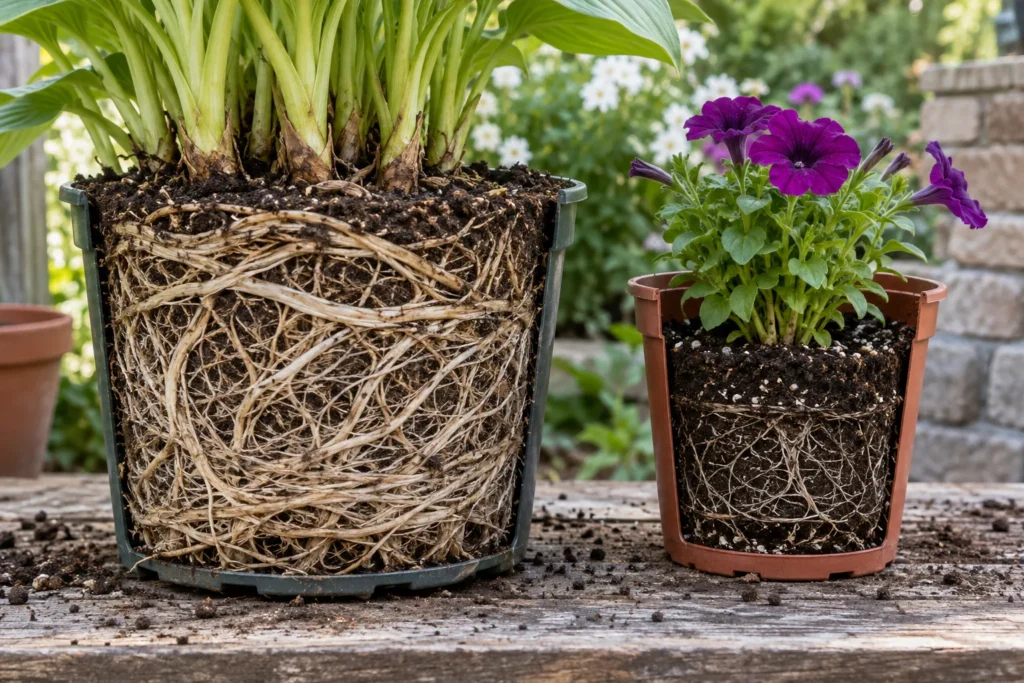
Roughly a tie, but for different reasons. An annual’s roots only need to support one season of growth, so container size matters less over the plant’s total lifespan; whatever fits it for a few months is fine. A perennial’s roots keep developing year over year, which means it will eventually need repotting into a larger container as described in our guide to repotting a balcony plant, an ongoing commitment an annual never asks for since it’s gone before that becomes a question.
Design flexibility
Annuals win here too. Since you’re replanting every year anyway, an annual-heavy container is easy to redesign completely each season, new colors, new combinations, no sunk emotional or financial cost in ripping out what’s currently there. A perennial-anchored container is more like a long-term relationship: you’re generally building the rest of the arrangement around it instead of swapping it out on a whim, which is a real strength if you want visual consistency year to year, and a real drawback if you like changing things up often and enjoy the yearly redesign process itself.
Which one really fits your balcony
- You want maximum color with minimum long-term commitment: lean annual. Petunias, calibrachoa, and marigolds reward almost no long-term planning with a full season of bloom.
- You’re renting somewhere temporary and don’t want to leave plants behind: lean annual, for the same reason, nothing to feel obligated to keep alive past moving day.
- You want a lower-maintenance container over several years and don’t mind a shorter, less intense bloom window: lean perennial, since you’re not replanting from scratch every spring.
- You’re building toward a specific, evolving design you plan to live with for years: perennials give you that anchor to build around.
- You want both: most experienced balcony gardeners land here eventually, a perennial or two as the container’s backbone, with annuals filling in around them for color that the perennial’s shorter bloom window doesn’t cover on its own.
- You’re gardening somewhere with truly brutal winters and no realistic way to bring plants indoors or shelter them: lean annual by default, since even a well-chosen “hardy” perennial can struggle in a container exposed to that kind of cold without real intervention.
The category in between: biennials
There’s a third, less-talked-about category worth knowing before you buy: biennials, which spend their first year growing foliage and establishing roots, then flower, set seed, and die in their second year. Foxglove and many ornamental kales fall into this group. On a balcony, a biennial behaves like a perennial in year one, present but not particularly showy, and like an annual in year two, one final bloom before it’s finished. If a plant tag mentions a two-year cycle instead of a simple “annual” or “perennial” label, that’s the category you’re dealing with, and it’s worth knowing in advance so a quiet, unremarkable first year doesn’t read as a failure to thrive when it’s really right on schedule.
Signs a perennial won’t make it through winter
Not every perennial that’s rated hardy for your zone survives its first winter in a container, since container roots run colder than the same plant would experience in the ground. A few signs the plant didn’t make it: no new growth emerging from the base once spring temperatures warm up consistently, stems that snap dry and hollow instead of bending with any flexibility, and roots that come apart mushy and dark instead of firm and pale when you check them at the base. If you’re seeing all three well past your area’s typical last frost date, it’s reasonable to treat the container as empty and replant instead of waiting indefinitely, weeks longer, for a recovery that at that point simply isn’t coming.
A mixed-container approach
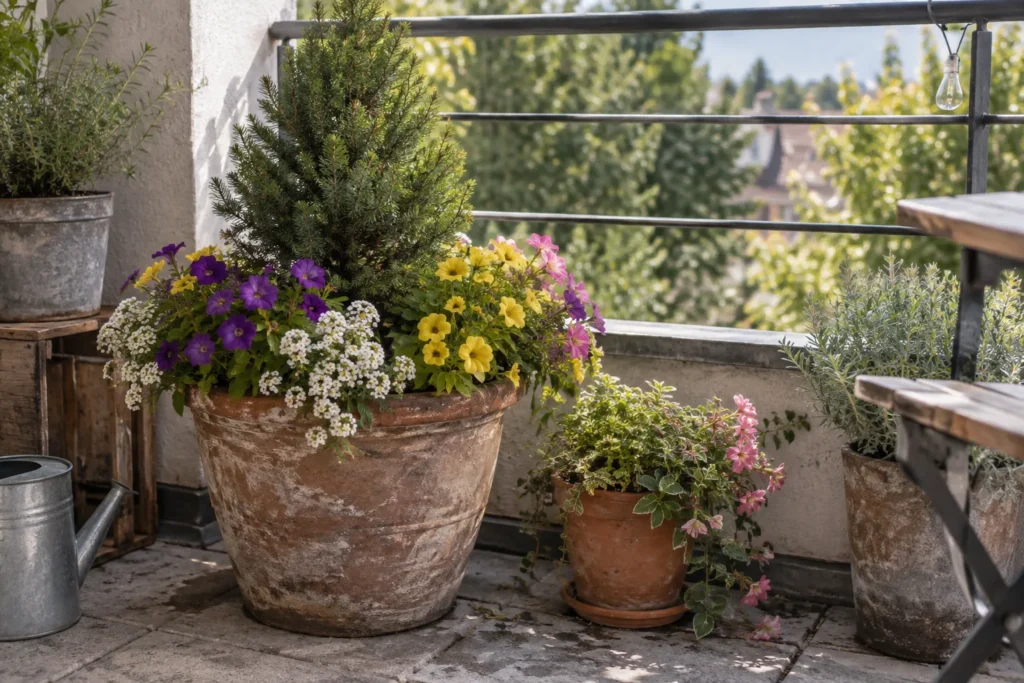
You don’t have to choose one category for the whole balcony, and most experienced container gardeners eventually stop trying to. A common, practical approach treats one or two hardy, well-suited perennials as the permanent structure of a container arrangement, an ornamental grass, a compact shrub, a hardy flowering perennial, then fills the remaining space with annuals that get swapped seasonally for whatever color and bloom the perennial isn’t providing at that moment. That way the container never looks bare between perennial bloom windows, and you’re only replanting a portion of your containers each spring, and spending a portion of a full replant’s budget, instead of starting completely from scratch every single year.
Common mistakes on both sides
- Buying a perennial without checking your winter hardiness zone against it. A “perennial” tag on the plant only means it survives winter somewhere; whether that’s your winter is a separate question worth checking before you buy.
- Treating an annual like an investment by overspending on premium pots or elaborate setups for a plant that’s gone in a few months anyway.
- Assuming a perennial needs no care because it’s not going anywhere. A neglected perennial in a container can decline just as fast as a neglected annual; it just takes longer to become obvious.
- Ignoring bloom timing when mixing the two. A perennial with a narrow spring bloom window paired only with summer-blooming annuals leaves the container looking unbalanced for part of the season.
- Sizing the container for the plant’s current size, not its eventual one. An annual won’t outgrow an undersized pot in the time it has, but a perennial started small will, often within a year or two.
Where this fits with the rest of your balcony
Whichever way you lean, the container and soil decisions underneath both categories are the same: adequate drainage, the right pot size for the root system you’re working with, and a potting mix that suits the plant instead of garden soil. If you haven’t settled those basics yet, our guides to choosing balcony pots and containers and balcony container sizing cover that groundwork regardless of which side of this comparison you land on, and are worth reading before you commit either an annual six-pack or a perennial start to a container that isn’t properly set up for it.