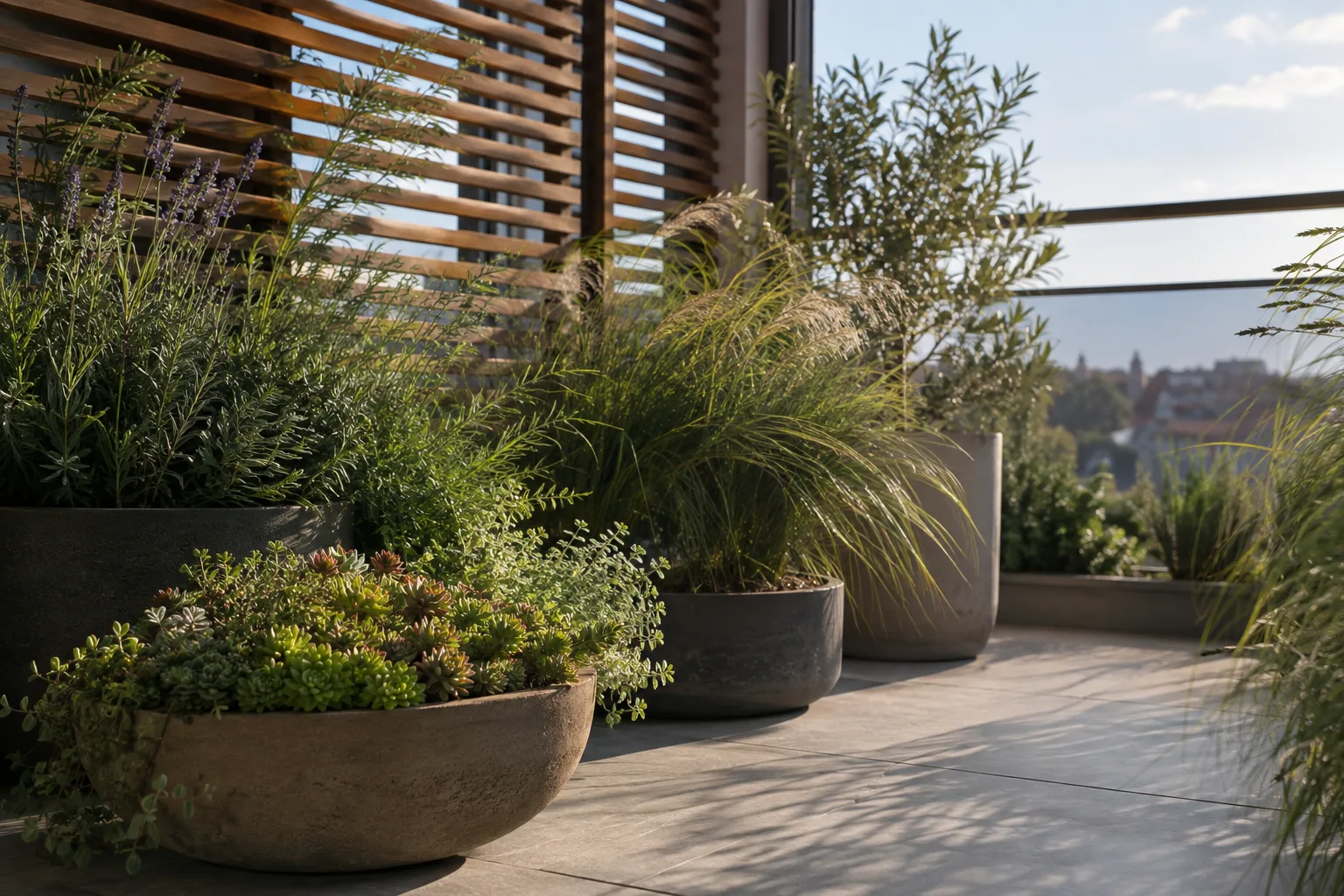
A gusty balcony dries pots faster than a still one, and most gardeners chalk that up to wind simply “drying things out” the way it dries laundry. That’s true as far as it goes, but the actual mechanism is more specific, and understanding it explains why a porous screen works better than a solid wall, why some plants shrug off wind that shreds others, and why a balcony can stay windy well after the storm that caused it has passed.
This is the science behind the practical advice in our guide to building a wind-resistant balcony garden; that guide covers what to do, this one covers why it works.

The boundary layer: wind’s real target
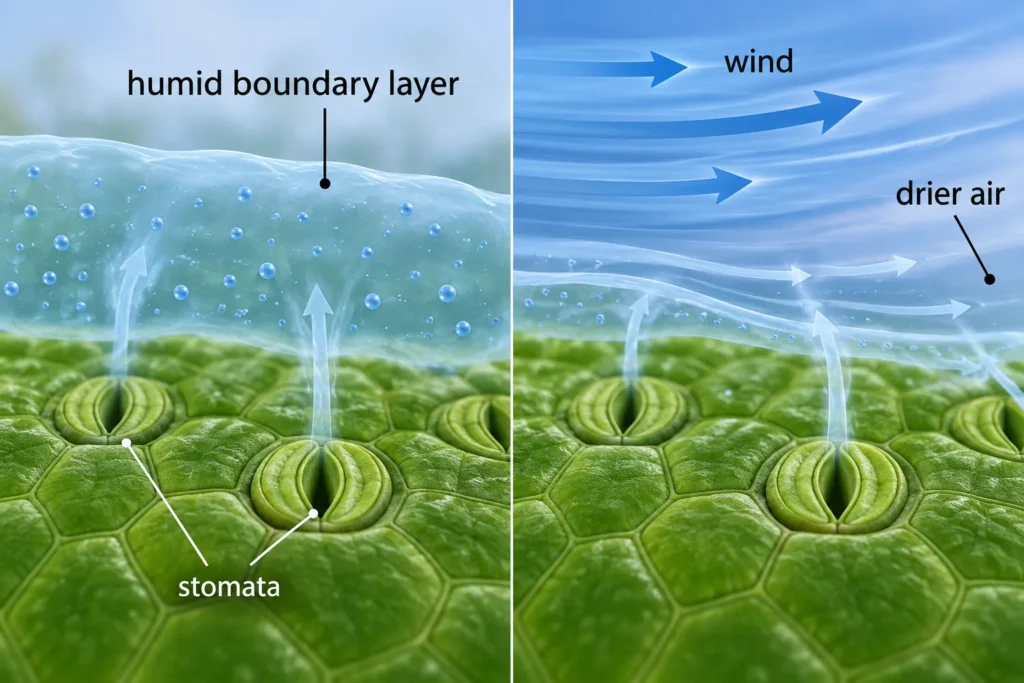
Every leaf is wrapped in a thin, mostly still layer of humid air called the boundary layer. Water vapor leaving the leaf through its stomata has to diffuse across that layer before it reaches the moving air beyond, and a thick, calm boundary layer slows that diffusion down, acting like a buffer that keeps humidity higher right at the leaf surface. Wind strips that buffer away. As air moves faster across a leaf, the boundary layer thins, the humid air sitting against the leaf gets swept off and replaced with drier air from further away, and the vapor pressure gradient driving water out of the stomata gets steeper.
That’s the actual mechanism behind “wind dries plants out”: not wind itself pulling water from leaves, but wind removing the humid air that was slowing water loss down. A 2024 study in The Plant Journal found this effect happens fast: stomata opened two and a half times faster in response to light at a modest wind speed compared to still air, because thinning the boundary layer changes the pressure dynamics inside the leaf almost immediately, not just the evaporation happening at its surface.
Why a windy day doesn’t just mean more water loss
The relationship between wind and water loss isn’t a straight line, and it isn’t purely bad news either. Research has found that wind can actually increase a leaf’s water use efficiency, meaning the plant fixes more carbon per unit of water it loses, even as total transpiration rises. A thinner boundary layer also improves CO2 exchange at the same time it increases water vapor loss, so a moderately windy plant can, within limits, photosynthesize more efficiently even while drying out faster.
That balance breaks down at the extremes. Strong, sustained wind can push a plant past what its roots can resupply, and the plant responds by closing its stomata to cut water loss, which also shuts down photosynthesis and growth. Very strong gusts cause a separate, purely mechanical problem: torn leaf tissue, snapped stems, and abrasion damage from leaves repeatedly thrashing against a wall or railing, none of which has anything to do with the boundary layer and everything to do with physical force exceeding what the plant’s tissue can withstand.
Why leaf shape predicts wind tolerance
Plants native to consistently windy places have evolved features that manage the boundary layer directly. Small, narrow, or needle-like leaves have a shorter path for humid air to travel before it reaches faster-moving outside air, which naturally limits how much the boundary layer can thicken in the first place, so there’s less to lose when wind strips it away.
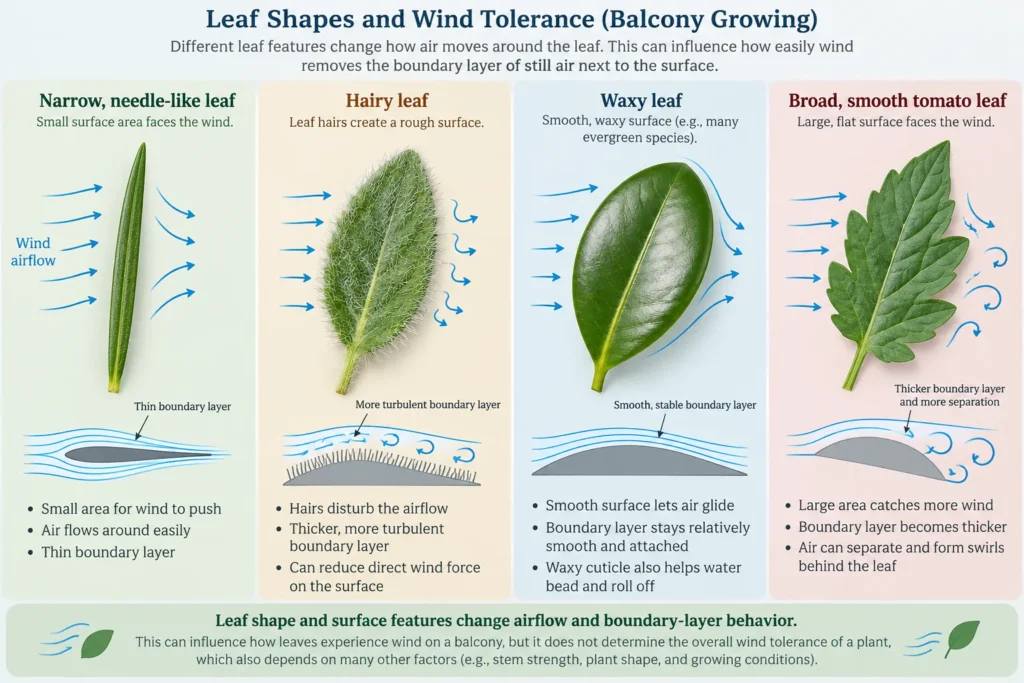
Fine hairs or a waxy cuticle on the leaf surface do something similar by physically trapping a layer of still air close to the leaf even in a breeze, effectively rebuilding a mini boundary layer that ordinary wind has more trouble disturbing.
This is the real reason thyme, sedum, and ornamental grasses handle an exposed balcony better than a broad-leaved tomato or a large tropical foliage plant. It isn’t toughness in a general sense; it’s that their leaf geometry keeps the boundary layer intact under conditions that strip it from a large, flat, smooth leaf almost immediately. Our guide to choosing plants for balcony conditions covers which species fit an exposed spot for this exact reason.
The other adaptation: how a plant reshapes itself after weeks of wind
Leaf shape is fixed by genetics before a seed ever germinates, but plants also have a second, much faster way of adjusting to a windy spot: they physically change how they grow in response to being repeatedly shaken. Botanists call this thigmomorphogenesis, and it was already documented by the Greek philosopher Theophrastus around 300 BC, who noticed that trees growing in exposed, windy sites ended up shorter and denser-wooded than the same species growing somewhere sheltered.
A research review in the Journal of Experimental Botany describes the core response as “a decrease in shoot elongation coupled to an increase in radial expansion”: in plain terms, the plant grows shorter while its stems get measurably thicker. Bean plants subjected to repeated mechanical stress in controlled studies showed a significant increase in stem diameter alongside stunted height, and repeatedly touched plants also show inhibited flower-stalk elongation and a delayed shift into flowering. The change isn’t instant: the very first physiological signals, shifts in the plant’s internal electrical activity and a temporary slowdown in phloem transport, appear within seconds to a couple of minutes of a gust, but the visible result, a shorter, stockier plant, only shows up after repeated exposure over days and weeks, driven partly by a rise in ethylene production several hours after each mechanical disturbance that reinforces stem thickening over time.
On a balcony, this explains something that boundary-layer drying alone doesn’t: why the exact same tomato or basil variety often ends up noticeably shorter and stouter-stemmed on an exposed, windy balcony than a sheltered one, independent of how much water or fertilizer it gets. That’s usually a net benefit, since a shorter, thicker-stemmed plant is also more wind-resistant going forward, but it does mean a variety bred for height or maximum yield may underperform its seed-packet description in a consistently windy spot, and it’s one more reason a very exposed balcony favors compact varieties from the start rather than fighting the plant’s own adaptive response.
The counterintuitive physics of windbreaks
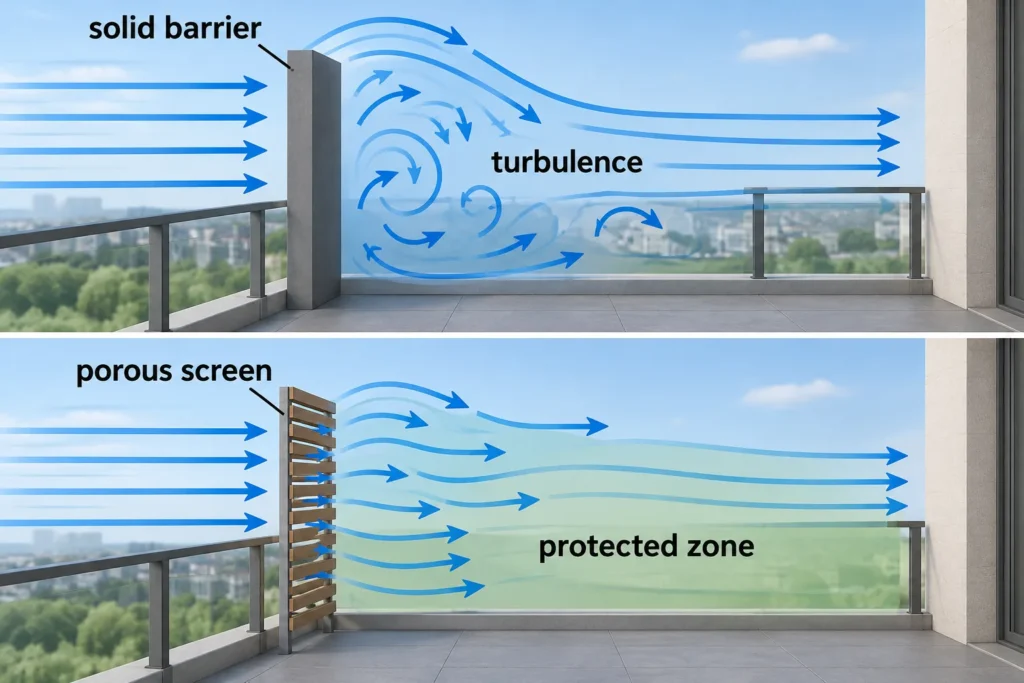
A solid wall seems like the obvious way to block wind, but windbreak research consistently finds that denser isn’t better past a certain point. Utah State University Extension explains the mechanism: as wind hits a solid barrier, it deflects up and over, and the low pressure that forms on the sheltered side pulls that deflected air back down quickly, shrinking the protected zone and often creating turbulence right where you wanted calm. A porous barrier lets some wind bleed through continuously instead of building up that pressure differential, which softens the airflow over a much larger area even though it “blocks” less wind in any single instant.
The extension research puts numbers on this: windbreaks in the 60 to 80 percent density range give strong protection over a small area, comparable to a residential lot or a balcony, while density below about 20 percent does almost nothing. That’s the physical justification behind the standard balcony advice to use a slatted or mesh screen rather than a solid panel: a well-chosen porous screen at roughly that density range cuts wind meaningfully without creating the turbulent eddies a solid wall generates on its lee side.
What this means for watering on a windy balcony
Because wind acts on the boundary layer at the leaf and on the exposed soil surface at the same time, a windy balcony dries out on two fronts a still one doesn’t: transpiration pulling water out through the plant, and direct evaporation pulling it out of the top layer of potting mix. That’s part of why wind can dry a container even on a mild, overcast day when the sun-driven evaporation most gardeners watch for is minimal. Checking soil moisture directly, rather than judging by temperature or how hot the day feels, catches this; our guide to the science of watering container plants covers how pot size, material, and exposure combine to determine how fast a given container actually dries.
Practical takeaways from the mechanism
- Favor small, narrow, or hairy-leaved plants on an exposed balcony; their leaf geometry naturally resists boundary-layer stripping.
- Choose a porous screen over a solid one. Somewhere around 60 to 80 percent density protects a small area like a balcony far more effectively than a wall that blocks more wind but creates turbulence.
- Check soil moisture directly on windy days, even mild or cloudy ones, since wind dries containers through a separate mechanism than heat.
- Don’t assume torn or damaged leaves mean the plant is drying out. Mechanical wind damage and transpiration-driven water stress are different problems with different fixes.
- Expect compact, thick-stemmed growth on a consistently windy balcony as a normal adaptive response, not a sign something is wrong; it’s usually a net gain in sturdiness.
For the broader setup this guide assumes, see our beginner walkthrough on how to start a balcony garden.
Sources
- Shapira et al., 2024, The Plant Journal: Wind speed affects the rate and kinetics of stomatal conductance
- Schymanski et al.: Wind increases leaf water use efficiency (PubMed)
- Utah State University Extension: Windbreak benefits and design
- Royal Horticultural Society: Wind scorch
- Chehab et al., 2009, Journal of Experimental Botany: Thigmomorphogenesis, a complex plant response to mechano-stimulation
Windbreak density research comes primarily from agricultural and forestry settings at larger scales than a balcony; the underlying airflow physics apply, but exact protected-area figures won’t translate one to one to a small, building-adjacent space.