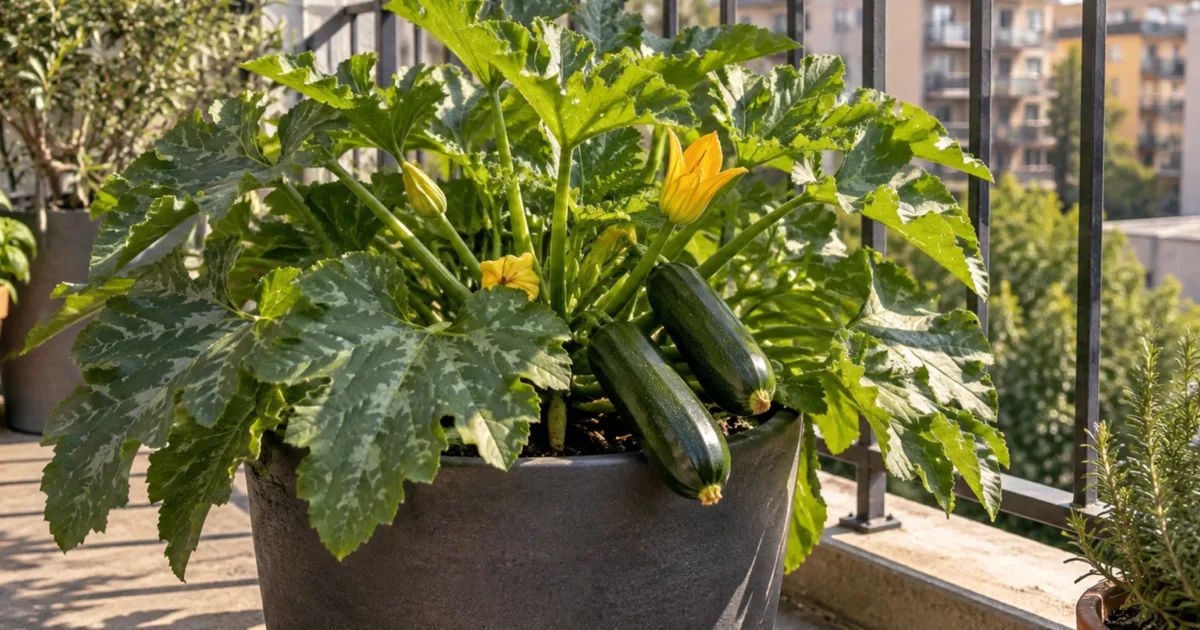
Zucchini has a reputation as the vegetable that produces so much you end up giving it away by the bagful, which makes it a strange one to call a balcony crop. It isn’t a natural fit for a container the way lettuce or peppers are, the plants get genuinely large and the fruit sets depend on pollination in a way most balcony vegetables don’t, but with the right variety and a couple of balcony-specific adjustments, it’s a realistic container crop, not a stretch.
Choosing the right variety: bush, not vining
Standard zucchini plants sprawl several feet in every direction, which rules them out for anything but the largest balconies. Bush varieties, bred to grow in a compact mound rather than sprawling vines, are the only realistic option for container growing, and they’re widely available under names like Fordhook, Eight Ball, Raven, and Jackpot Hybrid. A vining variety trained up a trellis can technically work in a large container, but a bush variety is the simpler, more balcony-appropriate default, and it’s worth confirming “bush” or “compact” is on the seed packet or plant tag before buying, since the difference matters more here than for almost any other container vegetable on this site.
Container size and setup
University of Maryland Extension classifies summer squash as a medium-sized container vegetable, needing a minimum of 4 to 6 gallons of growing media and a depth of 8 to 12 inches. That’s a real minimum, not a target; a bush zucchini plant grows large enough that erring toward the bigger end of that range, or beyond it, gives the root system more buffer and reduces how often the container needs watering once the plant reaches full size. One plant per container is the practical rule, since bush varieties still spread wide enough that crowding two into the same pot creates more competition for water and nutrients than the space can support.
Drainage holes are non-negotiable, since squash roots are particularly prone to rot in waterlogged soil, and a lighter-colored container keeps roots from overheating in full sun better than a dark one does, since dark material absorbs more heat and can push root-zone temperatures uncomfortably high on a hot, exposed balcony. Our balcony container size guide covers the general reasoning behind container sizing if you’re setting up multiple containers for the season and want to compare zucchini’s needs against other crops.
Sun, water, and feeding
Zucchini wants as much direct sun as a balcony can offer, ideally 6 to 8 hours a day; a plant that gets less will still grow leaves but produces noticeably less fruit, since flowering and fruit-set both depend heavily on the energy a full sun day provides. A large, actively fruiting zucchini plant is also one of the thirstier balcony vegetables, since its broad leaves lose a lot of water to transpiration and the fruit itself is mostly water; checking soil moisture daily during hot weather, rather than assuming a schedule will hold, catches the plant before it wilts under stress.
A balanced, container-formulated vegetable fertilizer applied on a regular schedule through the growing season supports the plant’s fast growth and heavy fruiting; our guide to fertilizing balcony container plants covers timing and application in more depth. A plant that’s producing lots of leafy growth but few flowers, or flowers that drop before fruiting, is more often a pollination problem than a feeding problem, which is the balcony-specific issue covered next.
The balcony-specific problem: not enough bees
This is the detail most general zucchini guides skip, and it’s the single biggest reason a balcony zucchini plant can flower heavily and still produce little to no fruit. Squash plants produce separate male and female flowers on the same plant, and a female flower only sets fruit after a pollinator, almost always a bee, physically carries pollen from a male flower to the female one. A ground-level garden usually has enough bee traffic passing through for this to happen reliably. A balcony, especially one several floors up or in a location bees don’t regularly visit, often doesn’t, and the result is a plant that flowers normally but drops unfertilized female flowers, or grows small fruit that shrivels and rots before reaching full size.
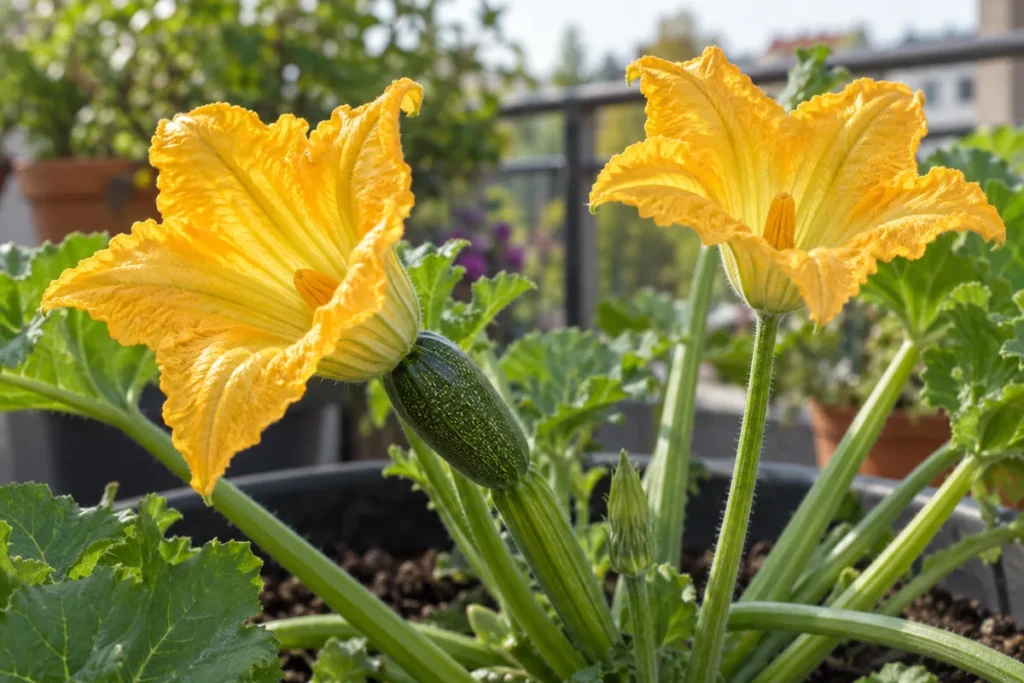
There are two real solutions, and they aren’t mutually exclusive. The first is choosing a parthenocarpic variety, one bred to set fruit without pollination at all, which sidesteps the problem entirely regardless of how many bees visit the balcony. The second is hand-pollination, which takes a couple of minutes every morning during the flowering period and works with any variety.
Parthenocarpic varieties worth looking for
Parthenocarpic varieties, ones that set fruit without any pollination at all, were originally bred for greenhouse growers who don’t have bees inside their structures, but they work just as well for a bee-scarce balcony. Clemson Cooperative Extension names Golden Glory (a yellow, zucchini-shaped squash), Dunja (dark green, nearly spineless plants), and Nocha (dark green and highly prolific) as reliable performers for home gardeners, and a Cornell University field trial separately confirmed Dunja and Golden Glory set a high percentage of fruit without any pollinator visits at all, ranking Dunja as the more efficient of the two. Other commonly available parthenocarpic names include Partenon, Cavili, and Venus. Seeds for all of these are sold by most major seed companies under their own name, not a special “container” or “balcony” label, so searching the variety name directly is the reliable way to find them.
Parthenocarpic varieties carry a second, less obvious benefit beyond skipping hand-pollination: since they don’t depend on bees to set fruit, the entire plant can be covered with a fine insect row cover for the whole season without any risk of blocking out the pollinators it would otherwise need. That single layer of physical protection is one of the more effective ways to prevent both squash vine borers and squash bugs from reaching the plant in the first place, which matters more in a small container setup where losing one plant to a pest is a bigger proportional loss than it would be in a large in-ground bed with several plants.
How to hand-pollinate a zucchini flower
UF/IFAS Extension’s guide to hand pollination lays out the identification and technique clearly. Female flowers have a swollen segment behind the bloom, the immature fruit, and a multi-lobed stigma in the center; male flowers sit on a plain, straight stem with no swelling behind them and produce a plain stamen coated in yellow pollen. Both usually open in the morning, which is the right time to check.
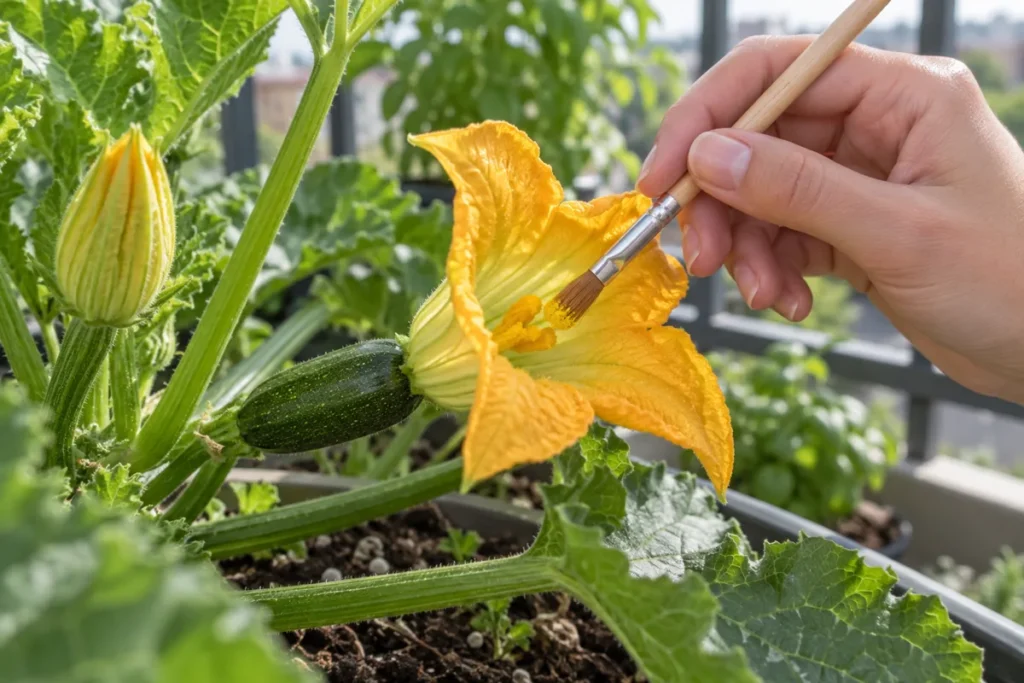
Using a small, soft-bristled paintbrush, pick up pollen from an open male flower’s stamen, then transfer it by gently brushing it onto the stigma at the center of an open female flower. Doing this for every open female flower each morning during peak flowering is enough to reliably set fruit; a plant with only a few male flowers open on a given day, or none at all yet, may need waiting a day or two before enough pollen is available. Repeating the process daily through the flowering season, rather than treating it as a one-time fix, keeps fruit set consistent as new flowers continue opening.
Starting from seed: timing and technique
University of Maryland Extension’s guidance is straightforward: sow seed directly into the container after the danger of frost has passed and the soil has warmed, which is the simplest approach for a variety that germinates quickly and doesn’t love having its roots disturbed by transplanting. Starting seeds indoors is a real alternative if the growing season is short or the goal is fruit as early as possible; sow into 3-inch pots roughly three weeks before it’s warm enough to move seedlings outside, using the same frost-date-anchored timing covered in our guide to starting seeds on a balcony.
If more than one seed is sown per spot to guard against a poor germination rate, thin down to the single strongest seedling once true leaves appear, and do it by snipping the extras off at soil level with scissors rather than pulling them, since pulling risks disturbing the roots of the seedling you’re keeping.
Succession planting for a longer harvest window
A single zucchini plant tends to decline partway through summer, whether from powdery mildew, a vine borer, or simply age, well before the growing season actually ends. University of Maryland Extension recommends starting a second planting between July 1 and July 15 for exactly this reason: a fresh, healthy plant coming into production as the first one starts to fade keeps the container productive through the back half of the season instead of going empty once the first plant gives out. On a balcony, where there’s usually only room for one zucchini container at a time, staggering a second sowing this way is a more space-efficient way to extend the harvest than trying to keep a single aging, disease-prone plant limping along.
Squash vine borer: the most serious problem to watch for
Of everything that can go wrong with a zucchini plant, this is the one worth actively watching for rather than reacting to after the fact, since it can kill an otherwise healthy plant within days once it takes hold. University of Maryland Extension describes the adult as a fat, black, clear-winged moth with orange legs and an orange-and-black abdomen, easy to mistake for a wasp at a glance, active and most visible from mid-May to mid-June, flying low around plants during the day. Females lay small, flattened brown eggs singly on stems near the base of the plant, and the larvae that hatch tunnel directly into the stem, where they feed protected from view.
The telltale sign is greenish-white, sawdust-like frass pushed out of a small entry hole near the base of the stem, often with the stem feeling soft or mushy right at that spot; a runner or the entire plant can wilt quickly once larval feeding inside the stem cuts off water flow, even though the roots below are perfectly healthy. Because container plants only have the one stem base to check, a quick look at the lower stem every few days during the mid-May to mid-June flight window catches this early, when it’s still manageable.
Prevention is far easier than treatment. A floating row cover left on until the plant starts flowering physically blocks the adult moths from ever reaching the stem to lay eggs, and this is exactly where a parthenocarpic variety has its second advantage, since a plant that doesn’t need pollinators can stay covered through the entire flight window without ever needing to be uncovered for bees. Wrapping a foil collar around the base of the stem when plants are young, extending slightly below the soil line, is a second physical barrier that works well in the confined footprint of a single container.
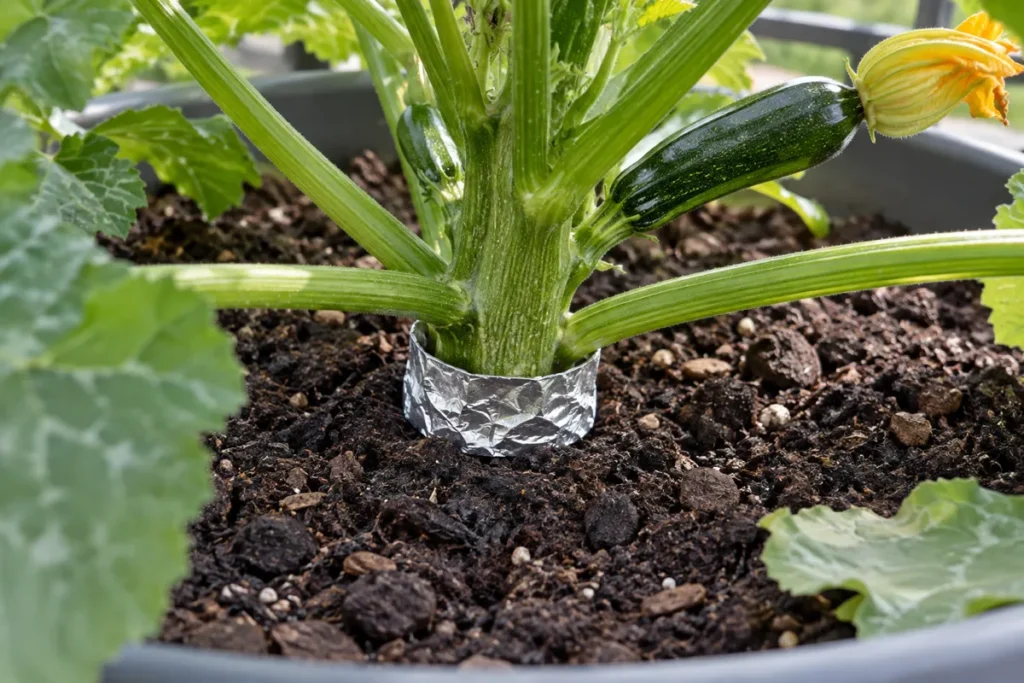
If frass and wilting already show up despite prevention, the plant isn’t necessarily lost. University of Maryland Extension’s surgical approach is to make a careful vertical slit upward from the entry hole with a razor or sharp knife, cutting about halfway through the stem, then physically removing and killing the borer found inside. Mounding moist soil over the wound afterward encourages the damaged stem to grow supplemental roots at that point, which can keep the plant alive and producing even with the original point of damage compromised.
Other problems and what they usually mean
- Lots of flowers, no fruit, or fruit that shrivels young: almost always a pollination problem on a balcony; hand-pollinate or switch to a parthenocarpic variety next season.
- Only male flowers so far: normal early in the season. Most squash plants open several rounds of male flowers before the first female flowers appear; this isn’t a problem to fix, just a timing pattern to expect.
- Powdery white coating on leaves: powdery mildew, a fungal issue that thrives in still, humid air around dense foliage. Improving airflow around the plant and avoiding wetting the leaves when watering both help; badly affected leaves can be removed without harming the plant.
Harvesting
Zucchini grows fast enough in warm weather that checking plants every day or two during peak season matters; a fruit that looks small in the morning can be oversized by the following evening. Harvesting at 6 to 8 inches long, while the skin is still glossy and easily pierced with a fingernail, gives the best texture; oversized zucchini turns watery and seedy, and letting fruit sit too long on the vine also signals the plant to slow down production of new flowers, so regular harvesting keeps the whole season more productive, not just the individual fruit better.
Quick recap
- Choose a bush or compact variety, never a standard vining type, for any container setup.
- Minimum 4 to 6 gallons and 8 to 12 inches of depth per plant, one plant per container.
- Full sun, 6 to 8 hours minimum, and frequent water checks once the plant is fruiting.
- Pollination is the balcony-specific risk. Choose a parthenocarpic variety like Dunja or Golden Glory, or plan to hand-pollinate daily through the flowering season.
- Parthenocarpic varieties also allow a full-season insect row cover, since they don’t need bee access, which helps keep vine borers and squash bugs out entirely.
- Watch the stem base for frass mid-May through mid-June, squash vine borer’s flight window; a foil collar or row cover prevents it, and an early catch can be surgically removed.
- Sow a second planting around July 1 to 15 to keep the container productive after the first plant naturally declines.
- Harvest small and often, at 6 to 8 inches, to keep the plant productive through the season.
Sources
- University of Maryland Extension: Types of Containers for Growing Vegetables
- UF/IFAS Extension (EDIS HS1149): Hand Pollination of Squash and Corn in Small Gardens
- Colorado State University Extension, GardenNotes #724: Vegetable Gardening in Containers
- Clemson Cooperative Extension: Give Parthenocarpic Squash a Try Next Year
- University of Maryland Extension: Growing Summer Squash (Zucchini) in a Home Garden
- University of Maryland Extension: Squash Vine Borer on Vegetables