More balcony plants get hurt by too much fertilizer than by too little. It’s an easy mistake to make: a plant looks a bit tired, so it seems reasonable to feed it, and if a little feeding helps, more must help more. Container plants really do need feeding more than in-ground plants, since watering steadily washes nutrients out of a small volume of soil, but the fix is a light, consistent routine, not periodic heavy doses whenever a plant looks off.
This guide covers what container plants really need, how to avoid the overfeeding mistakes that cause more visible damage than underfeeding does, and a simple routine that works across most balcony containers without a chemistry degree.
Why containers need more feeding than garden beds
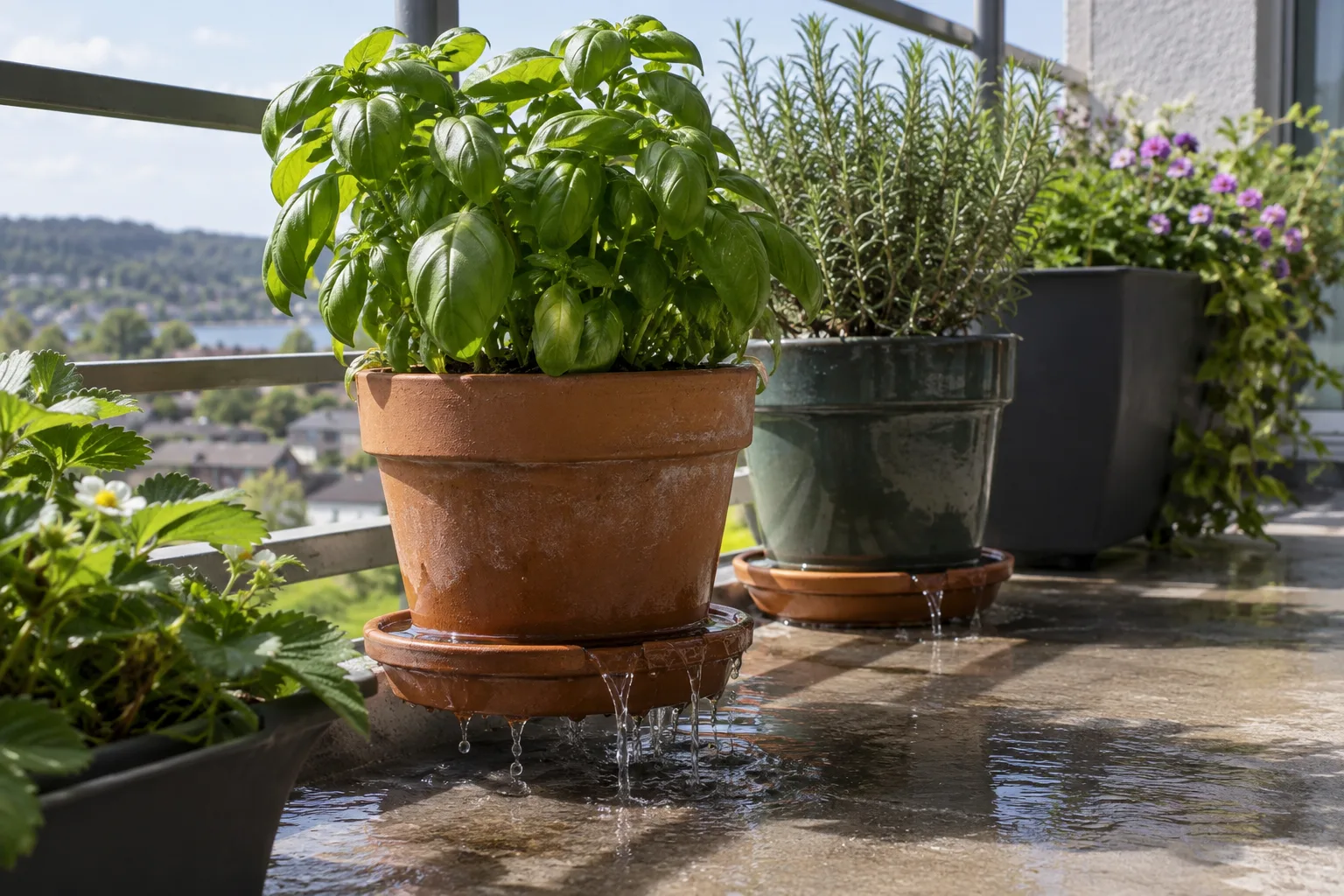
Garden soil holds a reservoir of nutrients built up over years, replenished by decomposing organic matter and a much larger volume of soil than any pot can hold. A container has none of that depth. Every time you water a pot, some nutrients wash out through the drainage holes along with the excess water, and there’s no surrounding soil to replace what’s lost. A regular, if light, fertilizing routine is how you keep a container plant’s small soil volume from running dry on nutrients partway through a full growing season.
Making sense of the three numbers on the label
Every fertilizer label carries three numbers separated by dashes, something like 10-10-10 or 5-10-5, representing the percentage of nitrogen, phosphorus, and potassium respectively. Nitrogen (the first number) drives leafy, green growth, phosphorus (the second) supports root development and flowering, and potassium (the third) supports overall plant health and stress tolerance. A balanced fertilizer with roughly equal numbers works as an all-purpose choice for most balcony containers, while a fertilizer with a higher middle number, marketed as a “bloom booster,” suits a plant you specifically want flowering or fruiting, not growing more leaves. You don’t need to memorize the chemistry, just enough to recognize why a “leafy greens” fertilizer and a “tomato and vegetable” fertilizer on the same store shelf carry different ratios for a reason.
Organic versus synthetic feed
Synthetic fertilizers deliver nutrients in a form plants can take up immediately, which makes overfeeding faster to happen but also faster to correct once you stop and flush the pot. Organic options, compost, fish emulsion, worm castings, release nutrients more gradually as soil microorganisms break them down, which makes them harder to drastically overfeed with but also slower to show a benefit after you apply them. Neither is inherently better for a balcony container; synthetic feed suits gardeners who want precise, fast control, while organic feed suits a lower-maintenance, harder-to-mess-up approach, often at the cost of a noticeable smell for a day or two after application, worth knowing before you use fish emulsion on a balcony you sit on regularly. If you’re curious which homemade options are worth the effort, our guide to homemade fertilizer for balcony plants sorts the ones backed by research from the ones that mostly aren’t.
The two main types, and which suits a balcony
Slow-release granules
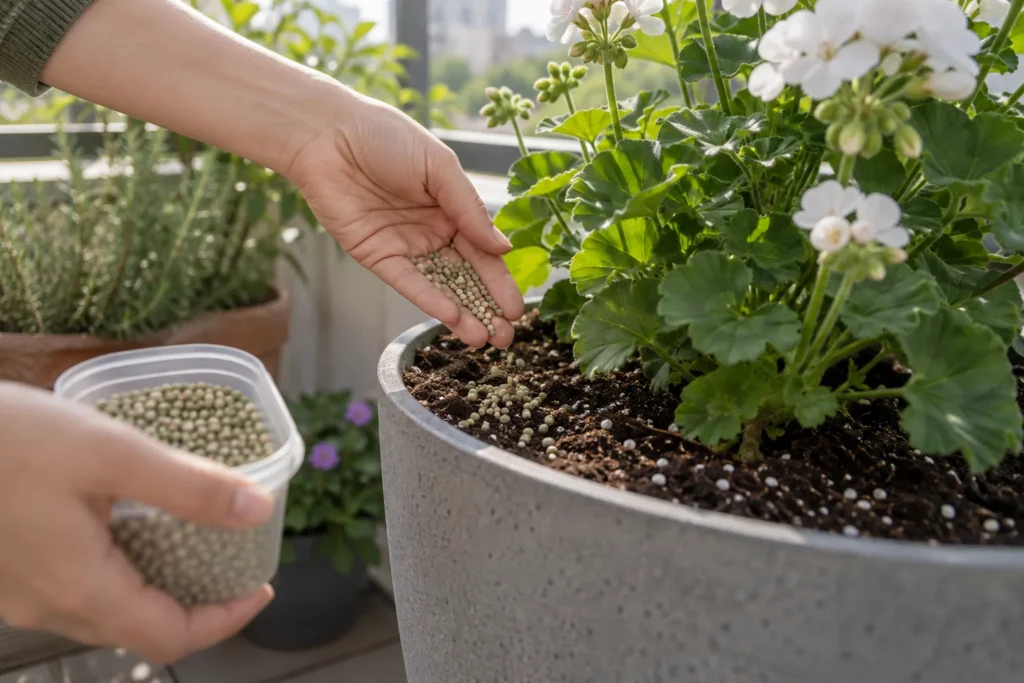
Mixed into the soil or scattered on the surface once at planting time, slow-release fertilizer breaks down gradually over weeks or months, feeding the plant a little at a time without you having to remember a schedule. This is the lower-effort option, well suited to a balcony gardener who wants to set it up once and mostly leave it alone for a stretch of the season.
Water-soluble liquid feed
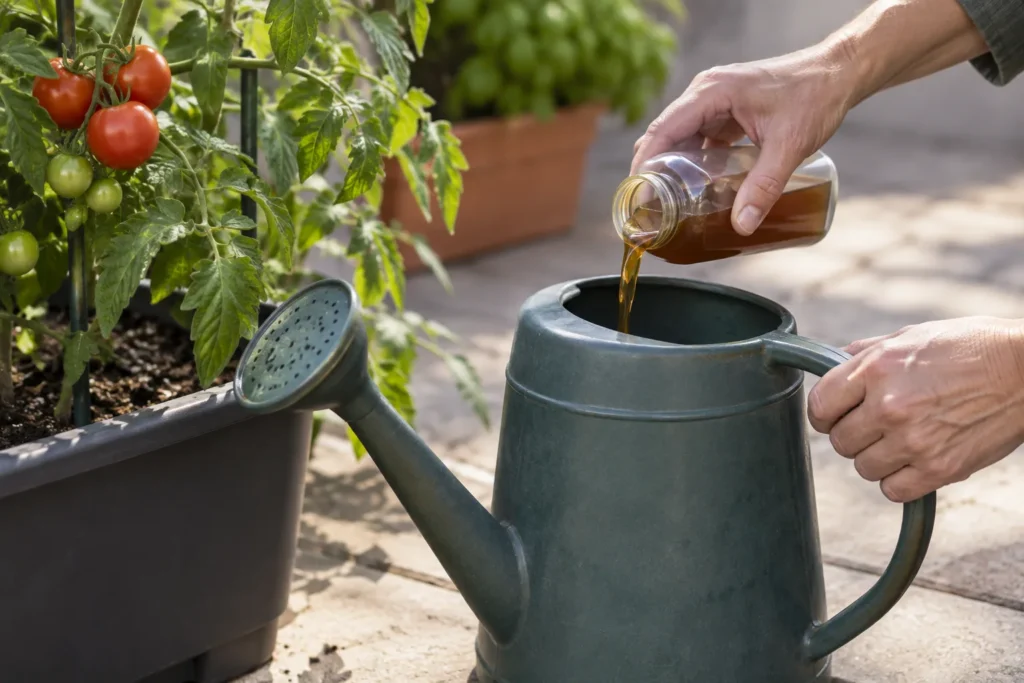
Mixed into water and applied every couple of weeks, liquid feed gives you more control, you can back off if a plant looks like it’s getting too much, or feed a bit more often during a heavy bloom or fruiting period. It takes more ongoing attention than slow-release granules, but suits heavy feeders like tomatoes and peppers that benefit from being able to adjust the schedule as the season progresses.
A simple routine that works for most containers
- Wait two to six weeks after planting before the first feeding. Fresh potting mix and nursery plants both usually come with enough built-in nutrients to cover early establishment.
- Choose one method and stick with it for the season instead of mixing slow-release and liquid feed on top of each other, which makes it easy to lose track of how much a plant has really received.
- Feed on moist soil, never bone-dry. Applying fertilizer to dry soil concentrates it right at the roots and increases the risk of burning them; water first, then feed.
- Follow label rates, or go slightly under them, instead of assuming more concentrated is better. Package rates are calculated for the plant’s benefit, not a floor to exceed.
- Watch the plant, not just the calendar. A plant putting out excessive soft, floppy growth with fewer flowers than expected is a sign to back off, regardless of what the schedule says.
Signs of overfeeding
- A white or crusty buildup on the soil surface or around drainage holes. This is usually a mineral salt residue from fertilizer, a sign the plant has been fed more than it’s using.
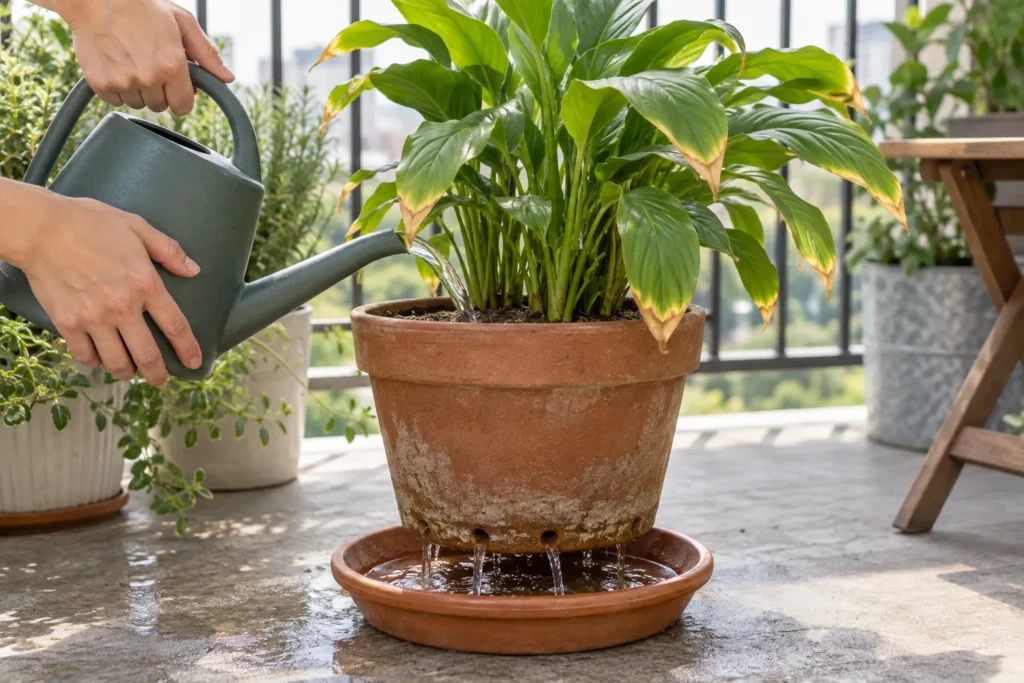
- Leaf edges that look scorched or browned despite consistent watering, a classic symptom of fertilizer burn on the roots.
- Excessive leafy growth with few or no flowers, especially common with high-nitrogen feeds applied to a flowering or fruiting plant that needs more phosphorus and potassium relative to nitrogen once it’s mature.
- Wilting that doesn’t improve with watering, since fertilizer salt buildup can genuinely make it harder for roots to take up water even when the soil is moist.
If you’ve overfed a plant
Stop feeding immediately, and flush the pot with plain water, running enough through slowly that it drains freely from the bottom several times, to wash out excess salts built up in the soil. Then hold off on any further feeding for several weeks and watch for new growth to come in looking normal, appropriately colored and not scorched at the edges, before resuming a lighter routine than whatever caused the problem in the first place. A plant that’s been overfed for a long stretch may take a few weeks to visibly recover even after the flush, so don’t expect an instant turnaround.
Adjusting for what you’re growing
Not every balcony container needs the same feeding intensity. Long-season fruiting vegetables like tomatoes, peppers, and cucumbers are heavy feeders and generally benefit from feeding roughly every two weeks throughout the growing season, covered in more detail alongside container sizing for these crops in our guide to vegetables that grow well in balcony containers. Drought-tolerant Mediterranean herbs like rosemary and thyme, by contrast, genuinely prefer lean soil and need very little supplemental feeding, over-fertilizing them tends to produce weak, floppy growth and dilutes the essential oils that give them their flavor and fragrance in the first place, the whole reason you’re growing them. Flowering annuals bred for continuous bloom, petunias and calibrachoa especially, are often heavier feeders than their compact size would suggest, since they’re putting constant, uninterrupted energy into flower production for essentially the entire season they’re alive.
Seasonal adjustments
Feeding needs track growth, not the calendar date. As days shorten heading into fall and growth naturally slows, cut back feeding frequency to match, continuing a full summer feeding schedule into a period of naturally slower growth is a common, easy-to-miss route to overfeeding without anyone ever touching the dose itself. Our guide to fall container gardening on a balcony covers this transition in more depth for containers switching over to cool-season plants.
When less feeding is really the answer
It’s worth saying plainly: a struggling balcony plant is more often underwatered, overwatered, root-bound, or simply in the wrong amount of light than it is underfed. Nutrient deficiency does happen, but it’s usually one of the last things to check, not the first, since the symptoms of a genuine nutrient problem, pale overall color, stunted uniform growth across the whole plant, are easy to confuse with several other, more common issues. Before reaching for fertilizer to fix a struggling plant, rule out watering and light first; feeding a plant that’s really dealing with a watering problem just adds a second stressor on top of the first instead of solving anything.
Common fertilizing mistakes
- Feeding a stressed plant to try to fix it. A wilting, sunburned, or newly repotted plant is usually struggling with something fertilizer can’t solve, and feeding it during that stress can compound the problem.
- Doubling up on slow-release and liquid feed without accounting for the combined dose, which stacks toward overfeeding without either application looking excessive on its own.
- Applying fertilizer to bone-dry soil instead of watering first, concentrating it right where it can burn roots.
- Feeding on a fixed weekly schedule regardless of season or plant response, instead of adjusting for slower growth, cooler weather, or visible signs of overfeeding.
- Reaching for fertilizer as the first fix for a struggling plant before ruling out watering, light, and root-bound roots, all more common culprits than a genuine nutrient deficiency.