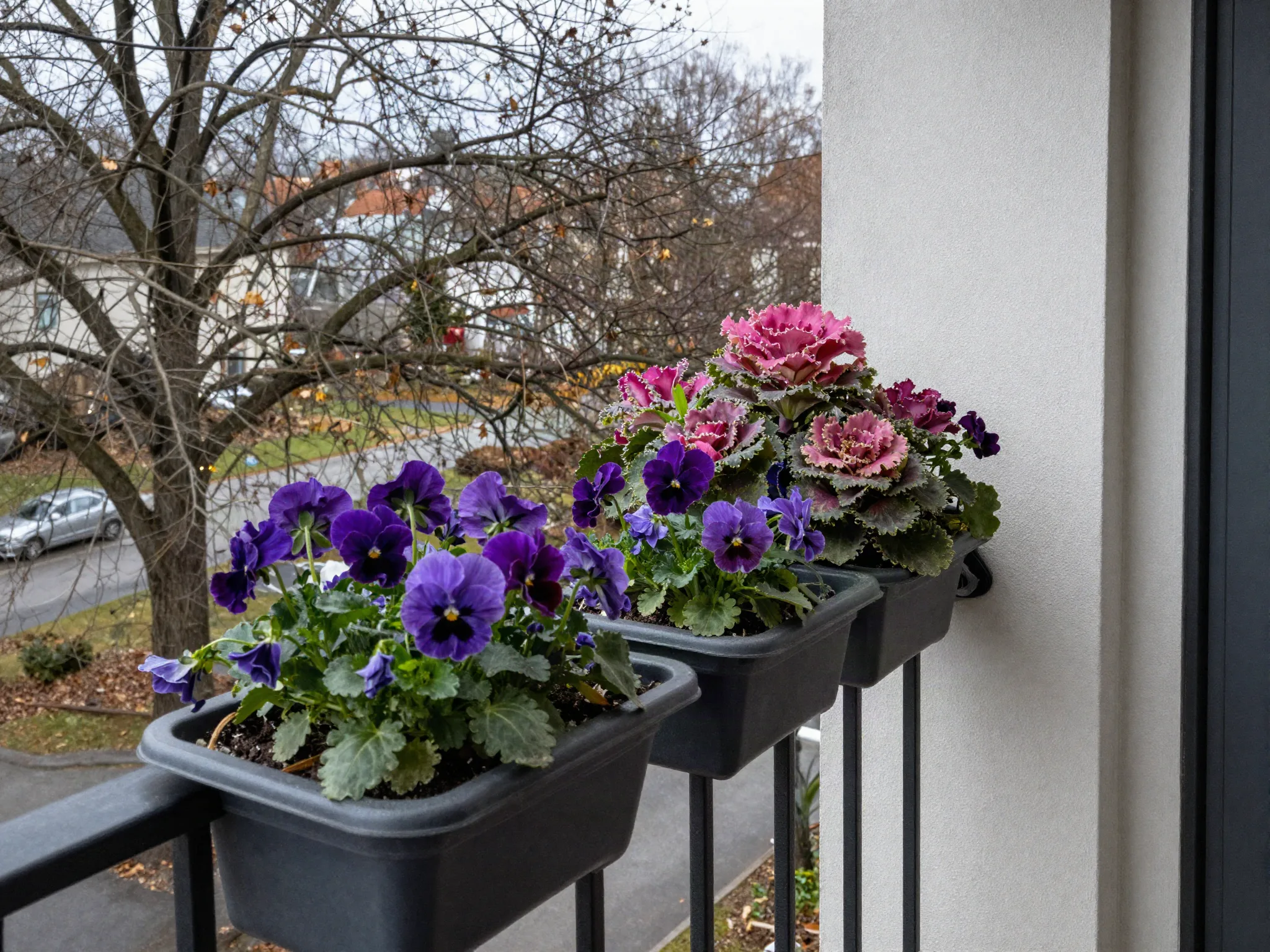
Most balconies go bare the moment the last mum drops its petals, not because nothing else can survive the cold, but because the plants that handle real cold rarely get a fair look. A handful of flowering plants keep producing color well past the point most container gardens get written off for the season, some of them into temperatures that would kill a tomato plant outright. Knowing which ones those are, and what “cold-hardy” really means in practice, is the difference between an empty balcony from November to March and one that just looks different than it did in July.
What cold-hardy actually means for a container flower
“Cold-hardy” on a plant tag covers a wide range, and the range matters more in a container than in the ground. A balcony container has no surrounding soil mass to buffer root temperature, so roots in a pot get colder faster and more completely than the same plant growing in a garden bed, even at the same air temperature. A plant rated hardy in the ground for your growing zone isn’t automatically hardy in a pot on an exposed balcony through the same winter.
The plants below are the ones that reliably take container conditions into real cold, not just a light frost, with specific temperature thresholds from university extension sources, not general marketing language. None of them need to come inside the moment the forecast mentions freezing.
Pansies and violas: the actual cold-season workhorse
If one flower belongs at the top of this list, it’s this one. Iowa State University Extension describes pansies as tolerating light freezes very well, and both pansies and violas are commonly rated cold hardy down into the mid-20s Fahrenheit without protection. That’s a meaningfully different claim than “survives a frost.” A light frost is a single cold night; the mid-20s is sustained winter weather across most of the US.
Blooming slows once temperatures drop consistently below freezing, since pansies and violas bloom best above 32°F, but the plant itself keeps going. That’s the pattern worth understanding: a dormant-looking pansy in a hard freeze isn’t dead, it’s paused, and it typically resumes flowering the next time temperatures climb back above freezing for a stretch. Keep soil moist but well-drained and feed every one to three weeks with a water-soluble fertilizer while the plant is actively blooming; established pansies in containers handle this with minimal fuss, which is most of why they show up in nearly every fall-through-winter planting recommendation.
Ornamental kale and cabbage: color that gets better with cold
Ornamental kale and cabbage aren’t technically flowers, their display is colorful foliage, not blooms, but they do the job of a cold-season flower so effectively that most container guides group them together anyway. The detail worth knowing is the opposite of how most plants behave: these get showier as it gets colder, not less. North Carolina State University Extension notes that white, pink, or red pigment in the rosettes begins developing once temperatures drop below 50°F, and once acclimated, the plants can survive down to 5°F.
That 5°F figure is well past where most flowering annuals have already given out, which makes ornamental kale and cabbage one of the few plants that can anchor a balcony container through a hard winter rather than just the shoulder seasons. The same NC State guidance suggests a practical pairing: a cabbage or kale in the center of a container, surrounded by pansies, or paired with other frost-tolerant plants like snapdragons or Swiss chard. That combination covers both ends of the cold-season display, foliage color that intensifies as winter deepens, and flowers that keep blooming on the milder days in between.
Snapdragons, sweet alyssum, and compact asters: the shoulder-season fillers
These three aren’t the plants to count on for the coldest stretch of winter, but they fill the fall and early-spring window especially well, and compact cultivars of all three are bred specifically for container use. Clemson Cooperative Extension’s guidance on fall-through-winter container gardening is direct about the pattern with snapdragons: they bloom most heavily in fall and early spring, and less during the coldest winter days, which is a useful thing to know going in, instead of discovering it as a disappointment in January.
Sweet alyssum earns its spot for a different reason: it’s a trailing plant, which most of the cold-hardy flowers on this list aren’t, and it spills attractively over a container edge in white, pink, or purple with a genuine fragrance most of the upright options don’t offer. Compact asters, bred specifically for fall container growing instead of border use, add a shot of blue, pink, purple, or white right as summer annuals are fading, and they hold their color well into the point where night temperatures are reliably below 50°F.
None of these three needs to be the whole container. Used as the transition layer between a late-summer planting and the pansy-and-kale combination above, they stretch the color further into the year without asking a single plant to do work it isn’t suited for.
What changes about container care once real cold arrives
A container exposed on all sides loses heat faster than a plant growing in the ground, which is the reason cold-hardy flowers still need a few adjustments once temperatures drop for real. Iowa State Extension recommends sizing up: use containers of 12 inches or more for winter plantings, since a larger soil mass buffers root temperature better than a small pot. Elevating containers off the balcony floor on pot feet or a brick keeps the bottom from sitting directly against cold concrete or metal, and wrapping the outside of the container in bubble wrap or burlap adds a meaningful layer of insulation on an exposed balcony where wind pulls heat away faster than still air would.
For a hard freeze beyond what a given plant tolerates, the same guidance suggests moving containers temporarily into a cool but unheated space, a garage, enclosed porch, or stairwell works, not a warm indoor room, which can shock a plant that’s adapted to cold conditions. This is a short-term move for an unusual cold snap, not a storage plan for the whole winter; plants that spend the season going in and out of a heated apartment rarely do as well as ones left to acclimate outdoors with the adjustments above.
How this fits with what else is already here
This guide is specifically about the cold-tolerant end of the flowering spectrum, plants built for temperatures the rest of the garden has already given up on. If you’re planning a fall display around mums instead, our guide to fall balcony planters with mums covers that plant in more depth; mums are reliable through most of fall but, unlike pansies and ornamental kale, typically finish blooming by the time winter sets in. If you’re further back, still arranging a container for peak summer bloom, our guide to building a balcony that keeps flowering covers choosing and combining warm-season flowers by light exposure, which is a different problem than the one this guide solves. And if the question is less about which plants to choose and more about protecting what’s already out there, our winter prep guide covers the broader checklist beyond flowering containers specifically.
Put together, a reasonable cold-season sequence looks like this: compact asters and snapdragons carry the color as summer annuals fade, pansies and violas take over as the reliable base through the coldest months, and a center planting of ornamental kale or cabbage gets more colorful exactly when everything else is at its dullest. None of it requires bringing plants indoors or starting over each time the forecast turns, which is the main advantage a cold-hardy flowering container has over the alternative of an empty balcony until spring.