A watering can on a hot afternoon is easy to remember. A watering can on a Tuesday, when nothing looks obviously thirsty yet, is the one that gets skipped. Most balcony plant deaths I see in community garden plots and in my own pots trace back to that second kind of neglect: not a heat wave, just a run of ordinary busy weeks where the pots went five or six days between drinks instead of two or three.
This list is built around that pattern. It is not the same as a hot-balcony list, because heat tolerance and drought tolerance are related but different traits. A plant can handle blazing sun and still wilt fast if its roots are shallow and its leaves are thin, and a plant can sit in a cooler, part-shade spot and still go three weeks without water because it stores moisture in thick leaves or a fleshy root. What follows are plants chosen for the second trait: the ability to forgive an inconsistent watering schedule, separate from any particular talent for heat.
Why some plants tolerate a missed watering and others don’t

Drought tolerance in container plants comes down to a handful of physical traits, and knowing them makes it much easier to spot a forgiving plant on a nursery shelf before you buy it.
Succulent leaves and stems are the most obvious one. Plants like sedum, hens and chicks, and ice plant store water directly in fleshy tissue, which functions as an internal reservoir the plant draws down between waterings. Silver, gray, or fuzzy foliage is the second trait, and it works on a different principle: according to Colorado State University’s PlantTalk program, “the silver leaves of lamb’s-ears, lavender and gray santolina reflect the drying heat of the sun so the plant doesn’t lose water from its leaves.” The pale, reflective, or hairy surface cuts down how much moisture the leaf loses to the air in the first place, instead of storing extra water to make up for losing it faster.
A third trait is a deep or extensive root system relative to the plant’s size, which lets a plant pull moisture from a larger volume of soil than its leaf area would suggest. In a container this is capped by pot size, but plants bred from dryland ancestors still make better use of the soil they have. Put together, a plant with any one of these traits, and ideally two, is a reasonable bet for a balcony where watering happens on a human schedule rather than a strict one.
Succulents and other true water-storers

These are the plants built to go the longest between waterings, because they are not just drought-resistant, they are drought-adapted.
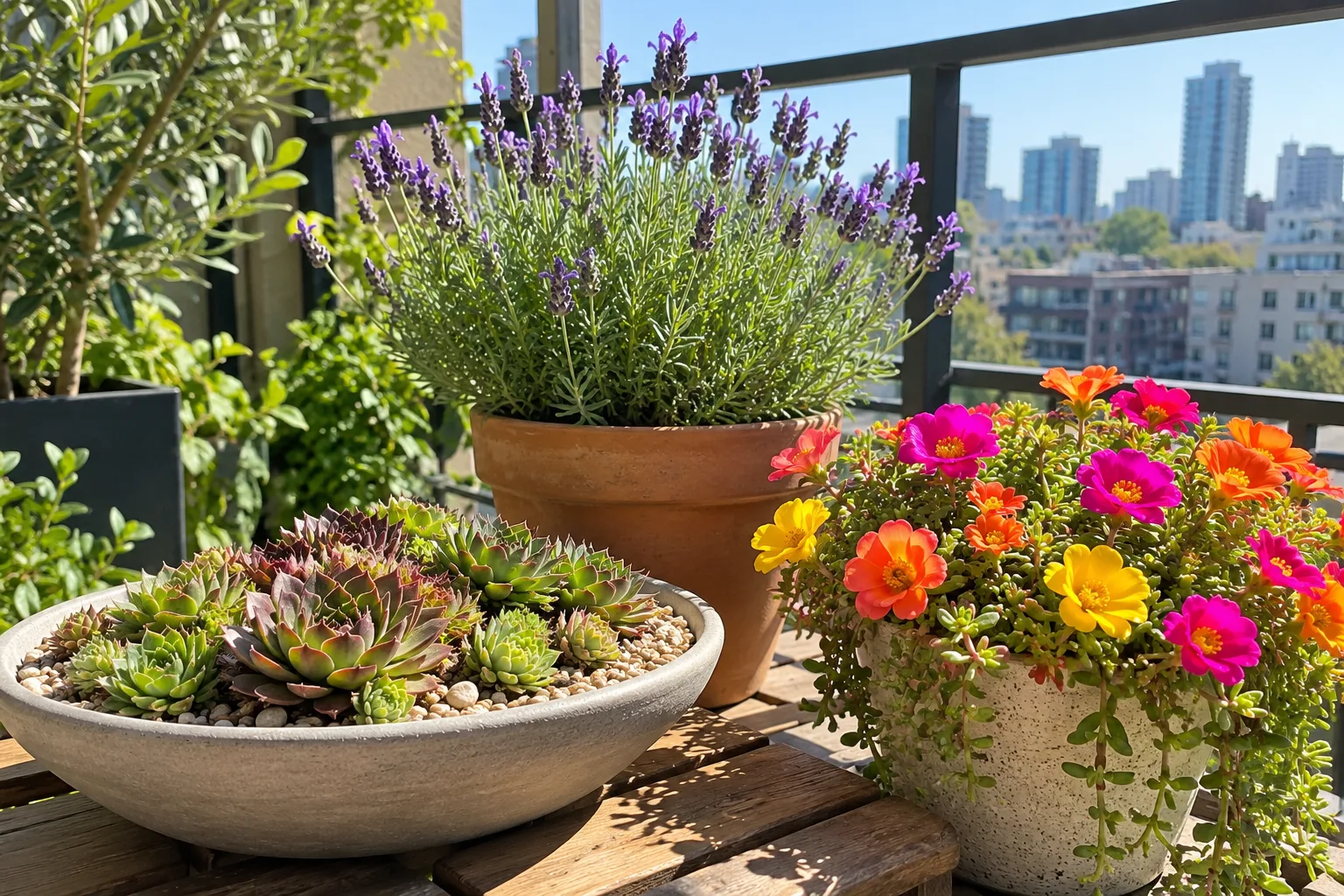
- Hens and chicks (Sempervivum tectorum). Hens and chicks form low rosettes that multiply into clusters, and NC State Extension notes the plant “thrives in sandy or gravelly soils and will tolerate poor soils and some drought,” adding that it “makes an excellent container plant.” A shallow dish 6 to 8 inches (15 to 20 cm) across suits a cluster well, since the roots stay close to the surface. Give it full sun and a gritty, fast-draining mix, and treat a missed week of watering as a non-event, not an emergency.
- Ice plant (Delosperma cooperi). This low, spreading succulent carries soft, fleshy leaves and covers itself in magenta daisy-like flowers through summer. NC State Extension describes it as “very drought tolerant” and notes it “flourishes in dry, sandy soil in full sun,” recommending it specifically for “the xeriscape landscape, rock walls or containers.” A wide, shallow pot around 10 to 12 inches (25 to 30 cm) across, planted with a mix that drains fast, lets it spread and trail slightly over the rim. The one thing it won’t forgive is standing water, so skip the saucer or empty it after rain.
- Agave and small yucca (where your climate allows winter survival outdoors, or grown as a summer annual elsewhere). Both store substantial water in thick rosette leaves and are built for soil that dries out completely between waterings. A compact agave in an 12 to 14 inch (30 to 35 cm) pot with excellent drainage can go two or three weeks without attention in cooler weather and still look better than most annuals after a single missed week.
Dryland perennials that take a casual watering schedule in stride

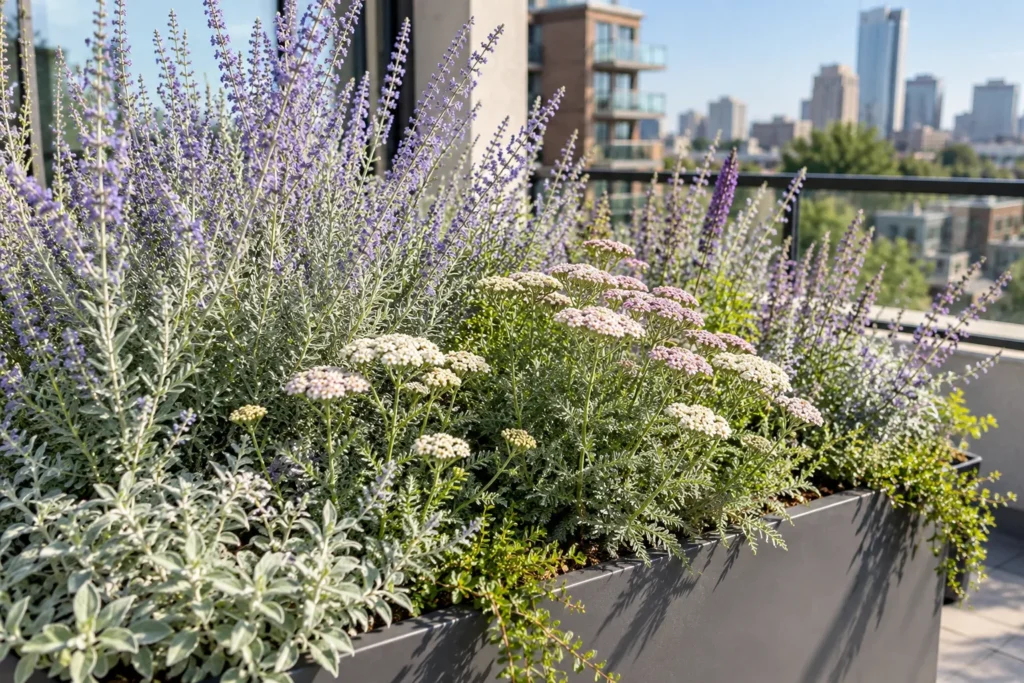
This group doesn’t store water the way succulents do, but their foliage and root habits were shaped by naturally dry climates, which makes them unusually tolerant of an irregular schedule once they’re established in a pot.
- Russian sage (Perovskia atriplicifolia, now also classified as Salvia yangii). Tall, airy, silver-gray stems with small lavender-blue flowers through summer and fall. NC State Extension lists it as preferring “full sun in well-drained, occasionally dry soil” and notes it “also performs best in dry arid conditions,” with low maintenance needs overall. It reaches 2 to 4 feet (60 to 120 cm) tall and wide, so give it a pot at least 14 inches (35 cm) across with real drainage holes, and resist the urge to keep the soil evenly moist; it does better slightly dry than slightly soggy.
- Yarrow (Achillea millefolium). Ferny, aromatic foliage topped with flat flower clusters in white, yellow, or pink depending on the variety. NC State Extension describes it as “poor soils and drought tolerant and moderately salt tolerant,” growing 1 to 3 feet (30 to 90 cm) tall in full sun and well-drained soil. It spreads by rhizomes even in a pot, so a 12 inch (30 cm) container gives it room without letting it take over a shared planting.
- English lavender (Lavandula angustifolia). The classic silver-leaved, drought-tolerant herb, and one where the foliage itself is doing the water-saving work described above. NC State Extension notes it “requires perfectly drained soil, preferably on the dry side” and lists drought tolerance among its particular strengths, adding that it “does well in containers.” The single biggest mistake with balcony lavender is treating it like a thirsty annual; keep it in a pot with generous drainage holes, go light on water, and it will outlast nearly everything else on the railing.
- Lantana (Lantana camara). Clusters of small, multicolored flowers that keep coming from late spring through frost, on a plant NC State Extension describes as tolerating “poor soil and drought” once established, tagged specifically for “drought-tolerant gardens.” It wants full sun and a pot of at least 12 to 14 inches (30 to 35 cm) to support its spreading habit. In cooler climates it’s grown as an annual; where winters stay mild it can persist for years.
Flowering annuals that keep blooming through an irregular schedule

If the perennials above feel too subdued, these annuals give brighter, more continuous color without demanding daily attention.
- Portulaca (moss rose). Succulent-leaved and ground-hugging, with papery flowers in nearly every warm color. It closes up in shade, so it only earns a spot in a sun-facing pot, but in that spot it tolerates drying out between waterings better than almost any other bedding annual.
- Calibrachoa (million bells). A trailing, petunia-like annual that covers itself in small flowers all summer. It has a fibrous, shallow root system, which means it dries out a little faster than the deep-rooted perennials above, but it tolerates that drying cycle without sulking the way a thirstier annual would.
- Gaillardia (blanket flower). Daisy-like red and yellow flowers on a plant bred from prairie and dryland wildflower stock. It holds up through a missed watering better than most bright annuals, and it keeps blooming into fall.
Setting the container up to extend the forgiveness window

Plant choice does most of the work here, but the pot and soil can stretch how long a plant goes before it actually needs you.
- Size up the pot where the plant allows it. More soil volume means more of a buffer before the root zone dries out completely. For the dryland perennials above, go a size larger than you would for a thirstier plant of the same mature size.
- Use a fast-draining, gritty mix. A standard potting mix cut with perlite, coarse sand, or small gravel drains quickly after watering, which suits these plants’ preference for dry-between-waterings conditions, and it prevents the waterlogging that kills most of them faster than drought ever would.
- Skip the saucer, or drill overflow holes if you use one. Standing water under a succulent or dryland perennial does more damage than a week of dry soil. If your setup requires a saucer to protect a floor or neighbor below, make sure it never holds water for more than an hour or two after watering.
- Mulch with gravel instead of bark. A thin layer of pea gravel or decorative stone on the soil surface cuts evaporation like organic mulch does, without holding the extra moisture against the crown of a drought-adapted plant the way bark can.
What “drought-tolerant” doesn’t mean
None of the plants above are drought-proof from the day they go into a pot. A newly planted succulent or dryland perennial still needs regular water for its first few weeks while its roots settle into the new soil; the forgiveness described in this guide applies once a plant is established, typically after its first month in the container. Treat the early weeks like you would for any new plant, and relax the schedule from there.
It’s also worth saying plainly that drought-tolerant is not the same as never needing water. Even hens and chicks and lavender die in a pot that goes bone dry for months on end, especially in a small container with little soil mass to begin with. The plants on this list buy you slack, not immunity.
Reading the signs of too little, or too much
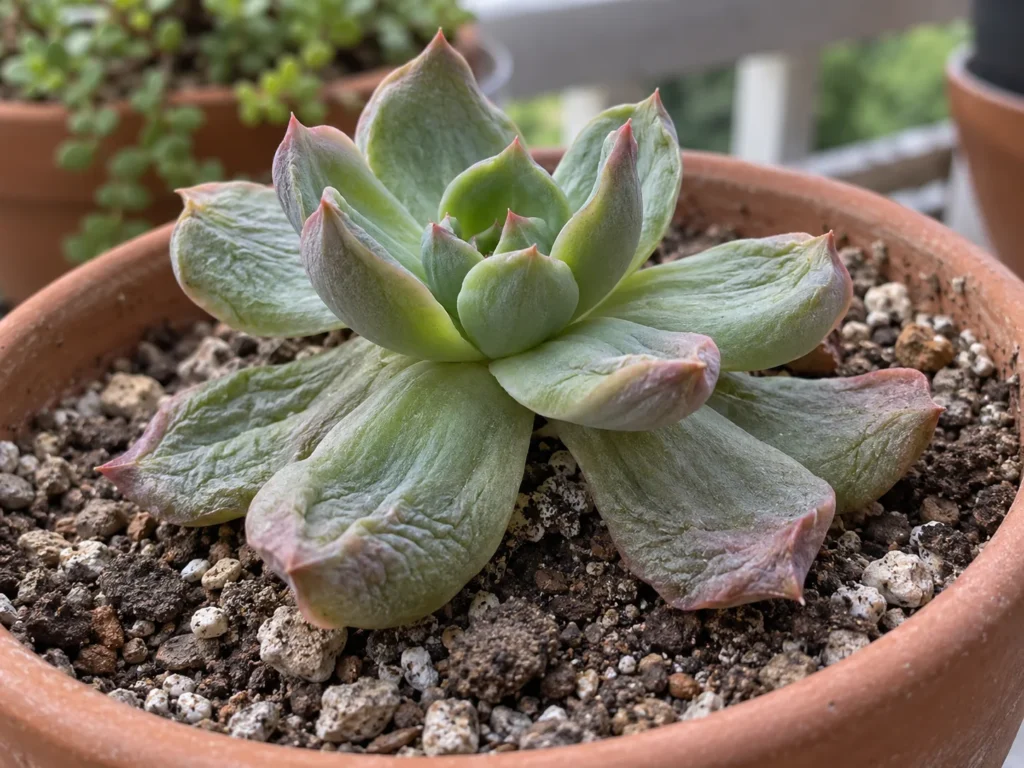

- Wrinkled, deflated succulent leaves. A sign the plant has drawn down its internal reserves and needs water now, not in another week. Water deeply and the leaves typically plump back up within a day or two.
- Soft, translucent, or yellowing succulent leaves. The opposite problem: too much water, often from a saucer that never dries out. Let the pot dry out completely before watering again, and check that drainage holes aren’t blocked.
- Lavender or Russian sage with blackened lower stems. Almost always a drainage problem, not a drought one. These plants fail much more often from wet feet than from dry ones.
- Lantana or calibrachoa dropping flowers and looking tired in a heat wave. Even tolerant plants slow down in extreme heat. A deep watering and a day out of the harshest afternoon sun usually brings them back within 24 to 48 hours.
Plants that look tough but aren’t
Part of building a low-water balcony is avoiding the plants that look like they should handle neglect but don’t. A few common mix-ups are worth naming directly.
- Ferns. The texture reads as wild and self-sufficient, but most ferns sold for containers come from moist forest floors and wilt within a day or two of drying out. They belong on a shade watering schedule, not a drought one.
- Fuchsia. The flowers look delicate, not necessarily thirsty, but fuchsia needs consistently moist soil and struggles the moment a pot dries out, on top of disliking heat. It’s a shade and part-shade plant with a watering routine closer to a vegetable than a xeriscape perennial.
- Mint and other soft-leaved herbs. Rosemary, thyme, oregano, and sage are genuinely drought-tolerant Mediterranean herbs, but mint is not in that family by habit even though it’s sold alongside them; its shallow, fibrous roots and soft leaves dry out fast, and it wants steady moisture.
- Hostas and other broad-leaved shade perennials. Big, soft leaves lose water quickly, and these plants are bred for consistently damp woodland soil. A forgotten hosta wilts dramatically within a single hot day.
The pattern across all four: thin, soft, or broad leaves lose water fast regardless of how tough the plant looks, while the succulent, silver, or needle-leaved plants earlier in this guide are built to hold onto moisture or avoid losing it in the first place. When you’re shopping and unsure, run a finger over the leaf; thick, waxy, or fuzzy usually means forgiving, thin and soft usually means it wants a more careful routine.
Mixing low-water plants in one container

A single pot with several drought-tolerant plants works better than mixing a thirsty plant in with tough ones, because every plant sharing a container is stuck on the same watering schedule whether it wants to be or not. Pair Russian sage or lavender with trailing calibrachoa or portulaca at the edge for a container that looks fuller than a single specimen while keeping the same water needs throughout. Avoid combining any of the plants on this list with fuchsia, mint, or broad-leaved shade annuals in the same pot; one half of the container will always be wrong, either drowning or dying of thirst, because their water needs don’t overlap.
Building a low-water balcony from here
Start with one dryland perennial in a well-draining pot, one succulent in a shallow dish, and one flowering annual for color, and you’ll have a working sense within a season of how much slack your specific balcony and schedule actually need. If your balcony also runs hot, our guide to plants for hot, sunny balconies covers the heat-specific side of container care, shade cloth, pot color, and watering timing, that pairs well with the drought-tolerant choices here. And if travel, not forgetfulness, is the real issue at home, how to keep balcony plants watered while you’re away covers the setups that bridge longer gaps than any plant alone can manage.
For the mechanics of why some pots dry out faster than others regardless of what’s planted in them, our science of watering container plants guide is worth reading alongside this one; it explains the soil-volume and drainage principles that make the pot choices above work the way they do.
Sources
- NC State Extension: Sempervivum tectorum (Hens and Chicks)
- NC State Extension: Delosperma cooperi (Ice Plant)
- NC State Extension: Perovskia atriplicifolia (Russian Sage)
- NC State Extension: Achillea millefolium (Yarrow)
- NC State Extension: Lavandula angustifolia (English Lavender)
- NC State Extension: Lantana camara
- Colorado State University PlantTalk: Xeriscape Plant Choices