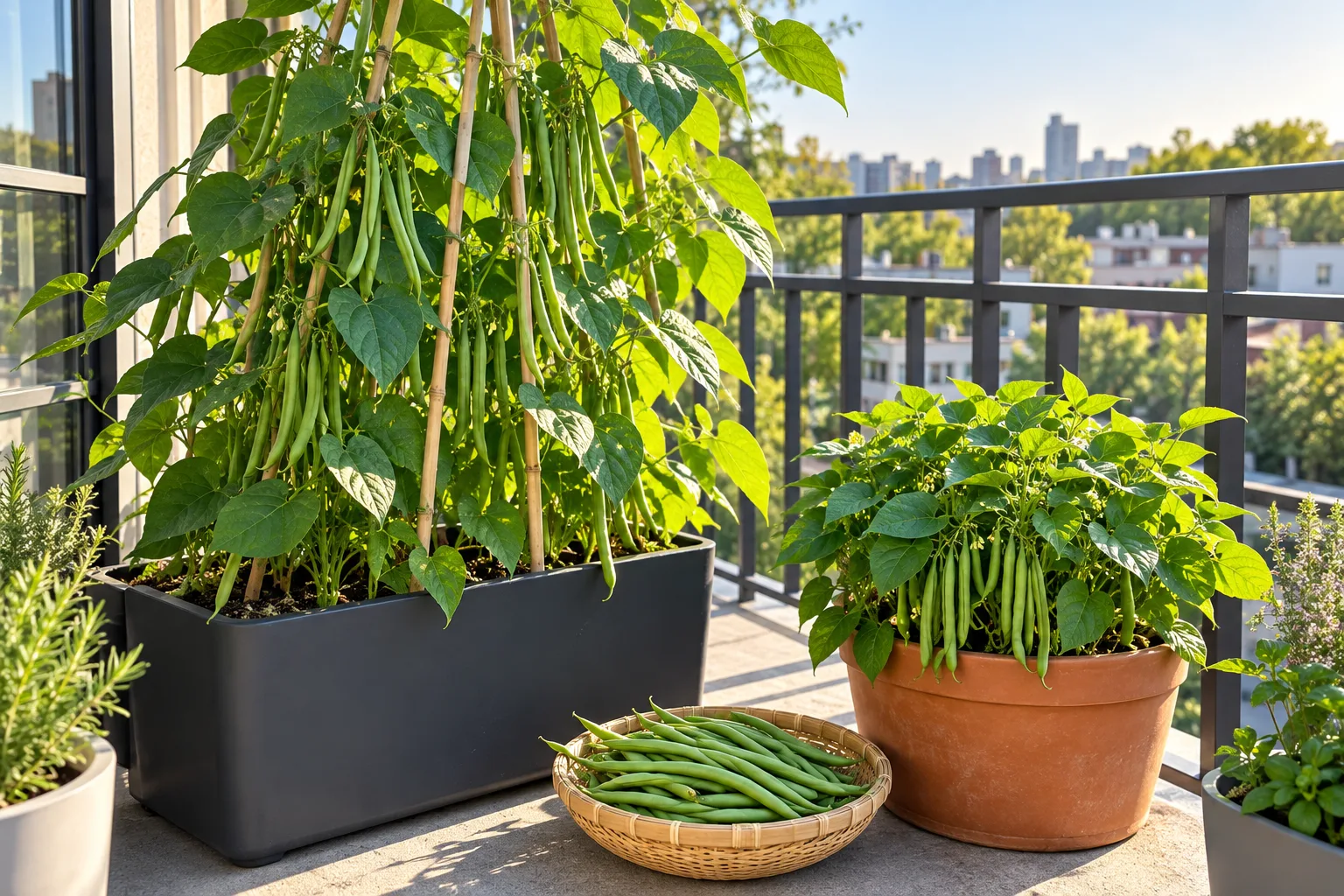
Green beans are one of the easiest vegetables to grow in a container. The choice between bush and pole beans determines nearly everything else: how much space you need, whether you need a trellis, and whether the harvest arrives all at once or continues through the season.
This guide explains which type fits a balcony, the container size each needs, how to keep the harvest going, and how to handle the pests most likely to appear on container-grown beans.
Bush or pole beans for a balcony?

Bush beans grow to about two feet tall, need no support structure, and produce their entire crop over a short window, roughly two weeks. That makes them the lower-commitment choice: plant, grow, harvest, done, with the container free again for a fall crop or something else. The tradeoff is yield per square foot. A bush plant gives you one concentrated harvest and then it’s finished.
Pole beans are vines that climb past six feet with support and keep flowering and producing beans continuously until the fall frost, as long as you keep picking. They’re more productive per square foot of container than bush beans, which matters on a balcony where floor space is the real constraint, not soil volume. The catch is that a pole bean without a trellis doesn’t grow sideways instead, it just collapses into a tangled heap that’s hard to pick from and worse to look at. If you’re not planning to install real vertical support, bush beans are the honest choice.
Bean varieties worth growing in a container

Not every variety bred for a 50-foot row performs the same way in a 2 or 5-gallon pot, so it’s worth naming a few that hold up well in containers specifically. Among bush types, ‘Provider’ tolerates cooler soil at sowing time better than most and still produces an early, reliable crop, which is useful if your balcony stays shaded into late spring. ‘Contender’ is similarly early and handles a short stretch of hot weather without stalling. ‘Blue Lake 274’ is the variety most often sold as a general-purpose snap bean, heavy yielding and consistent, and it’s a safe default if you don’t have a strong preference either way.
Among pole types, ‘Kentucky Wonder’ is the old standard, vigorous enough to cover a full trellis and productive for most of a season. ‘Fortex’ is a French filet type bred to stay tender even when the pods grow longer than average, which forgives a missed harvest day or two better than most varieties do. ‘Scarlet Runner’ is worth considering if you want the trellis itself to look good: it produces bright red flowers that draw hummingbirds, works as a living screen along a railing, and still yields edible pods, though they’re best picked young since the skin toughens quickly once the pod matures.
Days to maturity is worth checking on the seed packet too, not just the variety name. Most bush beans are ready to pick 50 to 60 days after sowing, while pole beans usually need closer to 60 to 70 days before the first pods are ready, offset by the fact that they then keep producing for weeks afterward instead of finishing in one pass. On a balcony with a short usable growing season, a faster bush variety can beat a slightly higher-yielding one that takes an extra week or two to start producing, especially if you’re planning a second crop in the same container later in the summer.
How big a container do beans need?
A 2-gallon container comfortably holds three bush bean plants. Pole beans need more room underground to support the larger plant on top: a 5-gallon container for three pole bean plants is the standard recommendation. Either way, drainage holes aren’t optional, beans planted in a container without them are at real risk of root rot after a single heavy rain.

Sow seeds about an inch deep. Wait until nighttime temperatures stay above 60°F (16°C); beans grow best in warm conditions, while cold, wet mix can cause seeds to rot before they sprout. Our container size guide covers weight and placement if you’re combining a bean container with other pots on the same railing or floor.
Container soil dries out faster than garden soil, and beans are especially sensitive to drought at one specific point: while they’re flowering and setting pods. Letting the mix go dry during that window is a common reason a plant blooms heavily but drops flowers without setting beans behind them. Check soil moisture daily once flowers appear, more often during a hot stretch, and water deeply enough that it runs from the drainage holes instead of just dampening the surface.
Set up the trellis before you plant, not after
If you’ve picked pole beans, install the support at planting time, not once the vine is already three feet of floppy growth looking for something to grab. A young bean seedling trains onto a trellis easily in its first couple of weeks; an established vine that’s already sprawled across the container and onto the floor is a genuine fight to untangle without snapping stems.

A simple teepee works well in a container: three or four tall bamboo canes or sturdy wood stakes pushed into the soil and tied together at the top. Netting stretched between two anchored points or a tall tomato cage both work too. Whatever you use, the vine will find it and start climbing on its own once it’s within reach, you don’t need to physically wind it around the support yourself.
Keeping a steady harvest instead of one big flush
Bush beans finish their whole crop in about two weeks, which is efficient but means you’re either drowning in beans for a short stretch or, more often on a small balcony, harvesting a modest amount all at once and then having nothing. Succession planting solves this: sow a new round of bush bean seeds every two to three weeks through the growing season, in a second small container if the first one’s still producing, or in the same container once it’s finished.

Pole beans don’t need this trick since they produce continuously on their own, which is why they’re the better pick if continuous harvest matters more to you than a short time commitment. If you have room for two containers, planting one of each gives you an early concentrated harvest from the bush beans while the pole beans are still getting established on their trellis, then a steady supply from the pole beans for the rest of the season.
Skip the heavy fertilizer
Beans are legumes. With the right soil bacteria, nodules on their roots can fix nitrogen, but that does not make a container self-fertilizing, and it doesn’t do much for whatever is planted in the pot next to it either; our look at the nitrogen-fixing companion myth covers why that popular claim doesn’t hold up in a shared container. A high-nitrogen feed can produce lush foliage at the expense of flowers and pods, so avoid applying it automatically. If a bean plant is thick and leafy but barely flowering, excess nitrogen is one possible cause.

Start with a quality potting mix and follow its label before adding fertilizer. If growth slows or leaves become pale, use a balanced or lower-nitrogen feed at the labelled rate rather than assuming beans need no feeding. Save high-nitrogen products for crops that clearly require them. If you’re arranging several containers, our companion planting guide explains which pairings are practical and which simply compete for light.
The pests most likely to show up on balcony beans
Mexican bean beetles are the one to watch for specifically on beans. They’re small, a quarter to a third of an inch, yellow to coppery-brown, convex like a ladybug, with eight small black spots arranged in three rows across the wing covers, easy to mistake for a beneficial ladybug at a glance, which lets them do damage before anyone notices. Both the adults and their fuzzy yellow larvae feed on the undersides of leaves, skeletonizing them. Most of the damage happens in July and August, so a very early or late-summer planting can sometimes miss the worst of it. Check the undersides of leaves weekly once plants are established, and remove beetles, larvae, and the yellow egg clusters by hand as soon as you spot them, a container-sized bean patch rarely needs anything more than that.

Aphids are the other common issue, soft-bodied, about the size of a pinhead, usually green but sometimes yellow, pink, or black, and most prevalent during cool, dry weather on young plants. A light aphid presence usually isn’t worth treating; a heavy cluster on new growth or flower buds is better knocked down with a strong spray of water or insecticidal soap than ignored, since aphids reproduce fast enough that a small problem becomes a large one within a week or two if left alone.
Bacterial blight: the disease problem beans run into

Beans are more prone to bacterial diseases than fungal ones, and the most common by far is bacterial blight, which shows up as small, water-soaked spots on leaves that enlarge into dark brown lesions ringed with a narrow yellow halo. On pods, infected spots look greasy rather than dry. It spreads fastest in warm, humid weather, and one of the main ways it moves from plant to plant is splashing water carrying bacteria from an infected leaf onto a healthy one, which is exactly what a hose or watering can aimed at the foliage does. Wind-driven rain and hail damage to the leaves can spread it too, but overhead watering is the one a balcony grower actually controls.
The fix is mostly about how you water, not what you spray. Water at the base of the plant instead of overhead, and avoid handling or picking beans while the foliage is still wet from rain or morning dew, since bruised or damaged wet leaf tissue is where the bacteria get in. If you spot blight, remove the affected leaves or the whole plant if it’s widespread, and throw the debris out instead of composting it, since that compost could end up back in a container next season. Container growing has one real advantage here: starting with fresh bagged potting mix each season means you’re not carrying the bacteria over in soil the way an in-ground bed can.
Common balcony bean problems
- A pole bean vine sprawling across the floor is a support problem; add a trellis or teepee now instead of letting it keep spreading, it’s easier to redirect a young vine than an established one.
- Beetle damage on leaf undersides, leaves looking lacy or skeletonized points to Mexican bean beetle; check weekly starting in early summer and hand-remove adults, larvae, and eggs.
- Clusters of small green or black insects on new growth are aphids; a strong water spray handles light infestations before they need anything stronger.
- Water-soaked spots turning brown with a yellow edge, or greasy spots on pods point to bacterial blight; switch to watering at the soil line immediately and remove affected foliage.
- One big harvest and then nothing is a bush bean timing issue, not a growing mistake; stagger plantings every two to three weeks, or switch to pole beans for continuous production.
When to harvest
Pick beans while the pods are firm, slim, and snap cleanly when bent, before the seeds inside bulge visibly against the pod wall. An overgrown, lumpy pod is still edible but turns tough and starchy fast. Check plants every day or two once flowering starts; beans move from ready to overgrown in just a few days during warm weather.
Use two hands to pick: one hand holds the stem steady where the pod attaches, the other pulls the pod free. A container plant has less anchorage than one growing in the ground, so yanking a pod with a single hand can loosen shallow roots or snap a stem that a garden-grown plant would simply shrug off.
Regular harvesting helps the plant keep producing. Pods left to mature signal the plant to shift energy from new flowers to seed. This matters most for pole beans: picking every day or two can keep the vine productive much longer.
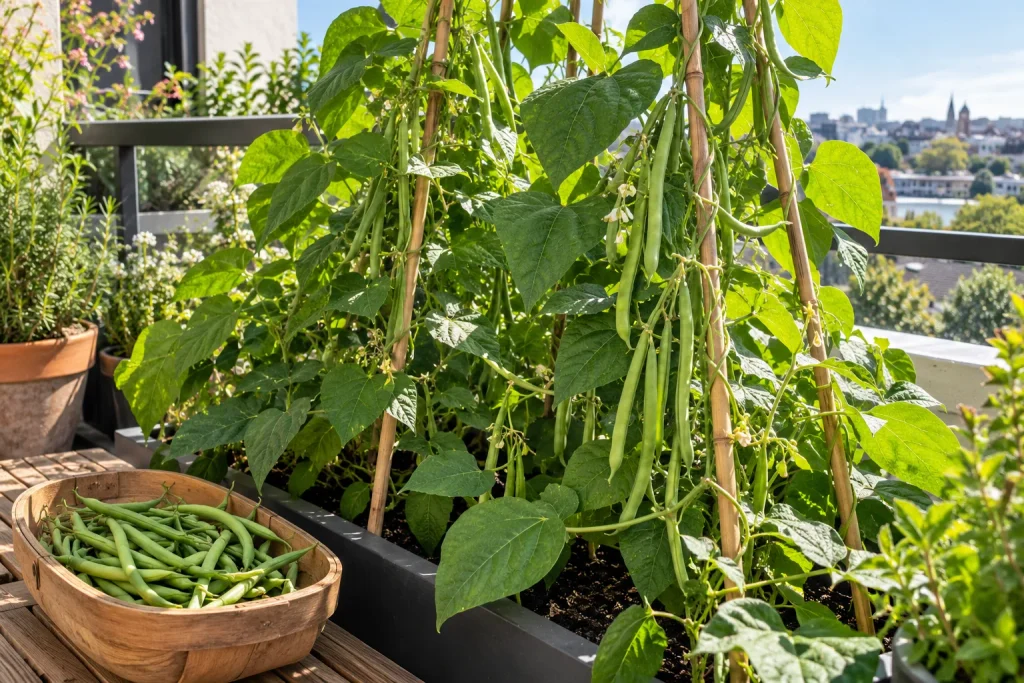
Unwashed beans keep in the refrigerator crisper drawer for about a week. For longer storage, blanch them in boiling water for two to three minutes, then plunge them into ice water before freezing; skipping the blanch and freezing raw pods gives you a mushier, less snappy bean once it’s cooked.
Good neighbors, and plants to keep a container away from
Beans share a container or a nearby pot reasonably well with cucumbers, radishes, and strawberries, none of which compete hard for the same light or root space, and radishes in particular come and go fast enough that they’re out of the way before the beans need the room. Members of the allium family, onions, garlic, leeks, and chives, are the pairing to avoid; grown immediately next to beans, alliums can suppress bean growth and vigor, so keep them in a separate container even on a crowded balcony.
Sources
- Clemson Cooperative Extension HGIC: Bush & Pole-Type Snap Beans
- Clemson Cooperative Extension HGIC: Bean & Southern Pea Insect Pests
- University of Maryland Extension: Growing Beans in a Home Garden
- West Virginia University Extension: Legumes & Nitrogen Fixation
- Colorado State University Extension: Bacterial Diseases of Beans