
You’re standing between a bag of kitchen scraps you’ve been saving and a bottle of fertilizer you bought at the garden center, and you want to know which one is better for the tomato plant wilting a little on your balcony. The honest answer is that neither wins outright. They’re good at different things, and most of the comparisons you’ll find online skip the part that matters most for a container: the mistakes that a backyard bed shrugs off can show up fast in four liters of potting mix.
This guide sorts out where store-bought fertilizer pulls ahead, where homemade inputs earn their keep, and the two questions, cost and food safety, that most “homemade vs. store-bought” articles skip over entirely.
Two different questions get bundled into one
Most comparisons treat “homemade vs. store-bought” as a single axis, but it’s really two separate decisions stacked on top of each other. The first is who made it: you, in your kitchen, or a company that bagged and labeled it. The second is what it’s made of: fast-release synthetic salts that plants can use almost immediately, or slow-release organic material that soil microbes have to break down first. A bag of store-bought blood meal and a jar of your own worm castings are both organic and both slow-release; they just came from different places. Keeping those two axes separate is the difference between a useful comparison and a confusing one, and it’s worth having straight before you read any “organic vs. synthetic” fertilizer content, since most of it is really talking about the release-speed axis, not the homemade one.
Where store-bought fertilizer has the real edge
A bag of commercial fertilizer tells you exactly what you’re getting. The three numbers on the label, something like 10-10-10 or 5-10-5, are a tested, consistent ratio of nitrogen, phosphorus, and potassium, and that number is the same in every bag from that batch. Oregon State University Extension notes that commercial fertilizers come in ratios built for a purpose, a “leafy greens” blend and a “tomato and vegetable” blend differ deliberately, and plants respond to whichever nutrients are available to them regardless of where those nutrients came from.
That consistency is the whole advantage. If a balcony tomato is nitrogen-hungry, a labeled 10-10-10 feed gives it nitrogen on a predictable schedule you can control. Nebraska Extension’s comparison of natural and synthetic fertilizers is direct about the tradeoff: synthetic products are fast-release and water-soluble, so a plant can take up what it needs within days, while organic inputs are “typically slow-release, requiring the action of soil microbes to break them down before nutrients become available for plant uptake, a process which may take days or weeks.” For a container plant that’s visibly struggling right now, days matter more than weeks.
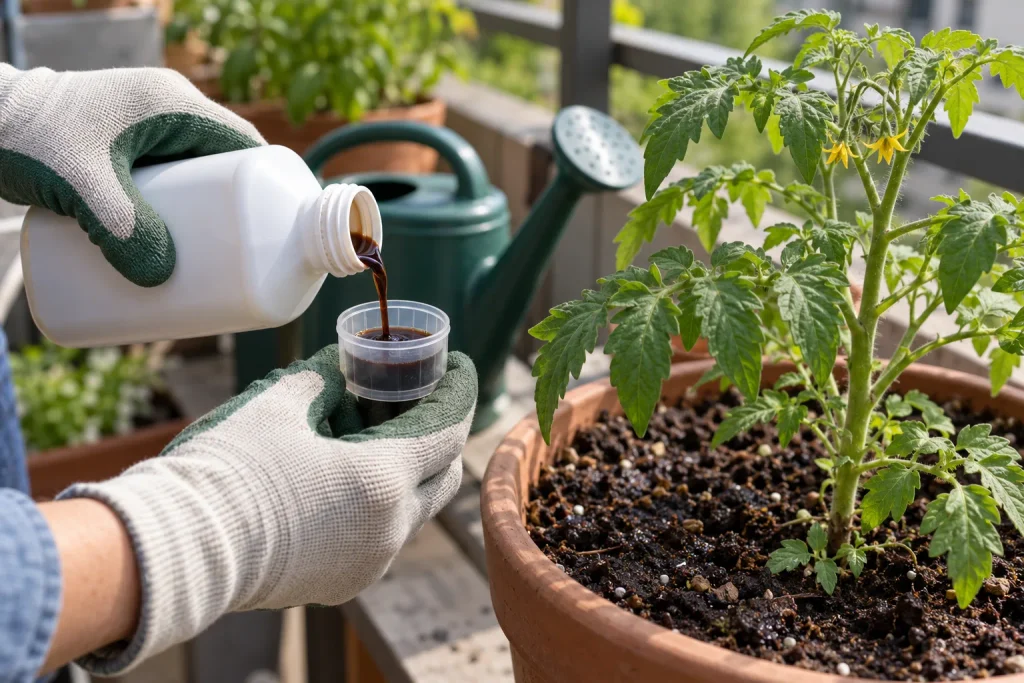
Store-bought feed also saves you the batch-to-batch guessing that homemade inputs carry. Manure, compost, and kitchen scraps vary by source, Nebraska Extension points out that the “nutrient content of manure is quite variable, based on the animal source, their age, their food source, and other factors”, so two batches of homemade compost tea made a month apart can feed a plant differently even if you followed the same recipe both times. A bagged fertilizer doesn’t have that problem. And it’s simply less effort: no steeping, straining, or waiting for anything to finish decomposing before you can use it, which matters on a balcony where storage space for a compost bin or a bucket of steeping manure tea is often the real constraint, not willingness.
Where homemade inputs earn their keep
What homemade compost and worm castings do well isn’t fast feeding, it’s building soil that holds together and drains properly over an entire growing season, something a bagged fertilizer was never designed to do. Oregon State University Extension frames this plainly: organic material is “better for building good soil and feeding the soil food web, the vast numbers of organisms that make up healthy soil.” A container that’s been topped with real compost season after season develops better structure than one running on synthetic feed alone, since synthetic fertilizer adds nutrients but does nothing for the potting mix itself.
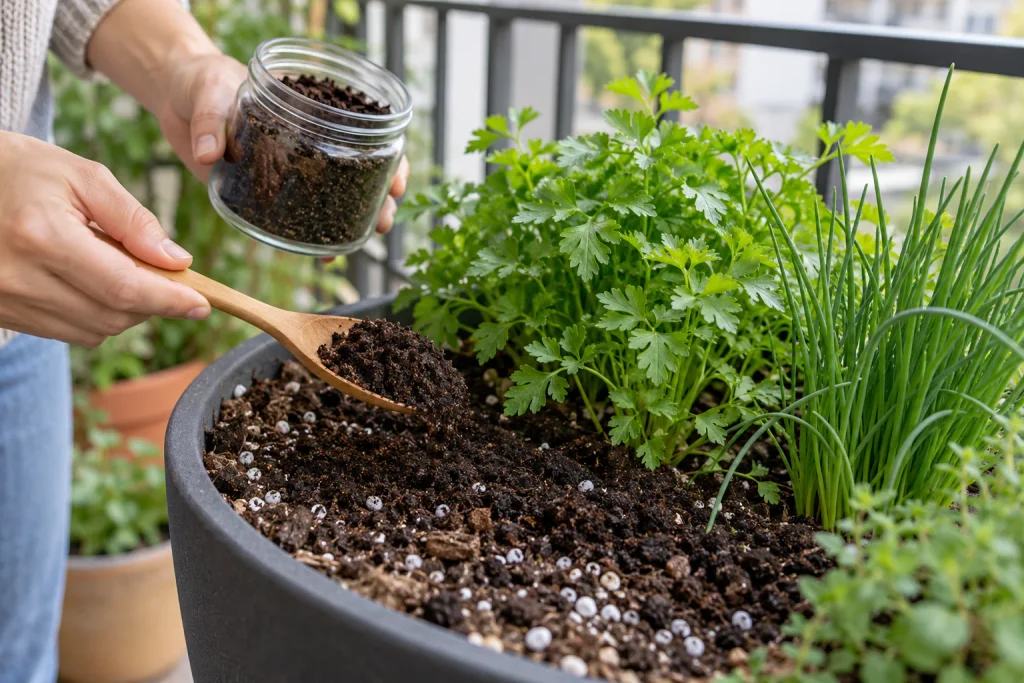
Slow release also cuts both ways in a way that favors homemade inputs when the goal is forgiveness rather than speed. Because organic material has to be broken down by soil microbes first, it’s noticeably harder to catastrophically overfeed a plant with finished compost than with a concentrated synthetic liquid feed measured out wrong. Clemson HGIC’s fertilizer guidance explains the mechanism behind fertilizer burn directly: excess fertilizer raises the salt concentration in the soil, which pulls water out of plant roots and produces drought-like symptoms, scorched leaf margins, yellowing, and dieback, even though the soil itself isn’t dry. Fast-release synthetic products are the more common cause simply because the nutrients are already in a form roots can absorb immediately, so a measuring mistake shows up faster and harder.
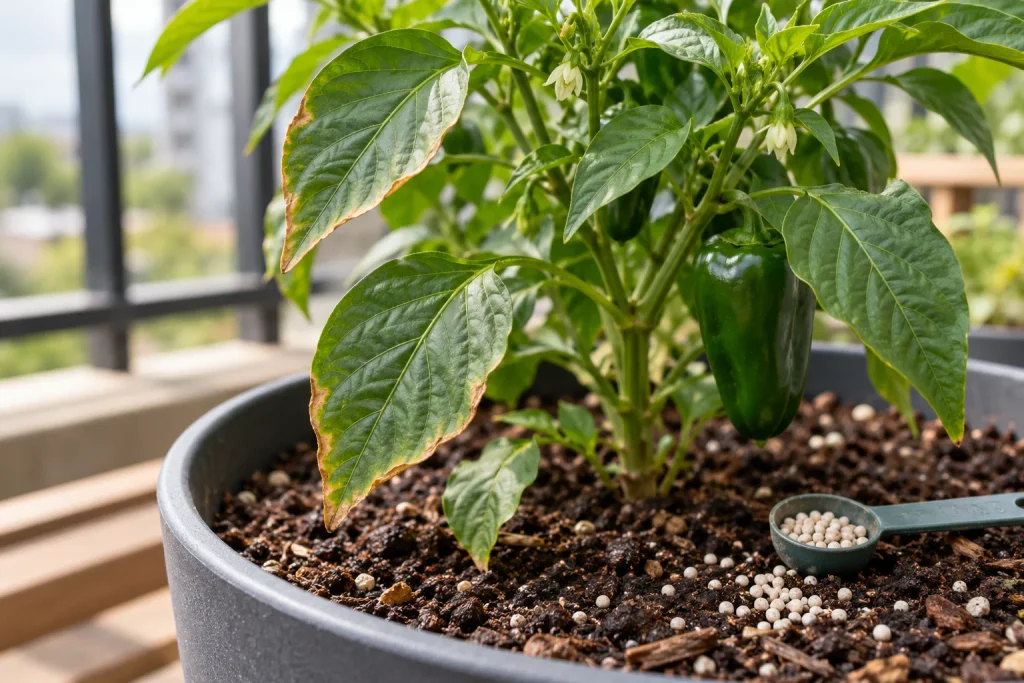
Worm castings are the most forgiving input on either side of this comparison. LSU AgCenter’s composting guidance is specific: castings “can be used fresh and will not burn plants,” and are “very mild” enough to use on sensitive plants at full strength, something you can’t say about a measured-wrong synthetic feed. That forgiveness doesn’t extend to every homemade input, though, a concentrated manure tea steeped too strong can still burn roots through the same salt mechanism, just more slowly than a synthetic product would. For the everyday mistake of eyeballing a dose instead of measuring it, finished compost and worm castings specifically are the more forgiving choice; a manure tea isn’t automatically in that same safe category. If you want the specific kitchen-scrap methods that hold up under actual testing, worth doing versus the ones that are mostly folklore, that’s covered separately in our guide to homemade fertilizer for balcony plants.
What the numbers actually look like
“Lower nutrient content” is easy to say and easy to skim past, so here’s what it means in the actual numbers on each label. A synthetic 10-10-10 is 10 percent nitrogen, available to the plant almost as soon as it’s watered in. Finished plant-based compost, by contrast, tests at roughly 1.0-0.5-1.0, University of Maryland Extension’s figure, and even that modest number overstates what a plant gets this season: the same source notes that “only 5%-10% of the N is mineralized (plant-available) in the year of application.” The rest stays locked in organic matter, released gradually over following seasons, not this one. Worm castings vary more widely, LSU AgCenter puts the range at 1-0-0 to 5-5-3 depending on what the worms were fed and how the castings were stored, so one bag of castings can be meaningfully stronger than another from a different source. Fish emulsion, the homemade liquid feed people reach for when they want faster results than compost, typically runs around 5-1-1, real nitrogen, but still half the concentration of a basic synthetic granular feed.

None of this makes homemade inputs useless, a container growing in soil built up with compost and castings over several seasons is working with better structure and a steadier nutrient reserve than one running on synthetic feed alone. But it does mean a visibly hungry plant this week needs more than a top-dressing of compost to fix it, which is exactly why our homemade fertilizer guide and our fertilizing routine guide both treat compost and castings as a supplement to measured feeding during active growth, not a replacement for it.
The cost comparison most articles skip

“Homemade is cheaper” is true in exactly one case: compost or worm castings made from scraps and worms you already have, where the only real cost is the bin or a secondhand container to keep it in. That version is close to free in practice, aside from your own time.
It stops being true the moment homemade means buying inputs specifically to make a fertilizer, fish emulsion concentrate, bagged manure, a starter culture for compost tea. Nebraska Extension’s comparison notes that organic fertilizers are “often more expensive per pound of nutrient” than synthetic ones, and that holds whether the organic product came from a store shelf or your own kitchen counter. A $20 bag of synthetic 10-10-10 can deliver more usable nitrogen per dollar than a $20 bottle of organic liquid feed, homemade or store-bought, because synthetic nutrients are concentrated and immediately available rather than locked in organic matter that still needs to break down. If cost per feeding is the deciding factor, run that math on what you’d really buy before assuming the homemade route wins by default.
Where homemade keeps its cost advantage honestly is time horizon, not price per application. Compost built from scraps you were already throwing away keeps paying off season after season as a soil amendment, long after a single bag of store-bought fertilizer is used up. It’s a different kind of return, slower, but real.
The food safety question almost nobody asks
This is the part of the comparison that balcony vegetable growers specifically need, and it’s largely absent from general lawn-and-garden fertilizer content because lawns don’t get eaten.
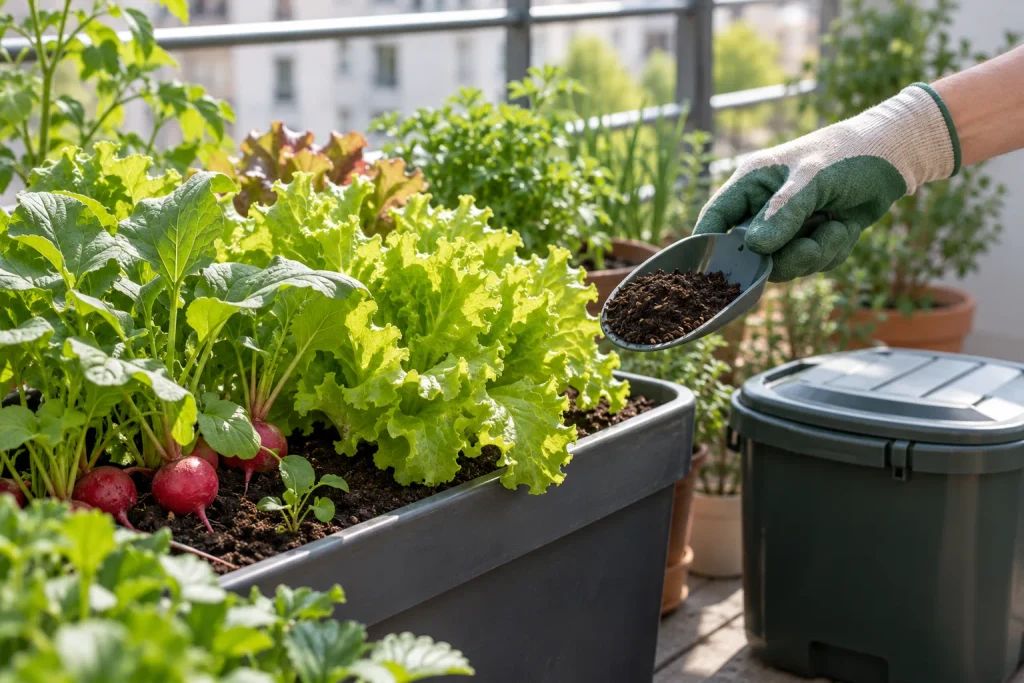
Commercial organic fertilizers made from manure go through a composting or heat-treatment process before they’re bagged, specifically to reduce the risk of pathogens like E. coli surviving into the finished product. A homemade manure tea steeped in a bucket on your balcony hasn’t necessarily gone through that process, even if it looks and smells similar to a finished compost. Nebraska Extension’s guidance on this is specific: wait at least 120 days after applying raw animal-based fertilizer before harvesting a crop whose edible part touches the soil, lettuce, radishes, carrots, and similar crops are the higher-risk category. A tomato or pepper, where the fruit grows well above the soil line, carries meaningfully less risk from the same input, but the 120-day window is the safe default whenever manure of any kind, homemade or not fully composted, goes into a container growing something you plan to eat.
Finished compost and worm castings made from plant-based kitchen scraps, no manure involved, don’t carry this specific risk the same way, which is one more reason they’re the homemade inputs worth your effort over folk remedies and manure teas improvised without a real composting process behind them.
Matching the choice to what’s in your pots
In practice, most balcony growers who stick with container vegetables for more than one season end up using both, not picking a side permanently.
- A few herbs or houseplants, low effort wanted: store-bought liquid or slow-release granules. The predictability outweighs any cost savings from a homemade routine you’d have to maintain for a handful of pots.
- Heavy feeders like tomatoes, peppers, or cucumbers through a full season: homemade compost or castings as a base amendment worked into the potting mix at planting time, plus a store-bought feed on a regular schedule once the plant is actively fruiting. Our guide to fertilizing balcony container plants covers that schedule in more detail. Compost alone releases too slowly to keep up with a tomato in peak fruit production.
- Already composting kitchen scraps for other reasons: keep doing it and blend the finished compost into potting mix at roughly a quarter of the total volume, the ratio research supports, then use store-bought feed for whichever containers are visibly hungry between compost applications.
- Growing root vegetables or leafy greens where the edible part touches the soil: skip manure-based inputs, homemade or store-bought, unless you can confirm a full composting process and the 120-day window. A plant-based compost or a labeled commercial fertilizer sidesteps the question entirely.
Neither option is the “real” or the “lazy” way to garden. A bagged fertilizer isn’t cheating, and a bucket of worm castings isn’t automatically safer or smarter just because you made it yourself. The actual decision comes down to what you’re optimizing for in that specific container: speed and precision, soil health over a season, cost per feeding, or the safety of something you’re about to eat. Most of the time the honest answer involves a bit of both.