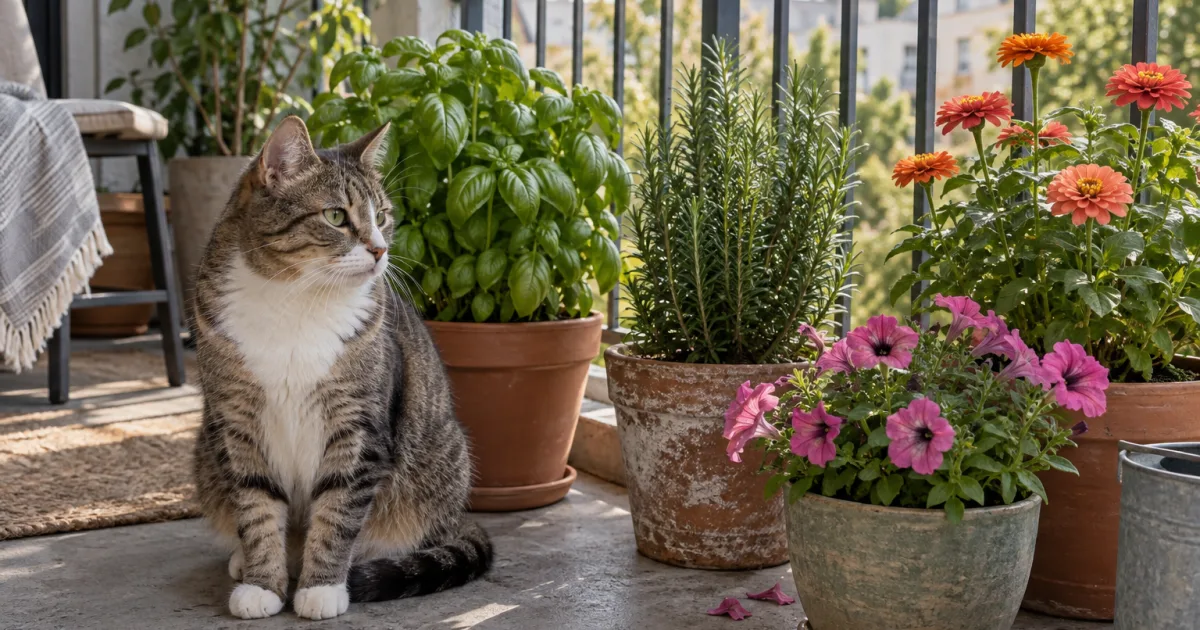
A surprising number of common balcony plants are dangerous to cats and dogs, and some of the worst offenders are the ones people reach for automatically because they look harmless: a familiar red flower from the garden center, a lily picked up for the color, a plant whose common name doesn’t hint at what’s really growing in the pot. If a cat, dog, or curious pet has access to your balcony, plant choice is a safety decision as much as a light-and-space one, and the two lists overlap less than most people expect.
This guide covers how to check a plant before you buy it, a few common balcony plants verified safe, the single most common mix-up that catches pet owners off guard, and the ornamentals worth avoiding entirely if a pet has balcony access.
How do I actually check if a plant is safe?
The ASPCA maintains a free, searchable database of toxic and non-toxic plants for dogs, cats, and horses, and it’s the standard reference for this question, not a gardening blog’s general impression or a plant tag’s marketing copy. Search by the plant’s full name, not just what’s printed on a generic nursery tag, since several unrelated plants share the same common name, and the tag rarely tells you which one you’re actually holding. If a plant isn’t in the database or you’re not fully certain of the species, treat it as unverified rather than assuming it’s fine because it looks similar to something you know is safe.
If a pet does eat part of a plant and you’re not sure whether it’s dangerous, the ASPCA Animal Poison Control Center operates a 24-hour hotline at (888) 426-4435. Don’t wait to see if symptoms develop before calling if you have any doubt about what was eaten.
A few common balcony plants verified safe
Several plants already covered on this site check out as non-toxic to both cats and dogs, according to the ASPCA database. Basil, one of the easiest herbs to grow on a balcony, is listed as non-toxic to dogs and non-toxic to cats. Rosemary, including the trailing prostrate variety often used in hanging baskets, is non-toxic to dogs, cats, and horses. Petunias, a common trailing flower for balcony rails and hanging planters, are also listed as fully non-toxic to dogs, cats, and horses, with the ASPCA’s own toxic-principles field simply reading “Non-toxic.” Zinnias, an easy, heat-tolerant annual flower, carry the same fully non-toxic classification for dogs, cats, and horses.
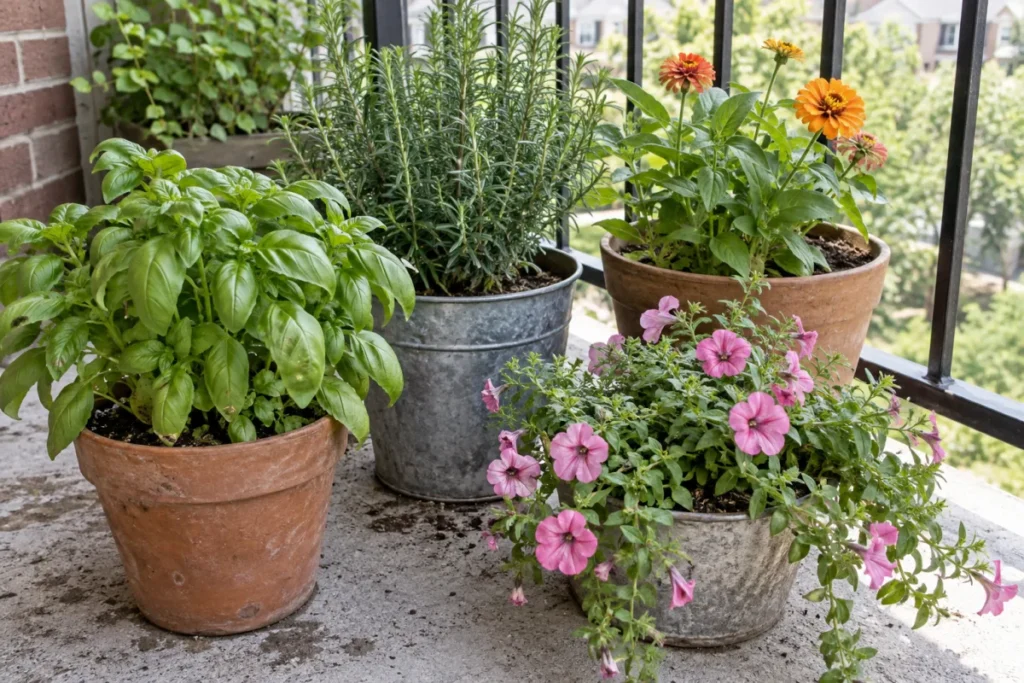
That’s a real starting list, not an exhaustive one; treat any plant not named here as unverified until you’ve checked it yourself, instead of assuming it’s safe because it’s related to or resembles something on this list.
The geranium trap (and the marigold mix-up)
Geraniums are one of the most common balcony and patio flowers sold at garden centers, and they’re also toxic. The ASPCA lists Pelargonium, the plant almost always sold under the name “geranium,” as toxic to dogs, cats, and horses, with geraniol and linalool as the toxic principles and vomiting, loss of appetite, depression, and skin irritation as the clinical signs. This is exactly the kind of mix-up that makes checking the database worth the extra minute: a plant that looks like a completely ordinary, cheerful balcony flower, sold in nearly every garden center every spring, isn’t one to have within reach of a pet.
True cranesbill geraniums, a different and less commonly sold plant, are a separate species from the Pelargonium sold as “geranium” in most nurseries; if you’re unsure which one you’re looking at, search the exact species instead of assuming the common name settles it.
“Marigold” carries its own version of this problem. Garden marigold, or pot marigold (Calendula officinalis), is listed as non-toxic to both dogs and cats. The marigolds most people buy from a seed packet, French and African marigolds (Tagetes species), aren’t the same plant despite sharing the common name, and their listing is separate from Calendula’s. Before buying “marigold” seeds or seedlings assuming they’re the Calendula variety covered here, check the Latin name on the tag or packet; it’s the one detail that reliably distinguishes them.
Plants worth avoiding entirely if a pet uses the balcony
A handful of common ornamentals are severe enough, or common enough, that they’re worth skipping outright rather than managing carefully around a pet. Lilies top that list for cat owners specifically: the ASPCA notes that cats are the only species documented to be affected, and that ingestion, of any part of the plant, including pollen, can cause vomiting, lethargy, loss of appetite, kidney failure, and death. There is no safe way to keep an Easter lily or a related true lily on a balcony a cat has access to.
- Lilies (true lilies, including Easter lilies): severely toxic to cats specifically, kidney failure and death possible from any part of the plant.
- Sago palm: one of the ASPCA’s most-searched toxic plants; every part of the plant is considered dangerous.
- Azaleas: common flowering shrub, toxic and among the ASPCA’s top-searched entries.
- Tulips: the bulb carries the highest concentration of toxic compounds, but the whole plant is listed as a concern.
- Geraniums (Pelargonium): covered above, toxic despite being an extremely common balcony flower.
None of this means a balcony with a pet has to be plant-free. It means treating plant selection the way you’d treat any other safety decision on a balcony a pet has access to, the same category of thinking already covered in our guide to choosing the right plants for your balcony: check first, then plant, not the other way around.
What about fallen leaves and petals?
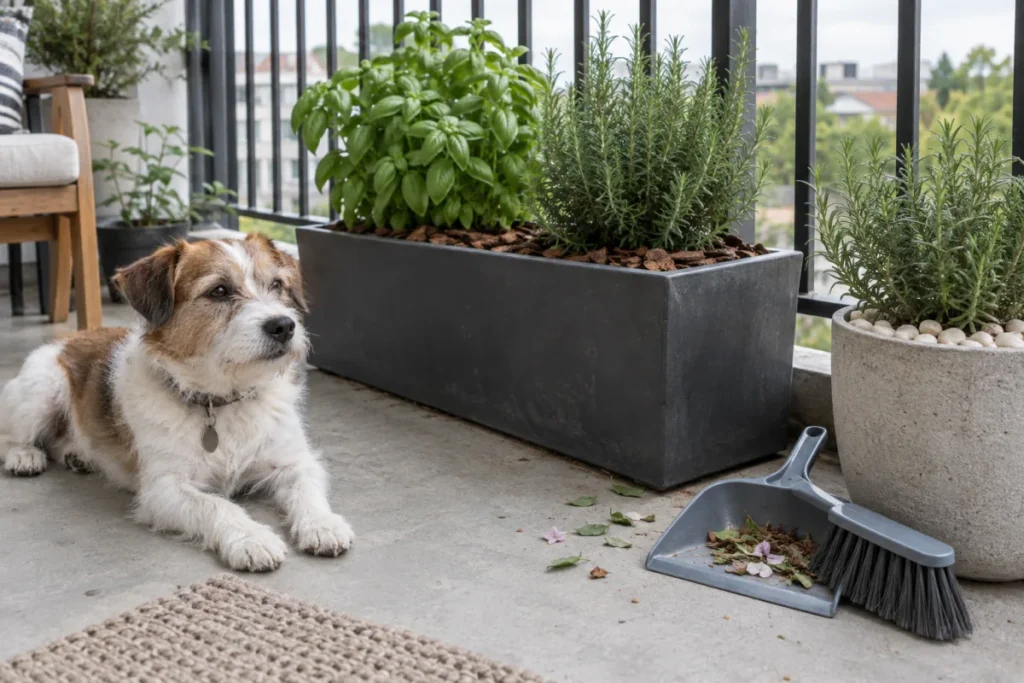
A toxic plant’s danger doesn’t stay confined to its pot. Fallen leaves, dropped petals, and anything a wind gust knocks loose onto the balcony floor are just as reachable to a curious pet as the plant itself, sometimes more so, since a dropped leaf on the ground is at exactly the height a cat or dog investigates first. Sweeping up plant debris regularly matters more on a balcony with a toxic plant than most people assume, and it’s one more reason a verified non-toxic plant is the lower-effort choice long-term, not just the safer one on day one.
The mulch in the pot can be dangerous too
Decorative cocoa bean mulch, sold as a topping for containers for its rich color and chocolate smell, is genuinely dangerous to dogs and easy to overlook, since the plant sitting on top of it might be completely safe on its own. It contains theobromine and caffeine, the same compounds that make chocolate toxic to dogs, at concentrations the ASPCA Animal Poison Control Center has measured at roughly 300 to 1,200 mg of theobromine per ounce. In cases the APCC has tracked, dogs that ate a few ounces developed vomiting and an elevated heart rate, and larger amounts led to tremors and, in rare cases, seizures. If a dog has balcony access, skip cocoa mulch and use a plain bark, straw, or stone mulch on top of containers instead. A genuinely safe alternative costs about the same, so there’s no real upside to the risk.
Why this matters more on a balcony than a yard
A pet with a full yard has room to wander past a toxic plant without much interest in it; a pet on a balcony is often confined to a much smaller space with far fewer things to investigate, and a handful of containers can end up being most of what’s there to sniff, chew, or dig into. Cats in particular sometimes chew on plant material out of simple curiosity or boredom rather than any nutritional need, which is part of why the ASPCA’s guidance treats “is a pet nearby” as reason enough to check a plant, not just a precaution for households with a known plant-eating pet. A container garden concentrates the risk instead of spreading it out, which is exactly why checking each plant individually is worth the small effort it takes.