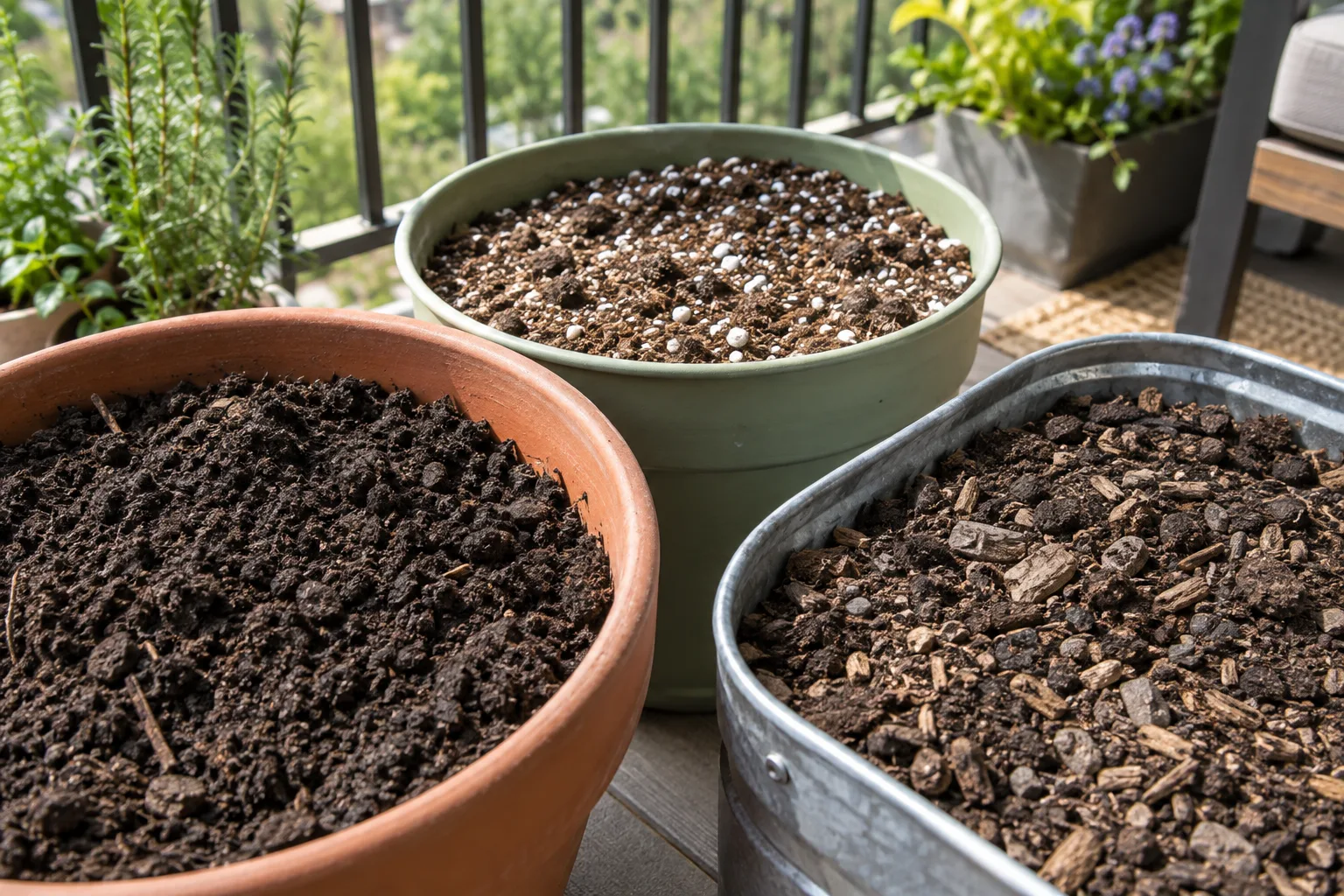
“Soil” is doing a lot of work as a catch-all word, when in practice a balcony gardener runs into at least three truly different products sold under that umbrella: garden soil dug or bagged from the ground, potting mix formulated specifically for containers, and raised bed soil blended for a middle ground between the two. Grabbing the wrong one is one of the most common, and most avoidable, reasons a balcony container underperforms from day one, regardless of how well everything else about the setup, the container, the plant choice, the placement, is handled.
Here’s what really separates them, and which one belongs in a balcony pot.
Garden soil
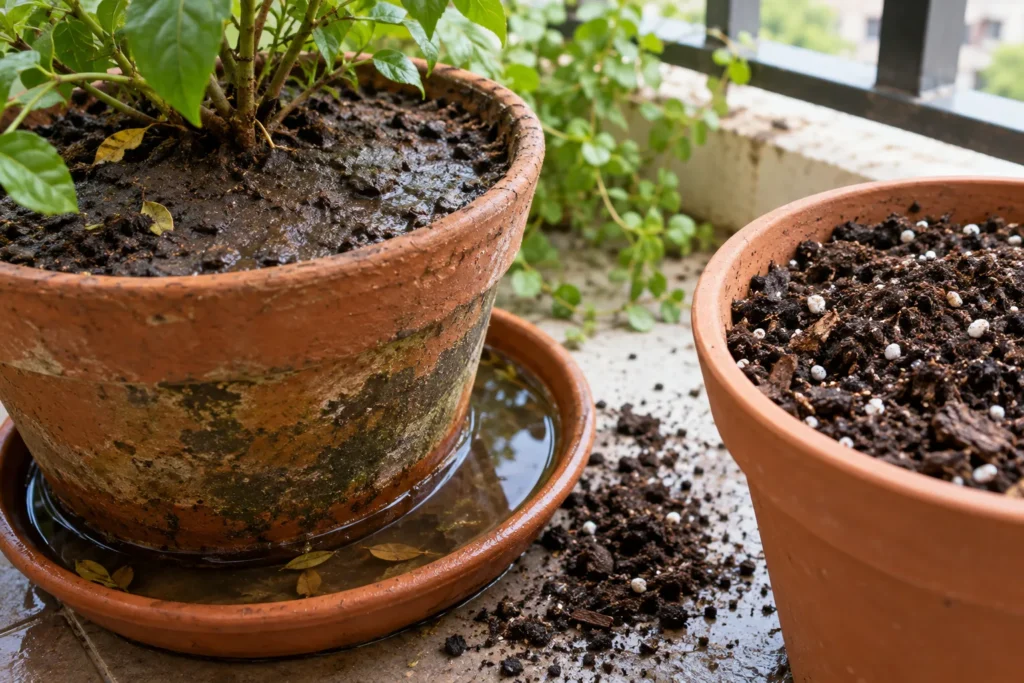
Garden soil, whether dug from the ground or bought bagged and labeled simply “soil” or “topsoil,” is dense, mineral-heavy, and built to perform in open, unconfined ground where roots can spread indefinitely and excess water drains away into the surrounding earth. Packed into a container, none of those conditions hold. The same density that helps garden soil retain structure outdoors compacts hard in a pot, squeezing out the air pockets roots need and holding water long after the surface looks dry, a combination that suffocates and eventually rots roots in confined conditions. It’s also, pound for pound, the heaviest of the three options by a wide margin, a real consideration for anything you’re carrying up stairs or worried about on a weight-limited balcony floor. On top of the drainage and weight problems, unpasteurized garden soil can carry weed seeds, insect eggs, and soil-borne diseases that a sterile bagged mix doesn’t.
Potting mix
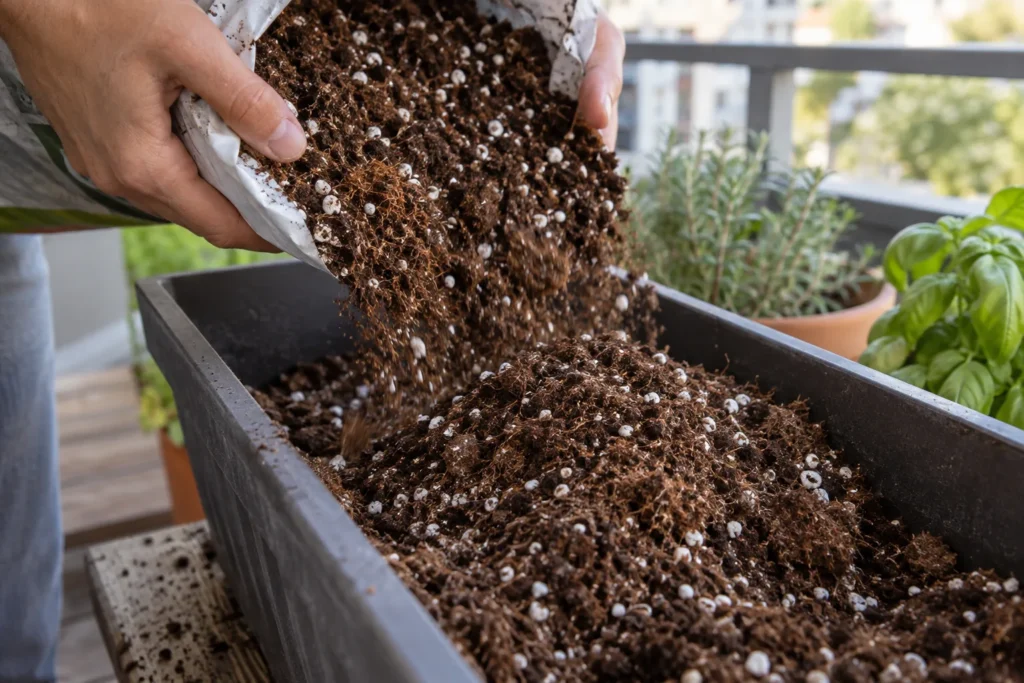
Potting mix isn’t soil at all in the traditional sense, it’s a soilless blend, typically built from peat moss or coconut coir, perlite or vermiculite, and some compost, engineered specifically to solve the problems garden soil creates in a container. It stays light and full of air pockets even when packed into a small pot, drains freely so excess water genuinely leaves through the drainage holes instead of pooling around the roots, and comes sterilized, free of the weed seeds and pathogens that can hitch a ride in garden soil. This is the default, correct choice for the overwhelming majority of balcony containers, herbs, vegetables, flowers, and most houseplants moved outside for the season all do well in a standard bagged potting mix.
Raised bed soil
Raised bed soil sits in between the other two: a blend of topsoil, compost, and sometimes a smaller portion of the same lightweight amendments found in potting mix, formulated for a raised garden bed’s deeper, larger volume, not a small, fully enclosed pot. It holds more nutrients and structure over a long season than potting mix alone, which suits a raised bed’s typically longer-term planting, but it’s also heavier and drains somewhat slower than pure potting mix, characteristics that matter less in a large raised bed with real depth than they do in a small balcony container. If your balcony setup includes a real raised bed instead of individual pots, this is the right product; for standard pots and containers, it’s a heavier, less ideal substitute for potting mix, not an upgrade.
Side-by-side comparison
| Garden soil | Potting mix | Raised bed soil | |
|---|---|---|---|
| Drainage in a pot | Poor | Excellent | Good |
| Weight | Heaviest | Lightest | Medium |
| Sterility | Not sterile | Sterile | Usually sterile |
| Nutrient longevity | Good outdoors, poor in pots | Depletes faster, needs feeding | Holds nutrients longer |
| Best use | Open ground only | Pots and containers | Raised beds |
Why the drainage difference matters so much
Drainage isn’t a minor technical detail, it’s close to the whole story of why the wrong soil kills container plants. Roots need oxygen as much as they need water, and they get it from air pockets in the soil around them. Dense garden soil packed into a container collapses those air pockets, and water that can’t drain away sits in the space where air should be, effectively drowning the roots from the outside in. This is why a plant in garden soil can show symptoms that look identical to overwatering, wilting, yellowing, root rot, even when you’re watering it exactly the same amount you’d give the same plant in proper potting mix. The soil, not the watering habit, is often the actual problem.
The nutrient tradeoff nobody mentions
Potting mix’s biggest advantage, that it drains fast and doesn’t compact, comes with a real tradeoff: it also doesn’t hold onto nutrients as long as denser soil does, since the same free-draining structure that moves excess water out of the pot also carries dissolved nutrients out right along with it, every single time you water. That’s not a flaw so much as a design decision, but it does mean a container in pure potting mix needs a more consistent feeding routine than the same plant would in a nutrient-dense raised bed or garden soil. If you haven’t set up a fertilizing routine to match, see our guide to fertilizing balcony container plants, since the soil and the feeding schedule are really two halves of the same decision.
The pH question hiding underneath all of this
Soil type and pH get treated as separate topics, but they’re connected in a way that matters for containers specifically. University of Arkansas Division of Agriculture Extension research on container growing media puts a number on it: most modern potting mixes lean heavily on peat and bark, both naturally acidic components, and getting a mix into the generally desirable 5.0 to 6.5 pH range for container plants is enough of a challenge that manufacturers routinely add lime before the bag ever reaches a store shelf. That pre-liming is why a standard bagged potting mix works for most plants straight out of the bag without any pH adjustment on your part.
It’s still worth knowing when pH becomes the actual problem instead of watering or feeding. The same research notes that once a mix’s pH drops below about 5.0, zinc and manganese become dramatically more available to the plant, often to the point of causing foliar toxicity, which can look confusingly similar to a nutrient deficiency even though the underlying cause is the opposite: too much of certain nutrients being absorbed, not too little. On the acid-loving end, plants like blueberries and azaleas specifically want a more acidic mix, in the 5.0 to 5.5 range, than a standard all-purpose potting mix provides, which is why a container blueberry benefits from a dedicated acid-loving-plant mix rather than the same bag used for the rest of the balcony. If a plant is showing deficiency-like symptoms despite correct watering and a normal feeding schedule, a cheap pH test strip in moistened mix is worth checking before assuming the fertilizer itself needs to change, since the wrong pH can lock nutrients out of reach regardless of how much you’re feeding.
What if you already have garden soil on hand
If a bag of garden soil is what you’ve got and buying potting mix isn’t an option right now, blending it instead of using it straight helps, though it’s still a compromise. Mixing garden soil roughly half and half with perlite, coarse sand, or compost improves drainage and reduces compaction somewhat compared to using it alone, but it won’t fully replicate what a purpose-built potting mix does, and it’s still heavier and less sterile than the real thing. Treat this as a temporary stopgap for one season, not a genuine long-term strategy for any container you’re planning to keep productive for several years running.
Specialty mixes worth knowing about
- Cactus and succulent mix. An even faster-draining variant of standard potting mix, with extra sand or grit, suited to plants that specifically dislike consistently moist soil.
- Seed-starting mix. Finer-textured and lower in nutrients than standard potting mix, formulated for delicate new seedlings, not established plants.
- Moisture-control potting mix. Standard potting mix with added water-retaining crystals or polymers, useful for a hot, windy balcony where pots dry out unusually fast, though it can work against you on a plant that specifically prefers drier conditions.
Matching the mix to what you’re growing
Standard potting mix works as a genuine default across most balcony plants, but a few categories benefit from a small adjustment on top of it.
- Vegetables and heavy feeders. A potting mix with compost already blended in, or one labeled specifically for vegetables, gives these plants a stronger nutrient starting point than a bare, low-nutrient mix, since they’ll be drawing on that nutrient reserve heavily for essentially the entire growing season.
- Herbs, especially Mediterranean ones. Rosemary, thyme, and lavender genuinely prefer leaner, faster-draining conditions than a nutrient-rich mix provides; blending in extra perlite or sand, or using a cactus-and-succulent mix, suits them better than a standard vegetable-oriented blend.
- Long-term perennials. A plant that’s staying in the same container for years benefits from a mix with a bit more structure and organic matter than a mix designed for one fast-growing season, closer to what a raised bed soil offers, since it needs to hold up physically over a much longer stretch without fully breaking down and compacting the way a one-season mix eventually does.
- Succulents and drought-tolerant plants. These specifically want the fastest-draining option available; standard potting mix retains more moisture than these plants prefer, and a dedicated cactus mix is worth the small extra cost for any drought-tolerant plant in this category.
Reusing soil from a previous season
Potting mix breaks down over a season or two of watering and root growth, the organic components decompose, the structure compacts, and whatever nutrients it started with are long depleted. Reusing old mix outright for a new planting tends to produce weaker growth than starting fresh, but throwing it out and buying entirely new mix every single season isn’t necessary either. Mixing roughly equal parts old mix and fresh new mix, with a handful of compost stirred in, refreshes a container’s soil without the full cost and waste of a complete replacement. Reserve a full soil replacement for a container that’s had a genuine disease or pest problem, where reusing the old mix risks carrying that same problem straight into the next planting.
The bottom line
For the overwhelming majority of balcony pots and containers, standard bagged potting mix is the right default, and garden soil straight from the ground or an unamended bag is the one option worth actively avoiding. Once the soil question is settled, the container itself is the next decision worth getting right; our guide to choosing balcony pots and containers covers material and drainage-hole requirements that pair with whatever soil you land on here.