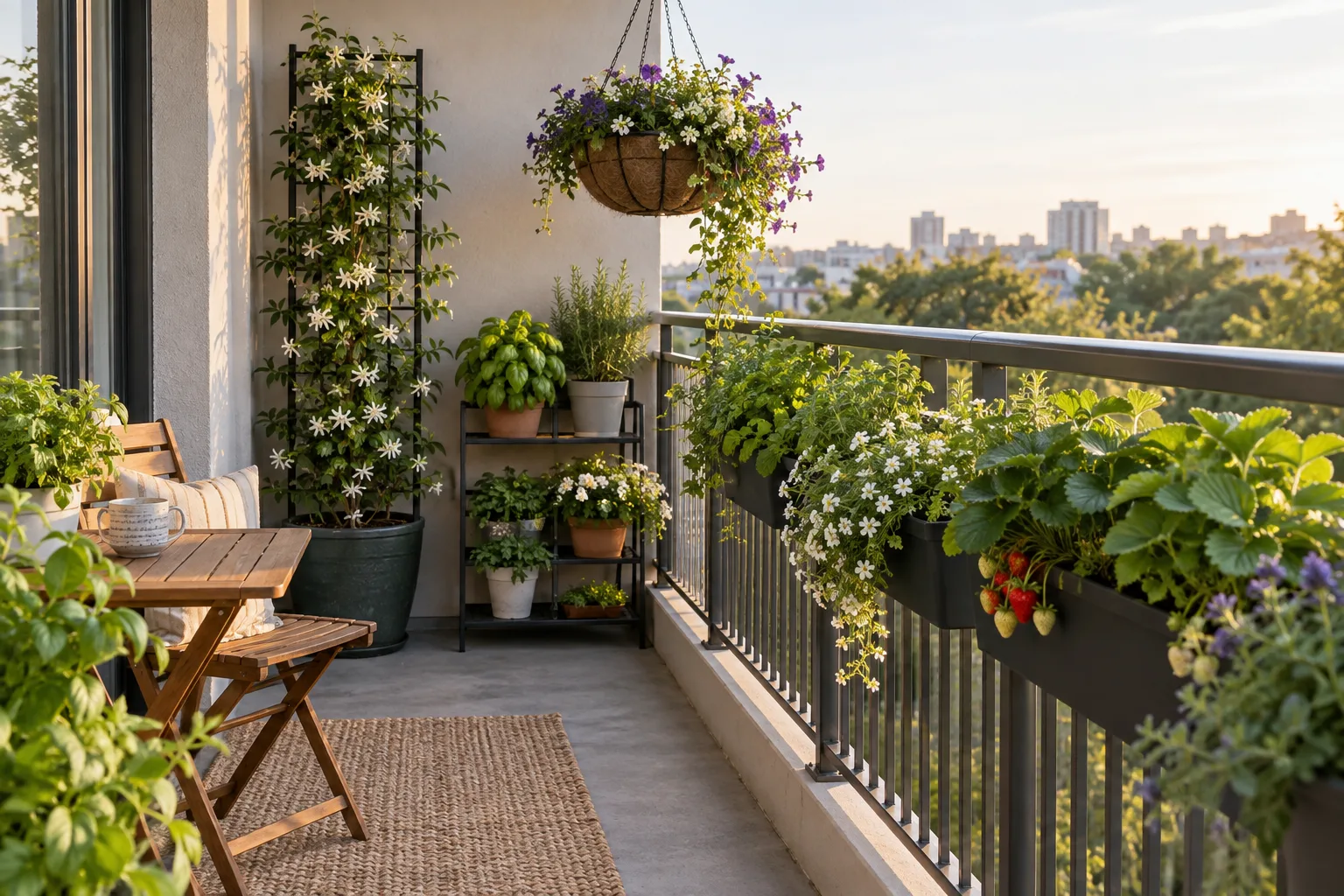
A small balcony has more growing space than it looks like, once you stop thinking only about the floor. Railings, walls, and the air above your existing pots can all hold plants if you use the right hardware. Vertical gardening turns a cramped 6-by-4-foot balcony into room for herbs, strawberries, trailing flowers, and even a few vining vegetables, without crowding the space you still need for a chair and your morning coffee.
This guide covers the main ways to grow up instead of out, what each method suits, and the weight and safety details that matter most when your “ground” is a railing several floors up.
Quick answer: Railing planters, hanging baskets, tiered plant stands, and wall-mounted pocket planters are the four easiest ways to garden vertically on a balcony. Herbs, strawberries, trailing flowers like petunias, and vining vegetables such as small cucumbers or peas on a trellis are all happier climbing up than sprawling out. Always confirm railing hardware is rated for the planter’s full watered weight, and hang nothing directly over a walkway below.
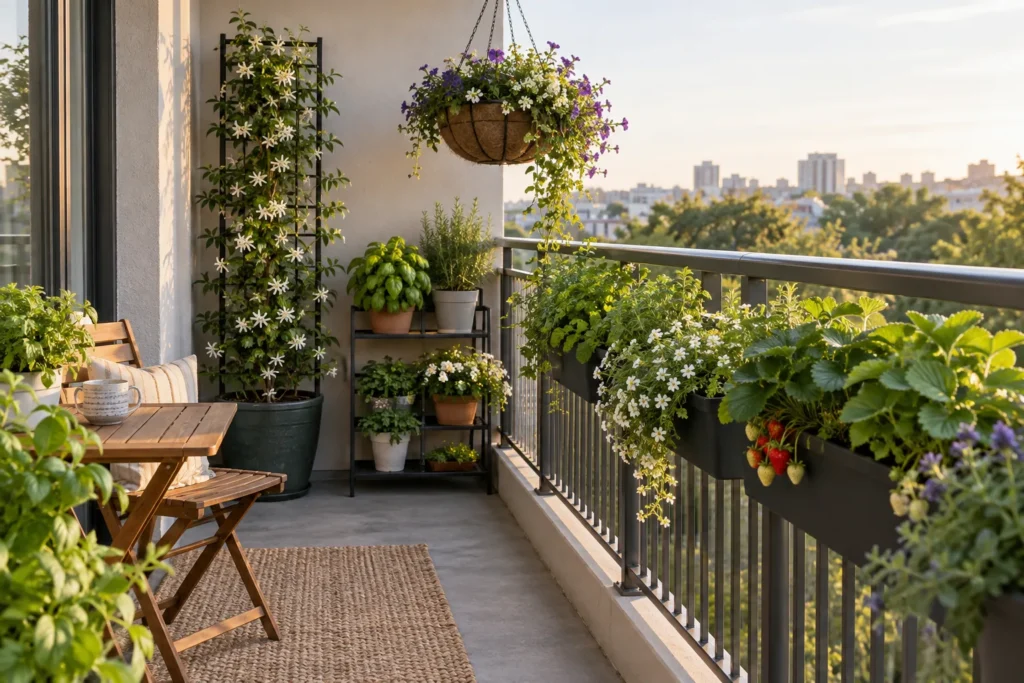
Why grow vertically on a balcony
Floor space on a balcony is usually the scarcest resource, especially if you also want a chair or a place to stand. Walls, railings, and the vertical air above waist-height pots are almost always unused. Moving even a third of your plants off the floor and onto a rail or wall can double what you’re able to grow without making the space feel more crowded, since vertical plants sit up at eye level instead of underfoot, and there’s something genuinely delightful about herbs brushing your shoulder as you walk past.
Ways to garden up instead of out
Railing planters
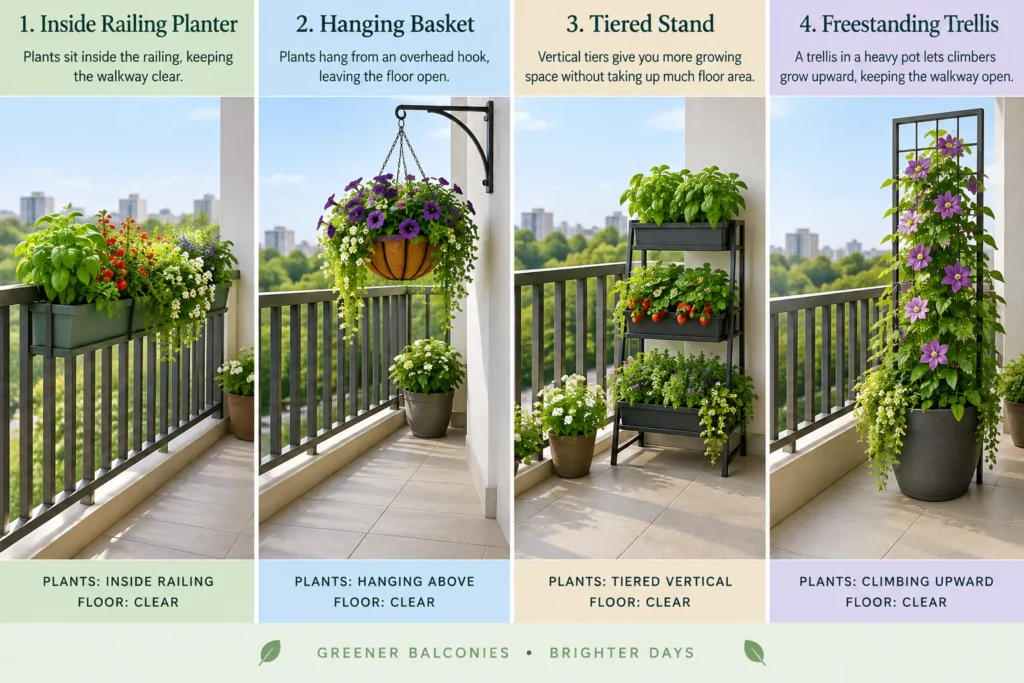
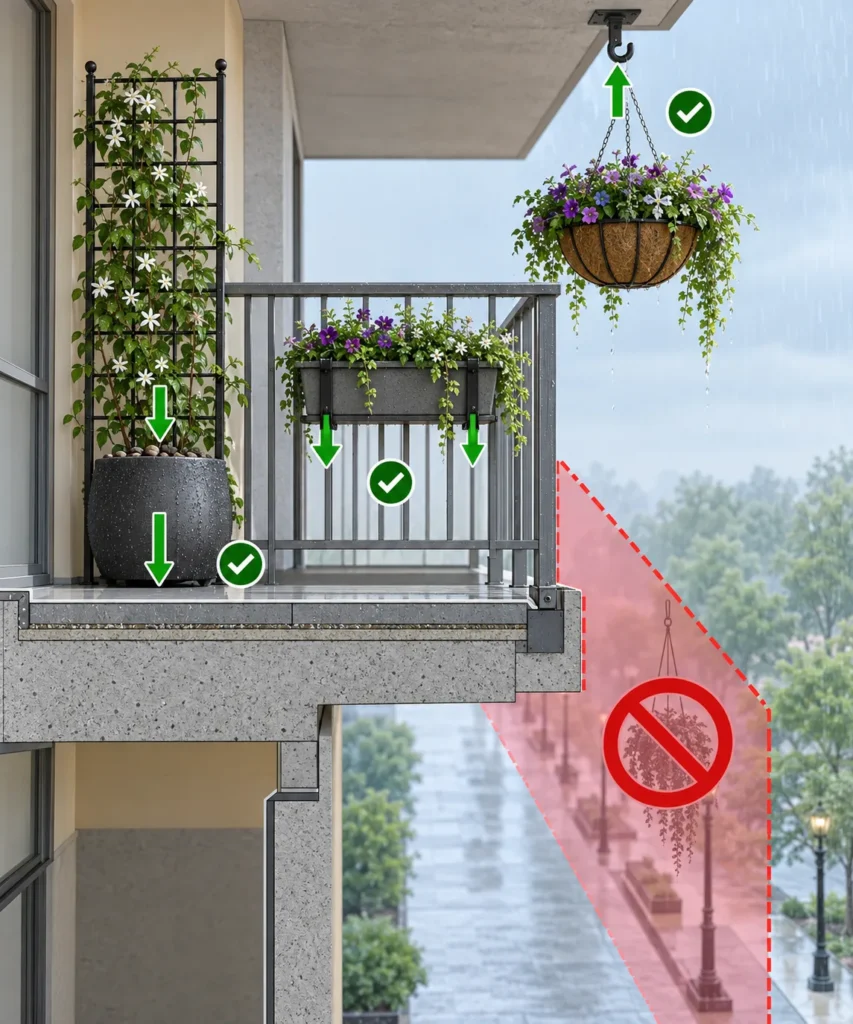
Railing planters clip or hook over the top of a railing and sit on either the inside or outside face. They’re one of the most space-efficient options because they use a surface you’re not otherwise growing on. Choose planters that hook securely over both sides of the rail instead of resting loosely, and check the clip hardware periodically, since UV exposure can make plastic clips brittle over a season or two. If your building or lease restricts hanging anything over the outer edge (common in many rental buildings for liability reasons), keep railing planters on the inside face only.
Hanging baskets
A hanging basket from an overhead structure, ceiling hook, or bracket works well for trailing plants like petunias, lobelia, or a trailing herb such as prostrate rosemary. Hanging baskets dry out faster than pots on the floor because they’re more exposed to air movement on all sides, so plan on watering them more often than an equivalent floor container, especially in summer. Make sure whatever you hang from, a ceiling hook, a bracket, or a shepherd’s hook stand, is rated for the basket’s full weight once the soil is wet, which can be 15 to 25 lbs (7 to 11 kg) for a mid-size basket.
Tiered and ladder plant stands
A tiered stand stacks several pots vertically in a small footprint, which is ideal for a collection of herbs or a mix of smaller plants that all want similar light. Because a tiered stand still sits on the floor, it doesn’t add hanging-hardware questions, but it does concentrate weight in one spot, so place it against a wall or over a structural point, not out on the balcony’s outer edge. Rotate pots occasionally if one side of the stand gets noticeably less light than the other.
Wall-mounted pocket planters and trellises
Fabric pocket planters or modular wall systems mount directly to a solid wall and hold multiple small plants in individual pockets, which suits shallow-rooted herbs and small flowers well. A trellis mounted to a wall or a large pot gives vining plants like peas, small cucumbers, or climbing nasturtiums something to grow up instead of sprawling across your floor space. Wall mounting requires drilling into the wall in most cases, so check your lease before installing anything permanent, and consider a freestanding trellis anchored in a large, stable pot as a no-drill alternative.
Plants that do well grown vertically
- Strawberries. A classic choice for hanging baskets or tiered stands; their trailing runners hang attractively and stay off the ground away from pests.
- Trailing herbs. Prostrate rosemary, trailing thyme, and oregano all spill nicely over the edge of a railing planter or hanging basket.
- Trailing flowers. Petunias, lobelia, bacopa, and calibrachoa are bred for hanging baskets and window boxes and bloom heavily all season.
- Vining vegetables on a trellis. Compact or bush cucumber varieties, snap peas, and pole beans can be trained up a trellis instead of sprawling.
- Nasturtiums. Fast-growing, edible, and happy to climb a trellis or trail from a railing planter with almost no maintenance.
Light can change once you go vertical
A spot that gets full sun at floor level isn’t automatically the same light higher up. An overhang, an upper railing, or a neighboring balcony can shade a hanging basket that sits a few feet above a sunny floor pot, and the reverse happens too: a high wall-mounted planter can catch sun that a shaded floor spot below misses entirely. Before committing a sun-loving plant to a hanging basket or a top tier, watch that exact spot through a few hours of the day instead of assuming it matches whatever light reading you took at floor height.
A no-drill trellis for renters
If your lease rules out drilling into a wall or railing, a freestanding trellis anchored in a large, heavy-bottomed pot gives you most of the vertical growing power without any permanent hardware. Push the trellis legs or stake well down into the soil before planting around the base, and choose a pot wide and heavy enough that the trellis can’t tip once the vines fill in and start catching wind. A single large pot set up this way can carry a surprising amount of growth: commercial vertical tower planters, which use the same basic principle of stacking growing space around a central support, are built to hold as many as 50 to 60 small plants in one freestanding unit. You don’t need a unit that large for a balcony, but it’s a useful sense of how much a well-built vertical support can carry compared with a flat bed of the same footprint.
Training vines to climb instead of sprawl
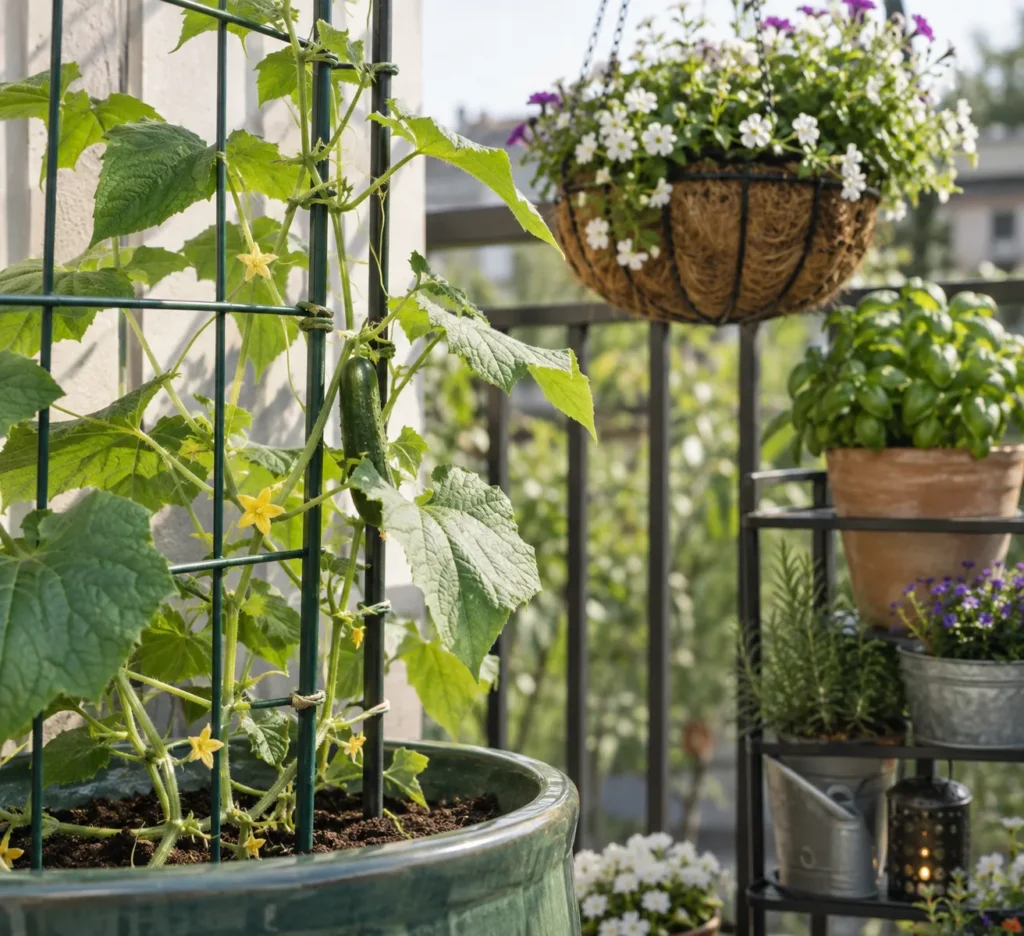
Vining plants don’t automatically know to grow up a trellis next to them; most need a little guidance while they’re young. Start training a vine as soon as it’s tall enough to reach the lowest part of the support, weaving the stem loosely in and out of the trellis mesh or wrapping it gently around a stake. After a few of these guided turns, most vines, cucumbers, peas, and nasturtiums included, will continue climbing on their own by sending out tendrils or twining stems. Check back every few days early on, since a vine left untrained for too long will flop over and sprawl across the floor instead of climbing, and it’s harder to redirect once it’s grown that way.
Watering vertical plantings
Anything mounted above the floor, hanging baskets especially, dries out faster than a floor pot of the same size because air moves around every side of the container instead of just the top. Water until it runs from the drainage holes, which tells you the whole root ball got a good drink instead of just the top inch, and check hanging baskets daily in warm weather since they can dry out within a single hot afternoon. A watering can with a long spout or a small watering wand makes reaching an overhead basket or a top tier of a plant stand much easier than trying to angle a regular can into a hard-to-reach spot. If daily watering isn’t realistic for your schedule, look for hanging baskets and railing planters with a built-in water reservoir, which work on the same principle as a self-watering planter but sized for a smaller vertical container.
Weight and safety checklist
- Weigh it wet, not dry. Estimate a planter’s weight after a full watering, not the empty weight printed on the box, before trusting it to a rail or hook.
- Never hang over a public walkway. A planter that could fall onto a sidewalk, entrance, or lower balcony is a liability regardless of how secure it feels.
- Check hardware each season. Clips, hooks, and brackets exposed to sun and rain degrade faster than the same hardware indoors.
- Confirm your lease allows exterior mounting. Many rental buildings restrict anything attached to the outside face of a railing or the building exterior.
- Mind the wind. Hanging and railing planters catch more wind than floor pots; in a windy balcony garden, prioritize wall-mounted and tiered options that sit lower and more securely.
Start with one vertical zone
You don’t need to convert the whole balcony at once. Pick one rail, one wall, or one corner for a tiered stand, get the watering rhythm right for that setup, and expand from there. Combined with the containers you already have on the floor, a single vertical zone is often enough to noticeably increase what a small balcony can grow. For the container types that pair well with vertical setups, see our guide to choosing balcony pots and containers.