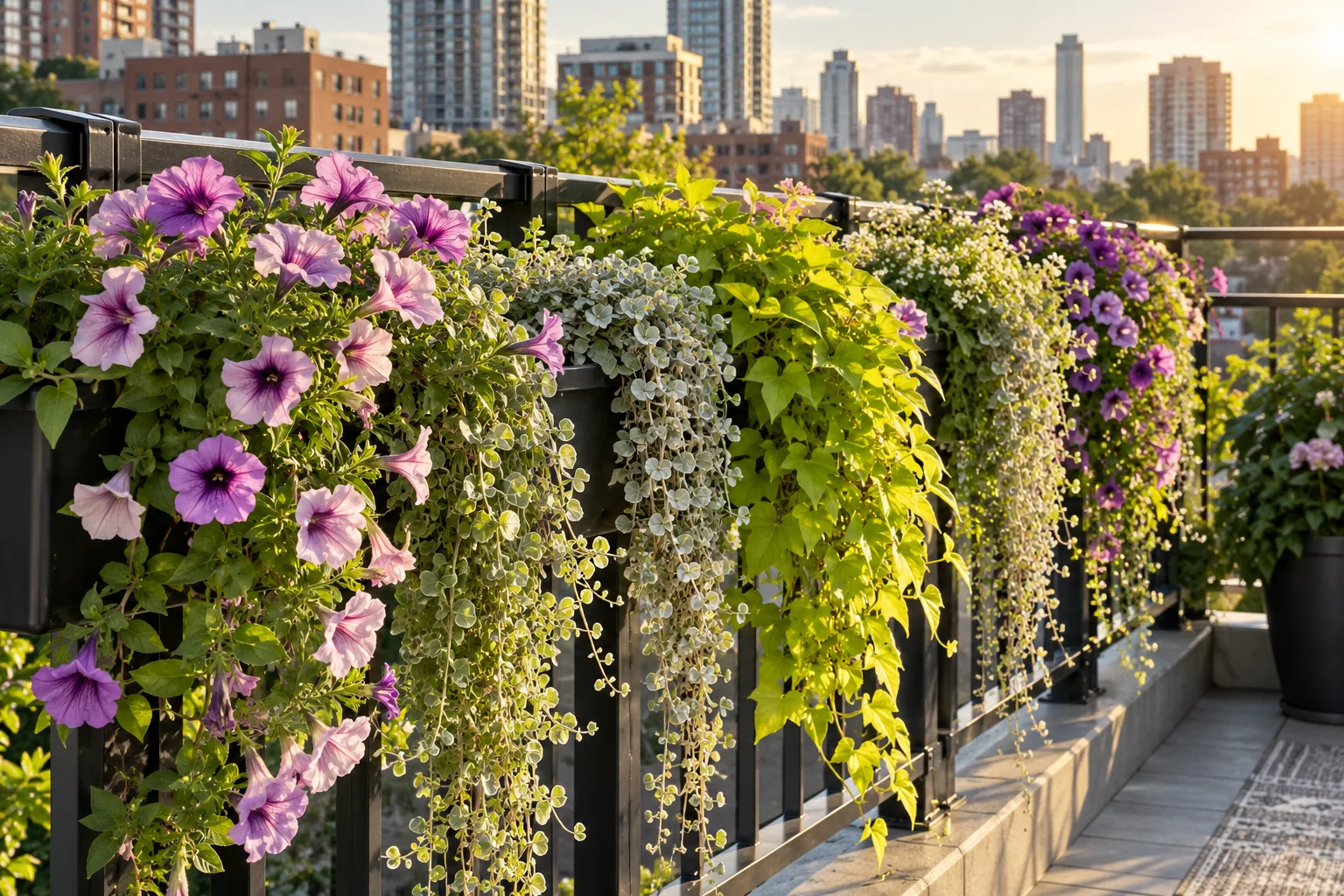
Two different questions get asked about balcony railings, and they sound similar but lead to different plant lists. One is practical: what survives the sun, shade, and wind at railing height. Another is protective: what blocks a neighbor’s sightline. This guide answers a third question, the one about appearance, not survival or screening: what spills, drapes, or cascades down over a railing in a way that genuinely looks good.
If you came here wanting the full rundown on depth, heat, and wind at railing height, our guide to plants for balcony railings: what works in sun, shade and wind covers that ground thoroughly, and this article builds on it instead of repeating it. If privacy is the goal, privacy plants for balcony railings covers screens, trellises, and tall grasses built to block a view. This guide sits between the two: it assumes you’ve already sorted out the conditions and the safety basics, and you’re now choosing plants specifically for the cascade effect, the look of greenery and flowers pouring down the outside of a railing.
The visual logic of a cascade
A trailing plant does something a mounded or upright one can’t: it turns a flat line of railing into a layered, three-dimensional display, with color visible from the street or the balcony below as well as from your own side. Oregon State University Extension describes the classic approach to a container meant to be seen from more than one angle as combining “a taller plant in the middle, clumping plants to fill in, and trailers around the edge,” a framework usually shortened to thriller, filler, spiller. On a balcony railing, the spiller role is the whole point, since the railing itself provides the vertical backdrop a thriller plant would normally supply in a freestanding pot.
Not every trailing plant cascades the same way, though, and matching the growth habit to the look you want matters more than most plant lists admit. Some plants drape in soft curtains of small leaves. Others send out long, searching runners that look more like a waterfall. Still others hold their flowers along the trailing stem instead of at the tips, which reads as a ribbon of color instead of a sheet of foliage. The sections below are grouped by that visual effect first, with the growing conditions as the second consideration, because for this particular guide the look usually decides the plant before sun or shade does.
Soft curtains of continuous flowers
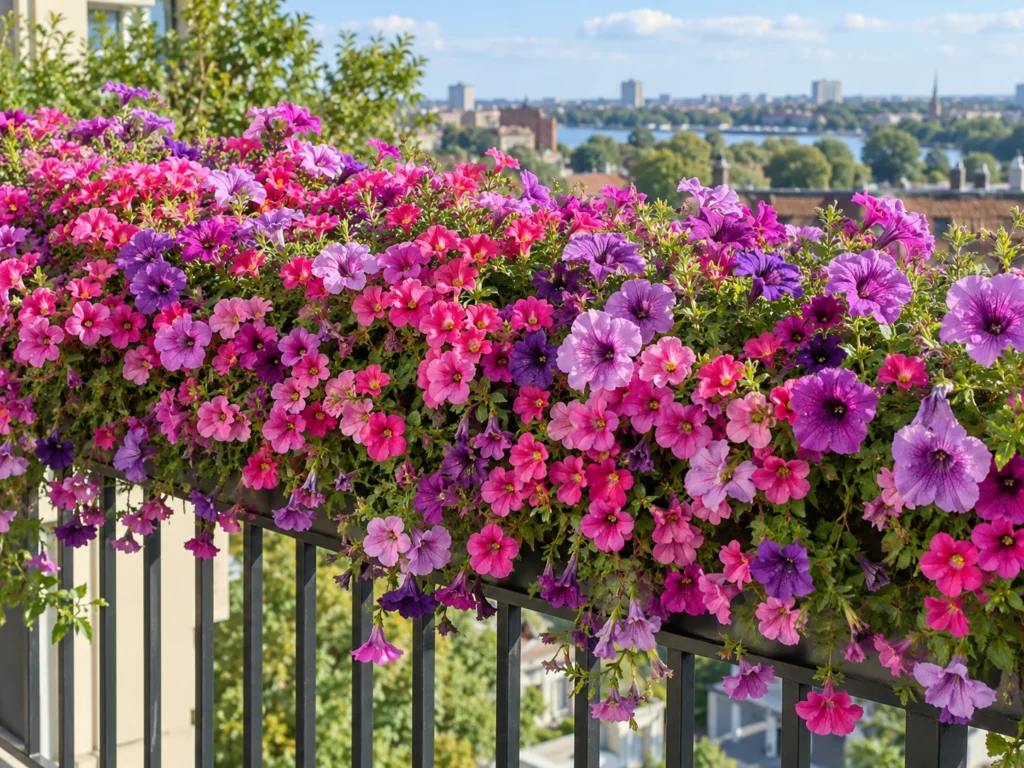
This is the effect most people picture first: a railing planter that disappears under a dense, even blanket of small blooms, with very little visible foliage once the plant fills in.
- Calibrachoa (million bells). Each stem carries dozens of petunia-shaped flowers an inch or less across, in colors from deep purple to coral, and the plant keeps producing new buds along its full length all summer. It wants full sun and a steady feed, since the nonstop flowering draws down nutrients fast in a rail box.
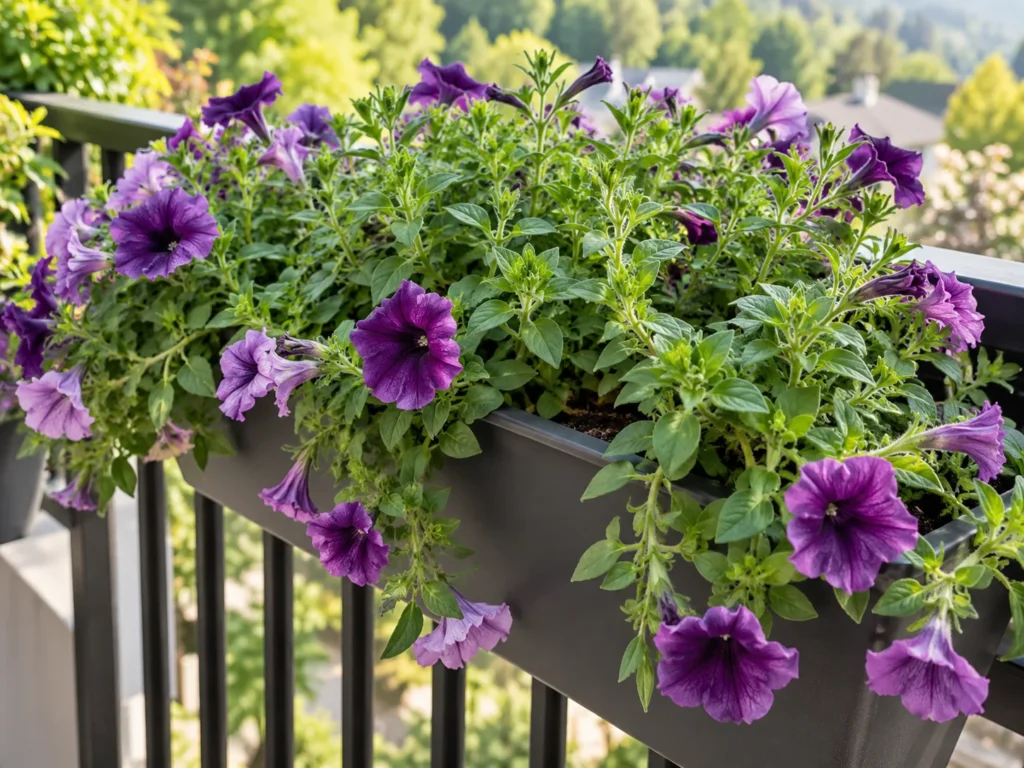
- Trailing petunia (Wave and Supertunia types). Bred specifically for this spilling habit, modern trailing petunias cover themselves in larger flowers than calibrachoa and need slightly less deadheading to keep blooming. Oregon State University Extension lists petunia among its recommended “trailers” for high, all-sides-visible baskets, alongside calibrachoa, alyssum, lobelia, verbena, and fuchsia.
- Bacopa (Sutera cordata). Smaller, star-shaped white, pink, or lavender flowers on fine, trailing stems. It reads as more delicate and less saturated in color than calibrachoa or petunia, which suits a softer look, and it holds up well through mild heat as long as the box doesn’t dry out completely.
Waterfall foliage, grown for leaves over flowers

Where the curtain effect above is about color, this group is about texture and movement; think of a plant pouring over the edge instead of blooming over it.
- Dichondra ‘Silver Falls’ (Dichondra argentea). Small, rounded, metallic silver leaves on stems that cascade dramatically. NC State Extension notes that “from a hanging basket, it will cascade down 3 to 6 feet (90 to 180 cm) in one season,” and describes the plant as “very drought tolerant,” which makes it one of the lower-maintenance choices in this whole guide. The silver color also does real work visually, since it lightens a dark-colored rail box and pairs well with almost any flower color planted alongside it.
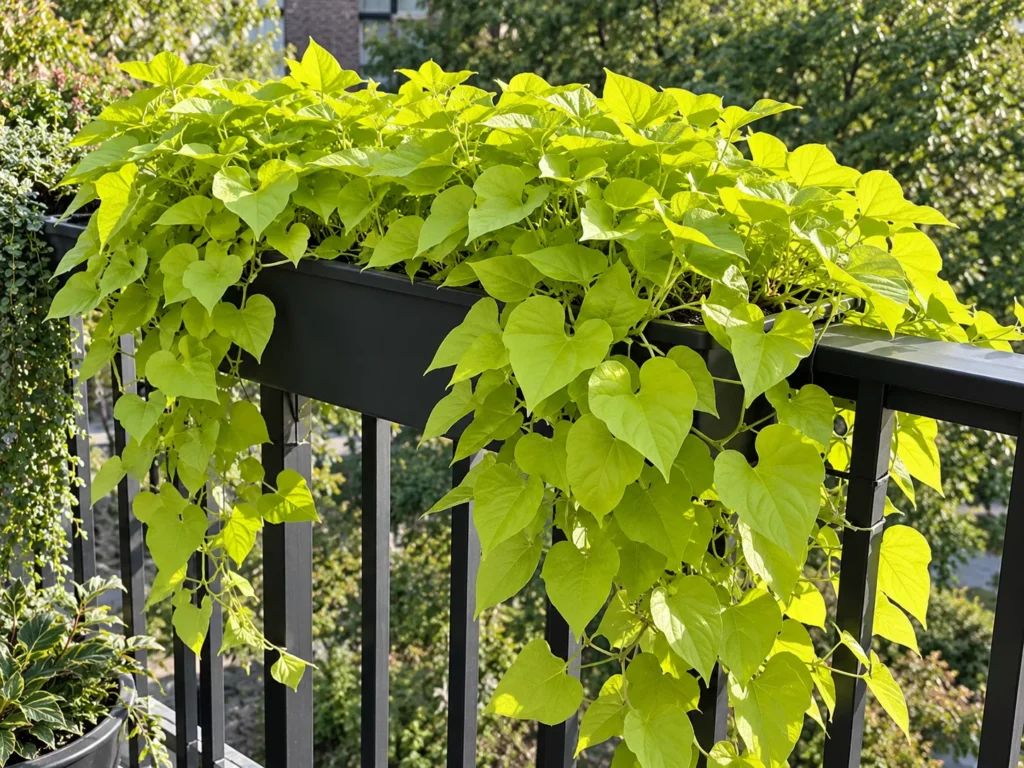
- Ornamental sweet potato vine (Ipomoea batatas). Bold, heart-shaped leaves in chartreuse, deep purple-black, or variegated forms, on vigorous stems. NC State Extension describes it as “a vigorous-growing, annual ground cover or vine” that “spreads quickly by runners” and is specifically listed for “hanging baskets” and “window boxes.” It grows fast enough to fill a rail box within a few weeks, and the thick leaves hold up to wind better than more delicate trailers.
- Licorice plant (Helichrysum petiolare). Felted, silvery-gray, rounded leaves on long trailing stems, grown purely for foliage. It softens and lightens a planting the same way Dichondra does, with a slightly fuzzier texture, and the gray tone sets off bright flower colors in the rest of the box without competing for attention.
Flowering vines trained to trail instead of climb
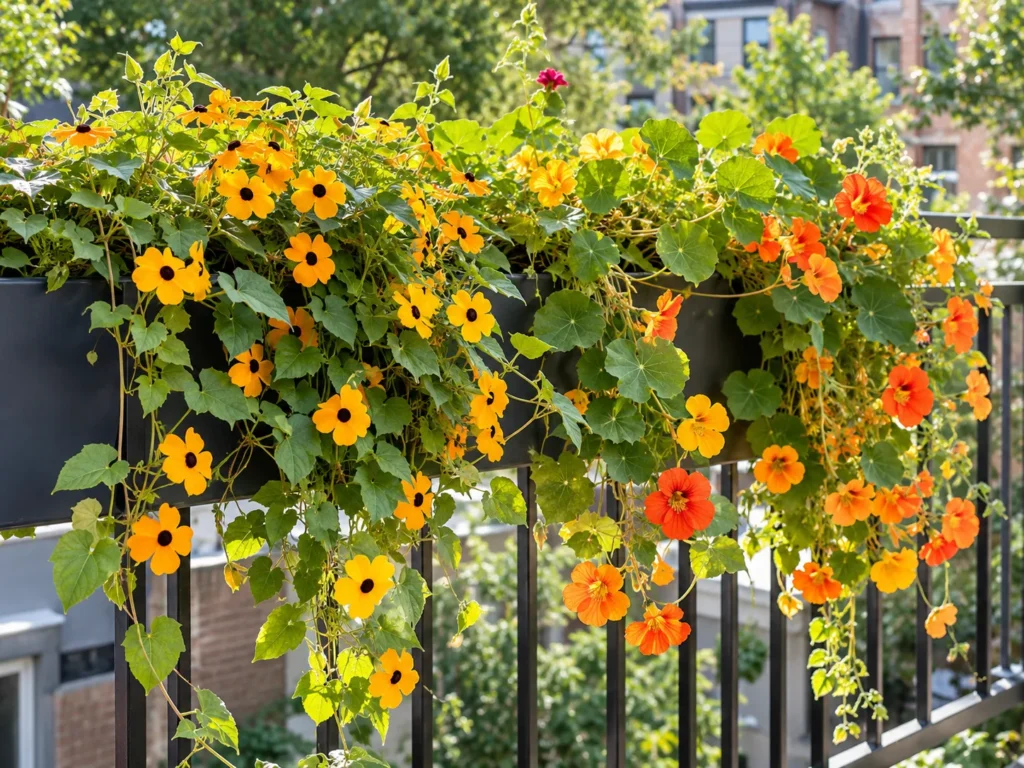
A handful of plants usually grown as climbers also work as trailers if you let their stems hang down the front of the railing rather than training them up a support.
- Black-eyed Susan vine (Thunbergia alata). Cheerful orange, yellow, or white flowers with a dark center, on a twining vine NC State Extension describes as having a “trailing habit cascading from a hanging basket” even though the same plant climbs readily given a trellis. Left untrained in a rail box, its stems hang down instead of reaching up, giving a looser, more casual cascade than the dense curtain plants above.
- Nasturtium (Tropaeolum majus), trailing types. NC State Extension rates nasturtium’s growth as “rapid” and notes several cultivars are specifically “trailing” or “semi-trailing” in habit. The rounded leaves and bright flowers hang in loose sprays, not a dense sheet, and the whole plant is edible, a real bonus in a box too shallow for most vegetables.
Trailing plants for a shaded railing
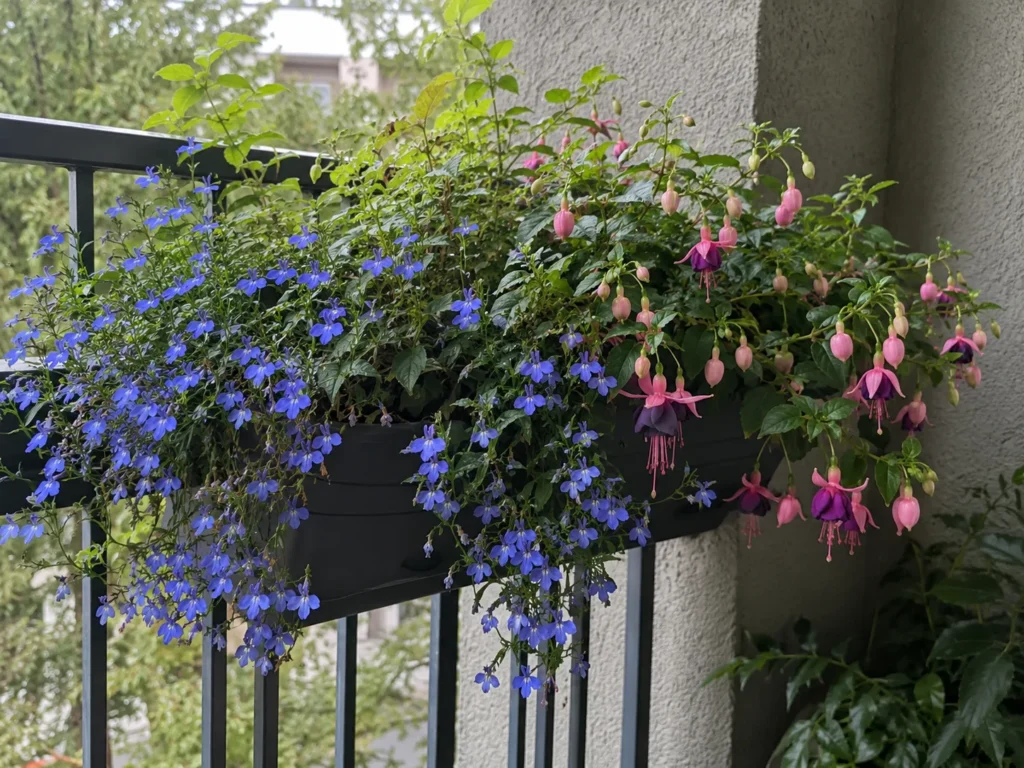
Most of the showiest trailers above want sun, which leaves a real gap for anyone with a north-facing or heavily shaded rail. These fill it.
- Trailing lobelia (Lobelia erinus). Small, intensely blue, purple, or white flowers on fine, draping stems. NC State Extension notes that “trailing forms are excellent for hanging baskets” and describes the plant’s preference for “full sun to part shade,” making it one of the few trailers on this list equally at home in a brighter or dimmer spot. It does want consistent moisture, since the extension page specifically notes it “does not tolerate drought,” which makes it a poor match for the dry-between-waterings approach that suits Dichondra or sweet potato vine.
- Fuchsia, drooping types. Pendant, two-tone flowers in pink, purple, and white hang below the foliage on long stems built specifically to trail. NC State Extension describes fuchsia as tolerating “deep shade” to “partial shade” and notes it “can withstand shade so makes a bright pop of color in a dark corner,” though it adds that “plants in containers or baskets will need frequent watering” and that the plant “do[es] not withstand drought conditions.” A shaded rail box with fuchsia needs more frequent checking than a sunny one with Dichondra, a trade worth making if the view beneath your railing is otherwise dim.
A wind-exposed railing, and what to trail there instead

The softest, most delicate trailers above, bacopa and trailing lobelia especially, tend to shred in sustained wind, since their fine stems and small leaves offer little structural resistance to gusts. On a high or corner balcony where wind is the dominant condition (our guide to plants for balcony railings covers the physics of why exposure increases at railing height), favor trailing verbena or Dichondra instead. NC State Extension describes garden verbena as “mounding, trailing or upright in form” and “fairly drought-tolerant once established,” and its wiry, flexible stems shed wind better than a plant built from soft, broad leaf tissue. Dichondra’s small, tough leaves handle the same exposure well, which is part of why it tolerates both drought and wind better than most of the flowering options above.
Pot and soil notes specific to a trailing display
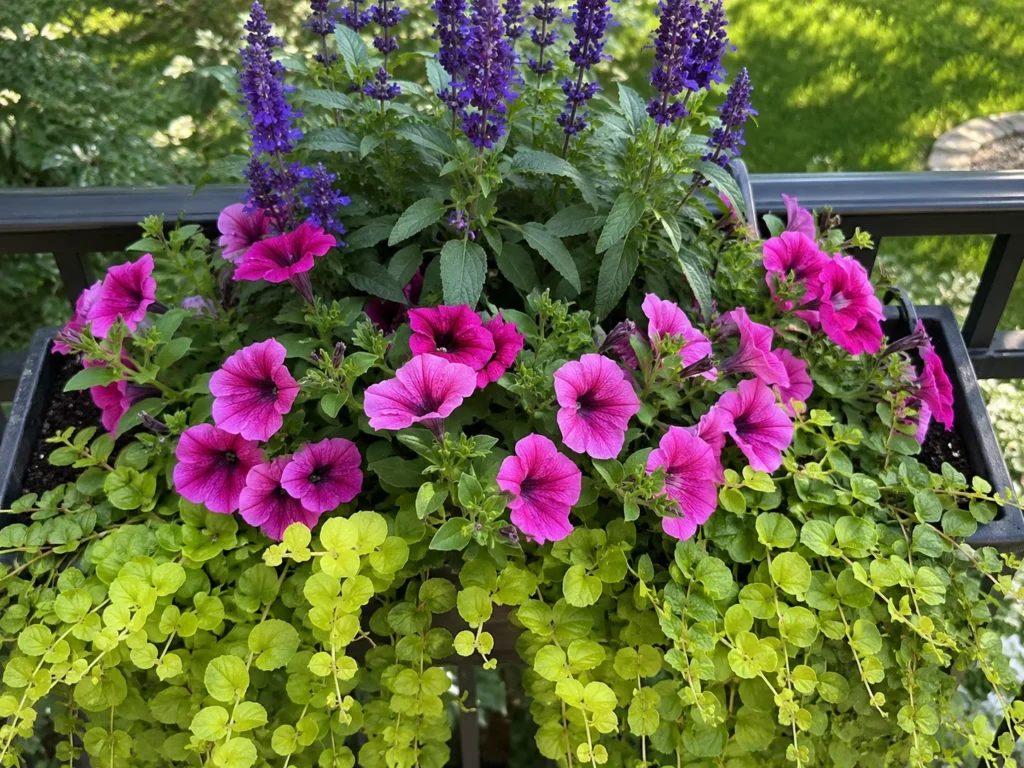
- Plant at the front edge, not the center. A trailing plant cascades best when its crown sits right at the rim of the box, with upright or mounding plants behind it. Centering a trailing plant wastes half its spill potential on growing sideways into its neighbors instead of down over the edge.
- Expect a shallower root run than a full-size floor pot allows. Rail boxes run 6 to 10 inches (15 to 25 cm) deep, and every plant in this guide has a fibrous, shallow root system suited to that depth; none of them need the 12 to 16 inch (30 to 40 cm) depth that full-size vegetables require.
- Trim to keep the cascade full, not just long. Left alone, trailing annuals often grow leggy and bare near the crown while the tips keep extending. Pinching the growing tips back by an inch or two every few weeks keeps new growth branching out along the whole stem, which fills in the display instead of just lengthening it.
- Feed more than you would a floor pot. A rail box holds less soil and less stored nutrition than a deep container, and the heaviest bloomers here, calibrachoa and trailing petunia especially, draw on that nutrition fast. A diluted liquid feed every one to two weeks during the growing season keeps the display from fading by midsummer.
Matching a cascade to the look you actually want
| Look you want | Best picks | Light needed |
|---|---|---|
| Dense curtain of flowers | Calibrachoa, trailing petunia, bacopa | Full sun |
| Silvery, textural waterfall | Dichondra ‘Silver Falls’, licorice plant | Full sun to light shade |
| Loose, casual spray | Black-eyed Susan vine, trailing nasturtium | Full sun to part shade |
| Color in a shaded corner | Trailing lobelia, drooping fuchsia | Part shade to shade |
| Wind-exposed railing | Trailing verbena, Dichondra | Full sun |
When a cascade isn’t working
- Bare stems near the top, leaves only at the tips. The plant has outgrown its last pinch. Trim the longest stems back by a third and new growth will branch out and fill in within two to three weeks.
- Flowering has stopped even though the plant looks healthy. Usually a feeding gap in a shallow box that’s run through its nutrients. Resume a regular diluted feed and flowering typically resumes within a week or two.
- Stems shredded or torn after a windy stretch. A sign the plant’s leaf and stem structure is too delicate for the exposure. Swap to trailing verbena or Dichondra, both of which tolerate wind that would tear bacopa or trailing lobelia.
- One side of the cascade is thin and the other full. The box is getting uneven light. Turn it around every week or two so growth evens out on both sides.
Pairing a trailer with an upright centerpiece
A rail box planted with nothing but trailing plants looks flat from above, even when it cascades beautifully from below. The thriller, filler, spiller logic that Oregon State University Extension describes works just as well shrunk down to a 10 inch (25 cm) box as it does in a full-size hanging basket: one upright plant toward the back for height, one mounding plant to fill the middle, and the trailer at the front edge. A dwarf ornamental grass or an upright salvia makes a workable thriller in a railing box, a mounding petunia or compact marigold fills the middle, and any of the spillers above finishes the front.
The combination also spreads the risk across a season better than a trailer alone. If calibrachoa fades in a late-summer dry spell or lobelia struggles once the weather turns hot, a sturdier upright or mounding neighbor keeps the box from looking bare while you sort out the trailing plant’s problem.
Seasonal swaps for a cascade that lasts

Most of the plants above are warm-season annuals that peak from late spring through the first frost and then fade. Planning the swap in advance keeps a railing from sitting empty or ragged between seasons.
- Spring into early summer. Trailing lobelia handles the cooler, unsettled weeks of early spring better than heat-loving calibrachoa or sweet potato vine do, which makes it a reasonable way to get a cascade started before the warmest trailers are safe to plant out.
- Peak summer. Calibrachoa, trailing petunia, Dichondra, and sweet potato vine hit their stride here and do most of the heavy visual work through the hottest stretch.
- Fall. Many of the summer trailers keep going until the first real cold snap, especially Dichondra and trailing verbena, both of which tolerate a light frost better than the softer-leaved flowering types.
- Winter. None of the plants in this guide are evergreen trailers suited to winter display; treat a rail box as empty or replanted with cold-tolerant foliage over the coldest months, and plan to restart the cascade the following spring.
Where this fits with the rest of your railing
A trailing display and a privacy screen solve different problems but often share the same few feet of railing, so it’s worth planning the two together instead of choosing one and bolting the other on afterward. The shallow, wind-tolerant trailers above work well planted low in front of a taller freestanding screen from our privacy plants for balcony railings guide, since neither competes with the other for the little root space a rail box offers. And whichever combination you land on, the mounting hardware for the box itself carries its own weight limit separate from the balcony’s overall rating; our guide to how much weight a balcony can hold walks through confirming that before anything heavy or fully watered goes up on the rail.
Sources
- Oregon State University Extension: Add color and lift with hanging baskets
- NC State Extension: Dichondra argentea ‘Silver Falls’
- NC State Extension: Ipomoea batatas (Ornamental Sweet Potato Vine)
- NC State Extension: Thunbergia alata (Black-Eyed Susan Vine)
- NC State Extension: Tropaeolum majus (Nasturtium)
- NC State Extension: Lobelia erinus
- NC State Extension: Fuchsia x hybrida
- NC State Extension: Verbena x hybrida (Garden Verbena)