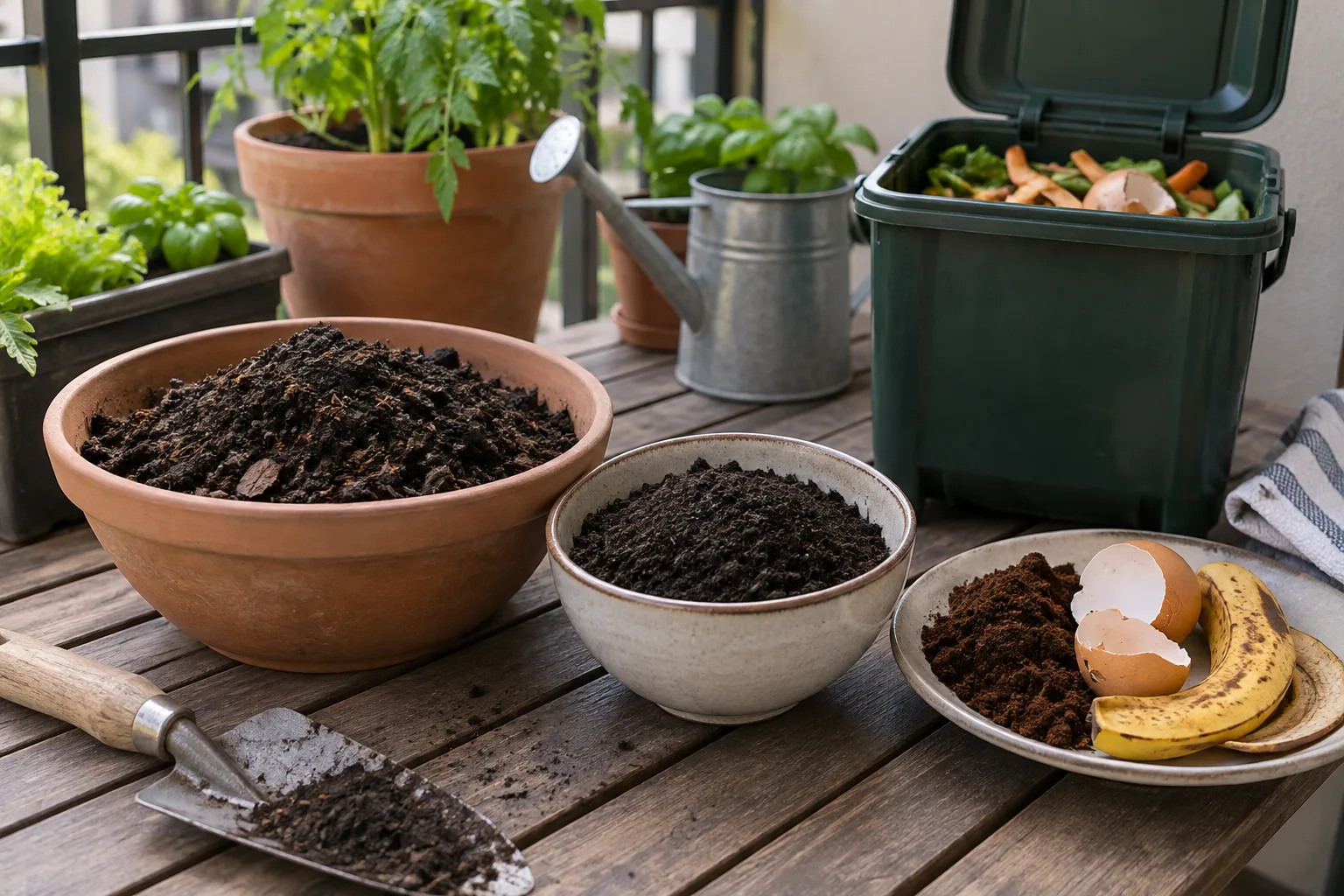
Coffee grounds acidify the soil. Eggshells stop blossom end rot. Banana peels feed flowers potassium. These claims circulate so widely that they read as settled fact, but university extension testing tells a different story for most of them. A few homemade fertilizers hold up on a balcony; several popular ones do almost nothing, and one or two can cause real problems in a small container where there is no surrounding soil to dilute a mistake.
This guide sorts the kitchen-scrap fertilizers that hold up from the ones that are mostly folklore, and covers the two homemade inputs, compost and worm castings, that deliver measurable nutrition to a balcony container.
Compost: the one that reliably works
Finished compost is the most dependable homemade fertilizer for a container, but it works as a soil amendment, not a stand-alone growing medium. South Dakota State University Extension recommends keeping compost to roughly 25 percent of the total mix by volume, blended into a quality potting base, not used alone. Pure compost in a pot packs down too tightly for good root aeration, drains poorly, and as it dries it can turn hydrophobic, repelling water at the surface while staying dry underneath, exactly the kind of watering confusion a balcony container can’t afford.
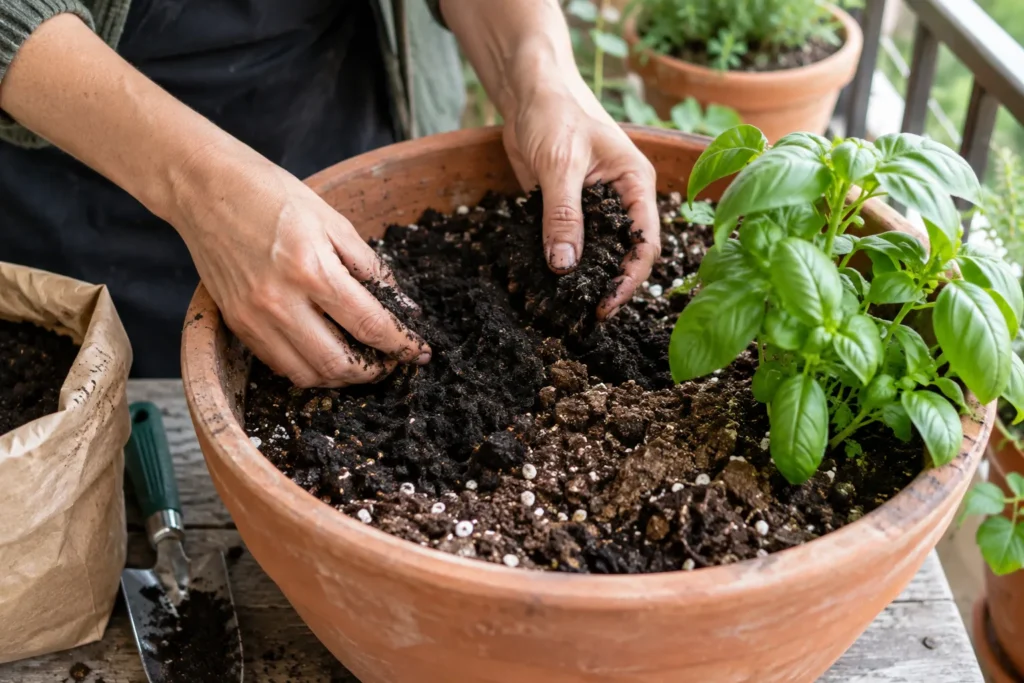
Compost also releases nutrients slowly, so a balcony container running on compost alone still benefits from an occasional quick-release feed early in the season while the compost’s own nutrients are still becoming available. If you don’t make your own, a small bag of bagged compost blended into your usual potting mix at planting time, or worked lightly into the surface of an established container, covers most of what homemade compost would offer.
Worm castings: the other one that works
Worm castings are the byproduct of composting worms processing food scraps, and they hold up well under scrutiny. Utah State University Extension notes that castings supply both slow-release and water-soluble nutrients, including calcium, iron, potassium, sulfur, magnesium, and phosphorus, along with beneficial microbial activity that can help suppress some soil-borne disease. For a balcony container, mix worm castings into potting soil at no more than about a quarter of the total volume, or use them as a light top dressing on an established plant.
A small worm bin under a kitchen sink can supply castings for a handful of balcony pots, though it’s a bigger commitment than most kitchen-scrap fertilizers on this list and not something to start purely for one or two containers. If you already compost food scraps in any form, castings or finished compost are worth prioritizing over the more folklore-heavy options below.
Compost tea: a mild, fast-acting boost, not a compost replacement
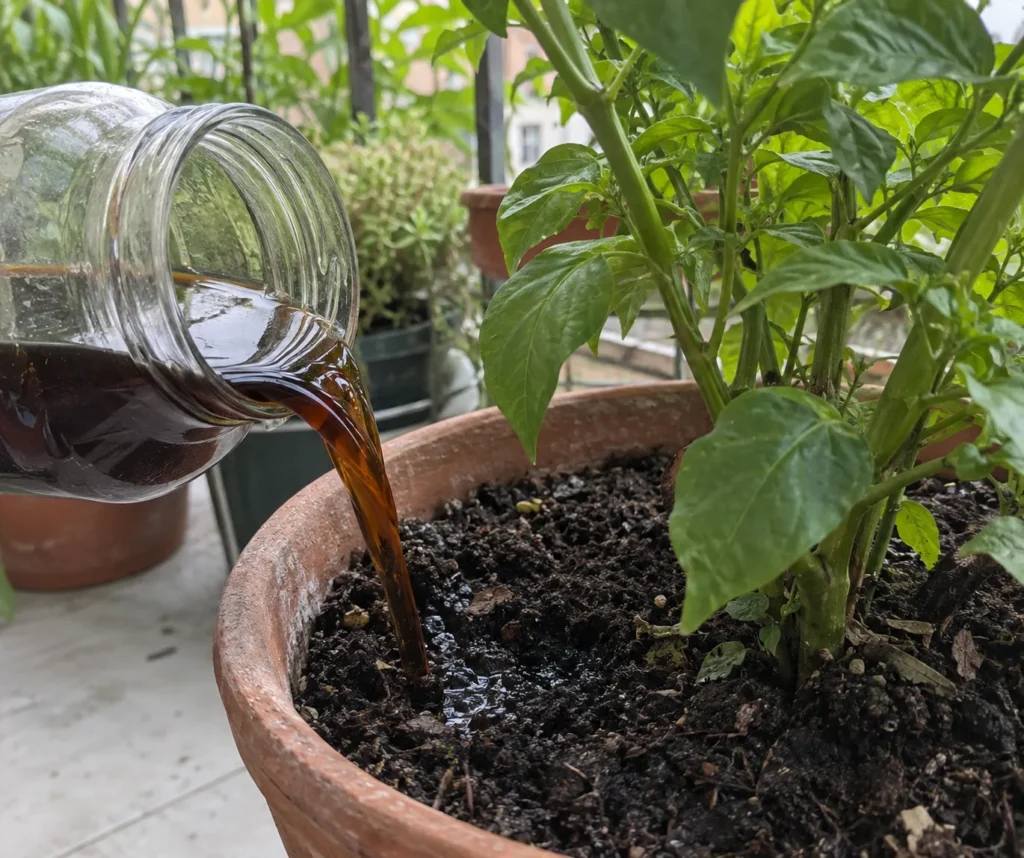
Compost tea, finished compost steeped in water, sometimes with an aquarium pump keeping it aerated, is genuinely different from spreading solid compost: steeping dissolves nutrients into a form roots can take up immediately, and a well-made batch can carry meaningfully more active microbial life than the same volume of solid compost. What it doesn’t do is multiply the underlying nutrients. Reviews of the practice are direct about this: the nutrient content of a batch of tea is a fraction of what was in the compost used to brew it, spread across a larger volume of water, so a tea works better as a mild, fast-acting supplement between regular feedings than as a stand-in for solid compost or a labeled fertilizer.
The disease-suppression claims attached to compost tea are more contested than the nutrient claims. Washington State University Extension’s review of the research found genuine, published support for some pathogen-suppressing effects from properly made aerated tea, alongside an equally real body of studies finding little or no benefit, particularly for foliar sprays, with no reliable way to predict which outcome a given home-brewed batch will land on. Treat any disease-control claim for compost tea as unproven for a specific use rather than assume it will work the way a fungicide would.
Safety matters more here than with any other option on this list, because brewing is exactly the kind of process that can go wrong quietly. Use only fully finished, fully decomposed compost, never fresh manure or unfinished scraps, and keep the brew actively aerated with a small pump for roughly a day; without constant oxygen, the same brewing process that makes tea useful can instead cultivate anaerobic conditions that favor harmful pathogens like E. coli, the exact opposite of what a home fertilizer should be doing. Use the tea within a few hours of finishing the brew, while it’s still oxygen-rich, and skip any additive marketed to “boost” a tea’s microbial count; extension guidance specifically warns that additives are more likely to feed harmful organisms than beneficial ones. For a balcony container, diluted compost tea applied to the soil, not sprayed on leaves, is the more conservative and better-supported use of the two.
Coffee grounds: mostly myth, one real use
The claim that coffee grounds acidify soil for acid-loving plants doesn’t hold up. Fresh, unused coffee grounds are acidic, but the used grounds people sprinkle on containers have had most of that acidity rinsed out in brewing and test close to neutral. University of California Marin Master Gardeners found little research support for the wider list of coffee-ground claims, including repelling pests, suppressing weeds, or meaningfully aerating soil.
Where coffee grounds do have a place is in a compost pile or bin, where they contribute nitrogen-rich material that breaks down along with everything else. Sprinkled directly and repeatedly onto the surface of a small balcony pot, they’re more likely to cake into a water-repellent layer than to help. Compost them instead of applying them straight to a container.
Eggshells: real nutrients, wrong timescale
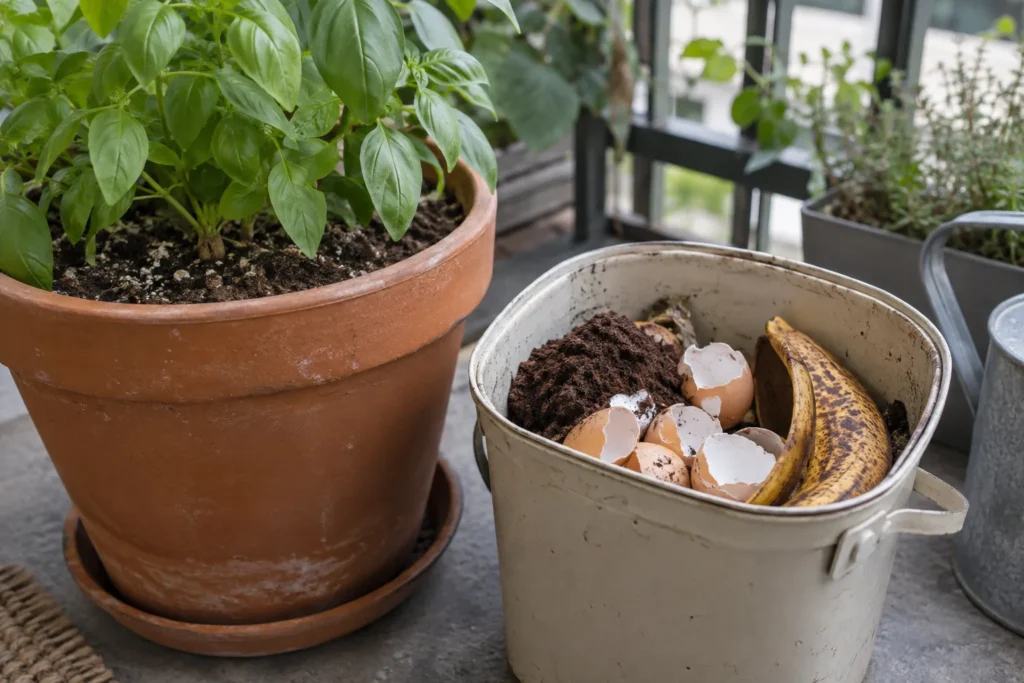
Eggshells genuinely contain calcium, along with smaller amounts of magnesium, potassium, and sodium. The problem is speed: even crushed into a fine powder, eggshells take years to break down enough to release that calcium into a form a plant can use. A few shells saved from breakfast and scattered whole or roughly crushed into one balcony pot will not meaningfully affect this season’s tomatoes, and blossom end rot, the deficiency eggshells are most often recommended for, is usually a watering problem, not a genuine shortage of soil calcium.
If blossom end rot is showing up on a balcony tomato or pepper, the more useful fix is steadier watering, covered in our guide to fertilizing balcony container plants alongside the broader feeding routine. Eggshells are fine to add to a compost bin along with everything else; they just aren’t a fast or reliable standalone fertilizer for a container that needs results this season.
Banana peels: better composted than buried
Banana peels do contain potassium, which supports flowering and overall plant health, so the underlying idea isn’t baseless. The trouble is what happens when a peel is buried directly in a container: breaking down the peel itself consumes nitrogen from the surrounding soil, which can temporarily reduce the nitrogen available to the plant’s roots right when it’s competing with the peel for the same small volume of soil. A shallow-buried peel in a container can also decompose slowly and unevenly, and on an outdoor balcony it can attract flies, ants, or other unwanted visitors before it fully breaks down.
Composting banana peels first, where they can decompose alongside a balanced mix of other material, gets you the potassium without the direct nitrogen competition or the pest risk sitting in an open pot on a shared building. If you don’t compost, a peel is simply better in the kitchen bin than under a balcony tomato.
Epsom salts: a narrow fix, not a general tonic
Epsom salts supply magnesium and sulfur, and they’re often recommended as a general plant pick-me-up. They only help a plant with a genuine magnesium deficiency, which is a real but relatively uncommon problem in a balcony container using fresh, reasonably balanced potting mix. Because Epsom salts are highly water-soluble, a draining container flushes them out quickly instead of letting them build up, so an occasional dose on a plant that doesn’t need it is unlikely to cause direct harm, but it also isn’t accomplishing anything. Treat it as a targeted correction for a diagnosed deficiency, not a routine feeding.
Two more myths worth retiring: tea leaves and wood ash
Used tea leaves get recommended in much the same way as coffee grounds, and the same caveat applies: brewing strips out most of the acidity and readily available nutrients before the leaves ever reach a pot. Composted, they contribute some organic matter like any other kitchen scrap; scattered loose on the surface of a container, they mostly just sit there and can mat down into a barrier that sheds water instead of letting it soak through.
Wood ash is a different case: it does contain potassium and can meaningfully raise soil pH, which is exactly why it’s risky in an undetermined dose. Most balcony potting mixes are already close to neutral, and a container has so little soil volume that a heavy-handed sprinkle of wood ash can push pH up further and faster than the same amount would in a full garden bed, potentially locking up other nutrients in the process. If you burn wood and want to use the ash, treat it the way you’d treat any high-potassium, high-pH amendment: a light dusting worked into compost, tested cautiously, not a routine addition to every pot.
Why balcony containers are less forgiving of DIY mistakes
A backyard garden bed has real depth and a large soil volume to buffer a fertilizer mistake; a banana peel decomposing unevenly, or coffee grounds caking on the surface, gets diluted across a much bigger area. A balcony container doesn’t have that buffer. The same small mistake concentrates in a pot that might hold a single plant’s entire root system, which is part of why the popular kitchen-scrap fertilizers underperform more noticeably in containers than gardeners expect from backyard anecdotes.
Balcony gardening adds its own practical constraints too: food scraps sitting in an open pot can draw pests or a smell that a neighbor a few feet away will notice, and anything that decomposes slowly just sits there looking untidy in a small, visible space. Composting scraps properly, even in a small countertop bin, sidesteps most of these problems and produces a finished product, actual compost, that behaves predictably in a pot instead of an experiment with an uncertain outcome.
A simple homemade routine that actually holds up
- Compost food scraps properly in a bin or small worm system instead of burying them directly in containers.
- Blend finished compost or worm castings into potting mix at roughly 25 percent or less by volume, never as the entire growing medium.
- Use compost or castings as a light top dressing on established containers once or twice a season, worked gently into the top inch of soil.
- Skip the direct-burial folk remedies, coffee grounds, eggshell halves, banana peel strips, on a container you expect results from this season.
- Reserve Epsom salts for a plant showing an actual, diagnosed magnesium deficiency rather than a routine additive.
None of this replaces a balanced fertilizer routine for a hungry container plant. Compost and worm castings are useful, genuine soil builders, but they release nutrients slowly and unevenly compared to a labeled fertilizer, so a tomato or pepper working hard through a full season still benefits from the more predictable feeding schedule covered in our guide to fertilizing balcony container plants. Think of homemade inputs as a supplement to that routine, not a replacement for it, and check your potting mix before assuming a struggling plant needs feeding at all.
Sources
- South Dakota State University Extension: Using compost in raised beds and containers
- Utah State University Extension: Vermicomposting
- University of Maryland Extension: Indoor worm composting
- UC Marin Master Gardeners: Garden myths busted
- Washington State University Extension (Linda Chalker-Scott): Compost tea research bibliography
- Piedmont Master Gardeners: The truth about compost tea
Homemade fertilizer results vary with the compost or castings you start with. When in doubt on a valued plant, favor the slower, better-tested option over an unverified folk remedy.