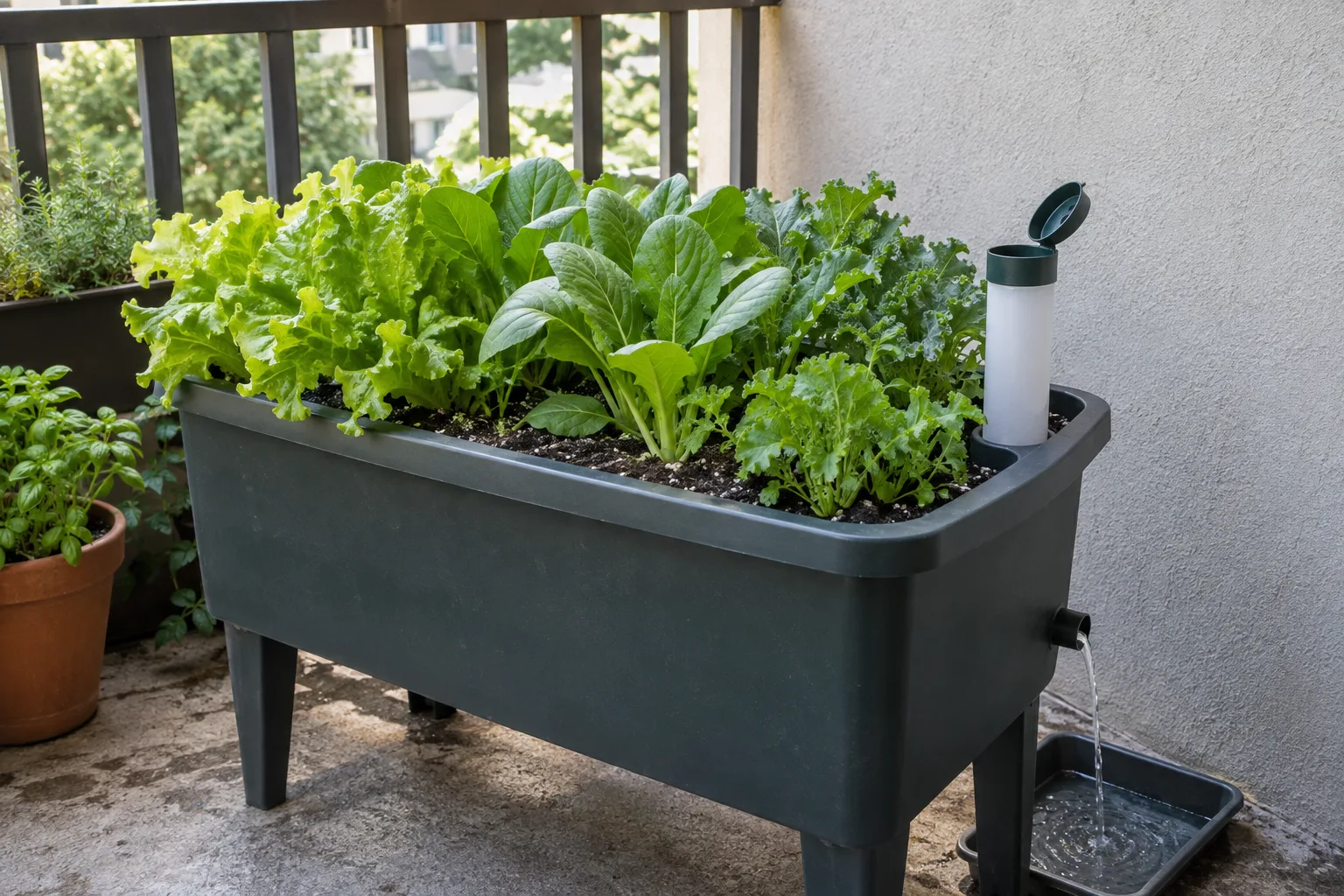
Self-watering planters sound almost too convenient: fill a reservoir, and the plant draws up exactly what it needs, whenever it needs it, without the guesswork of a watering can. That’s close to how they actually work, which is unusual for a gardening product claim, but the real research on capillary irrigation systems also surfaces a couple of genuine limitations worth knowing before assuming a reservoir planter is the strictly better choice for every container on the balcony.
The physics: capillary action, not a pump
Capillary action is the same force that pulls water up a paper towel dipped in a glass, or up through the narrow channels between soil particles: the attraction between water molecules and the surrounding material is strong enough to draw water upward against gravity, through small enough spaces. A self-watering planter puts this to work deliberately: a wick, or columns of potting mix itself acting as the wick, stays in contact with a water reservoir below, and water moves up through that material into the drier soil above by the same capillary force, continuing as long as the soil above is drier than the material below it and the wick stays in contact with both.
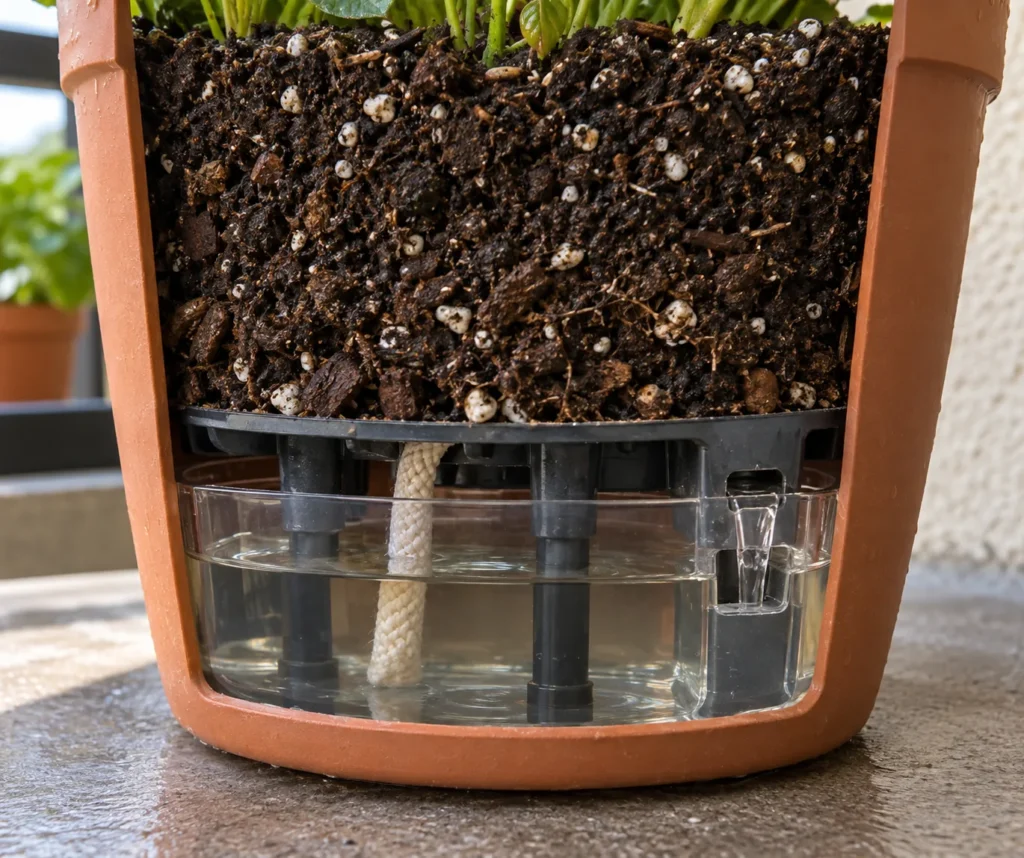
Nothing about this requires power or moving parts, which is why the system works reliably once it’s set up correctly; the physics does the work, not a mechanism that can fail electronically. Where it does fail is more mundane: a wick that loses contact with the reservoir, soil that’s dropped into the water chamber and blocked the intake, or a reservoir that’s run dry, all physical set-up and maintenance issues, not failures of the underlying principle.
What the research actually finds on yield and water use
A 2018 systematic review of capillary irrigation research, covering wicks, capillary mats, and ebb-and-flow systems, found that these systems have consistently produced higher crop yields and used less water than conventional overhead watering across the studies reviewed. Part of that advantage comes from reduced leachate: water and dissolved nutrients that would otherwise run straight through a pot and out the drainage holes during a normal watering instead stay in the root zone, available to the plant, because the system delivers water from below only as fast as the soil draws it up.
The oxygen question, answered more carefully than the marketing usually does
A common concern with any bottom-watered system is whether constant moisture suffocates roots the way standing water does in a badly drained pot. Research comparing subirrigated and drip-irrigated substrates found the opposite of what that worry predicts: oxygen concentration stayed essentially unchanged through the soil profile in subirrigated substrate, while oxygen actually decreased with depth in the drip-irrigated comparison. The explanation is structural rather than chemical: a properly designed system keeps water in the lower portion of the container while the larger pore spaces in the upper substrate retain air, so roots growing through that upper zone have simultaneous access to both moisture pulled up by capillary action and oxygen held in the air spaces around it.
This only holds if the reservoir has a working overflow and the wick isn’t oversaturating the entire root zone; a system where water rises into and floods the whole container instead of staying confined below a properly functioning wicking zone does create the low-oxygen, root-rot-prone conditions people worry about. The overflow outlet isn’t a minor detail, it’s the feature that keeps the oxygen-retaining upper zone from disappearing.
The limitation the research doesn’t hide: salt buildup
Subirrigation research is consistent on one real downside: dissolved salts, mostly from fertilizer, accumulate in the upper portion of the root zone over time. Water moves up from the reservoir and evaporates at the soil surface, but the minerals it carried don’t evaporate with it, so they concentrate right where new roots are growing. Research reviewing this effect found something worth knowing before assuming it’s disqualifying: accumulated salts at the surface layer did not appear to meaningfully harm plant growth in the studies reviewed, though the same research recommends periodically watering from the top as well, letting some water flow through and out the drainage system, to flush accumulated salts back down and out instead of letting them concentrate indefinitely.
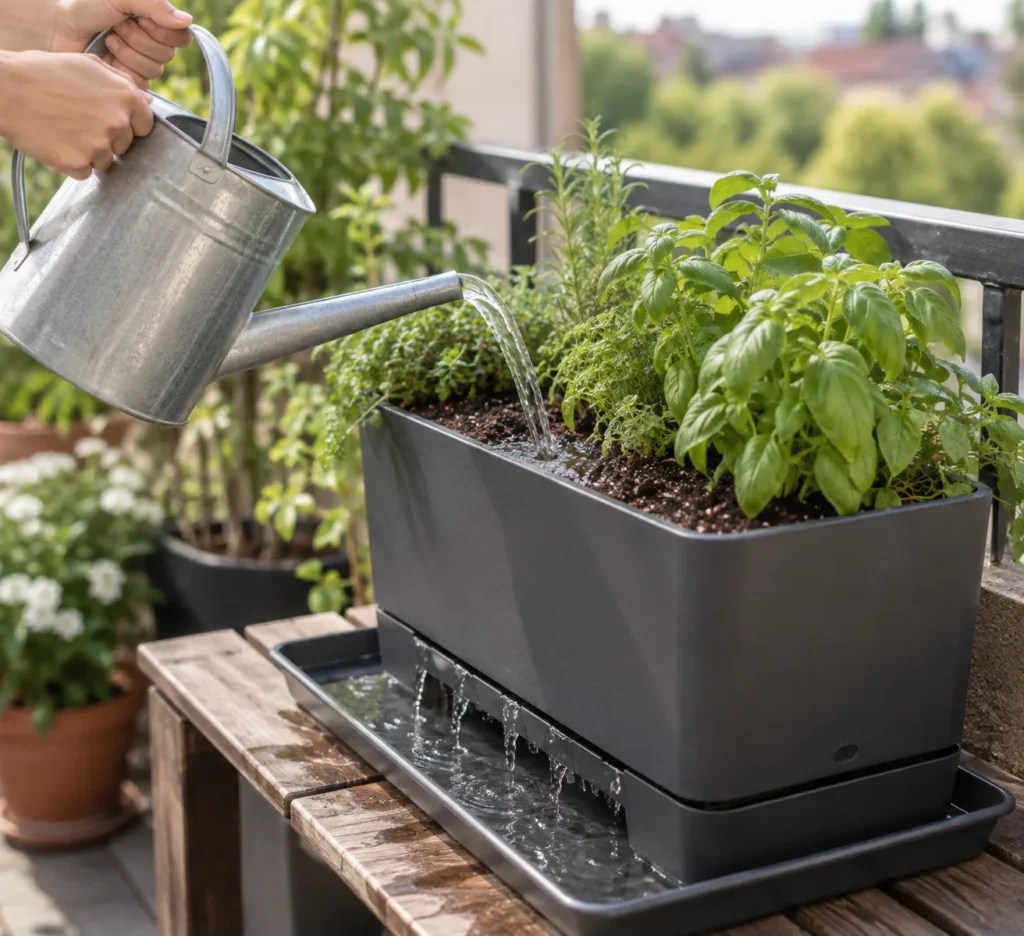
In practice, that means treating a self-watering planter’s reservoir as the default refill method, not the only one; an occasional top watering, heavier than a normal refill, functions as a flush. Our guide to self-watering balcony planters: setup and care covers this alongside the other maintenance habits, fill tube, overflow, and reservoir cleaning, that keep a system working as the research says it should.
Why the reservoir turns green, and why that’s a maintenance issue, not a root issue
A clear or lightly tinted reservoir left sitting in the sun eventually grows algae, the same way a forgotten glass of water on a bright windowsill does. Algae needs three things to establish: standing water, warmth, and light, and a translucent plastic reservoir under direct sun supplies all three continuously. It’s not a sign the system is failing or that the water has gone bad for the plant; algae isn’t toxic to roots at the levels that build up in a home planter. The real problem is mechanical: a biofilm layer coats the wick and the intake surface, and enough buildup there slows or blocks the capillary draw the whole system depends on, so a green reservoir that’s been ignored for months can genuinely stop wicking properly even though the water level looks fine.
The fix is mostly about blocking light rather than treating the water. An opaque reservoir, or a translucent one wrapped in foil, tape, or a dark sleeve, starves the algae of the light it needs and prevents the problem well before it starts; this is why most purpose-built self-watering planters use solid, non-translucent reservoir walls rather than clear ones. For a reservoir that’s already gone green, draining it, rinsing the chamber and wick with plain water, and covering the fill opening so light stops reaching the water going forward clears it up within one or two refill cycles. A wick that’s visibly slimed rather than just the water being tinted is worth replacing outright, since a cotton or fabric wick coated in biofilm won’t recover its capillary draw just because the water around it is clean again.
Which plants the physics actually favors
The mechanism itself tells you which plants benefit most. Steady capillary supply suits plants that want consistently moist soil and punish inconsistency, tomatoes, leafy greens, and many flowering annuals that wilt hard and set fruit poorly under fluctuating moisture. It works against plants that specifically need their roots to dry out between waterings, Mediterranean herbs, succulents, and other drought-adapted species, since a reservoir system is, by design, working to prevent exactly the dry-down period those plants have evolved to expect. That’s a design mismatch, not a flaw in the system: a self-watering planter is doing its job correctly even when the plant in it would rather it didn’t.
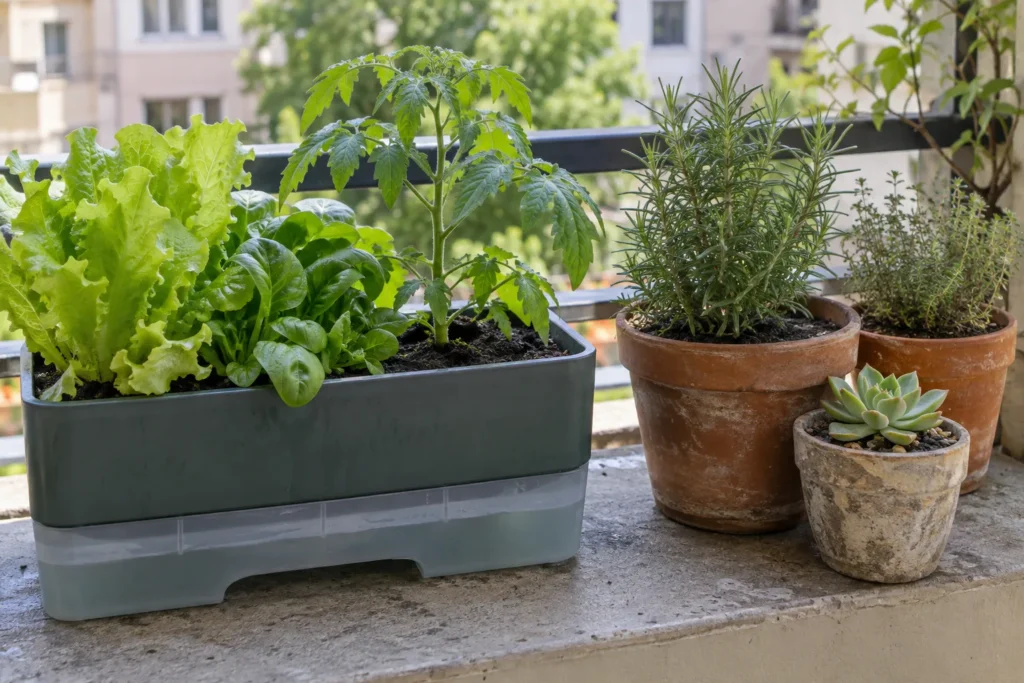
Our comparison of self-watering planters versus traditional pots covers this plant-by-plant fit alongside the cost and maintenance tradeoffs in more practical detail.
Retrofitting versus buying a dedicated system
The same capillary physics works whether the reservoir came built into the planter or was added afterward. A wicking insert kit, a false bottom and a wicking column dropped into an existing pot, relies on the identical mechanism as a planter engineered as one unit, and the research on capillary irrigation doesn’t distinguish between the two on whether the physics itself holds up. What differs is engineering quality: a retrofit kit’s overflow and wick contact are typically less refined than a purpose-built reservoir system, which is more a manufacturing detail than a limitation of the underlying principle. A homemade version, a cut plastic bottle with the neck wicking into soil above a small water reserve, works on the same basis too, just with a shorter buffer time than a properly sized commercial reservoir.
What the research supports and doesn’t
- Capillary action genuinely delivers water and preserves root-zone oxygen when the system is designed and maintained correctly, with research support for both higher yields and lower water use.
- Salt buildup at the surface is real but not typically severe, and it’s manageable with occasional top watering to flush the zone rather than a reason to avoid the system.
- The overflow outlet matters as much as the reservoir. Without it, the same mechanism that protects root oxygen can flood the whole container instead.
- Fit the system to the plant. Consistent-moisture plants benefit most; drought-adapted plants are working against the system’s whole design.
Sources
- Semananda & Ward, 2018: A Semi-Systematic Review of Capillary Irrigation (Horticulturae)
- UMass Amherst Extension: Subirrigation systems
Most capillary irrigation research comes from greenhouse and nursery production settings. The physical mechanisms transfer directly to a balcony-scale self-watering planter; exact yield figures from commercial studies won’t necessarily match a single home container.