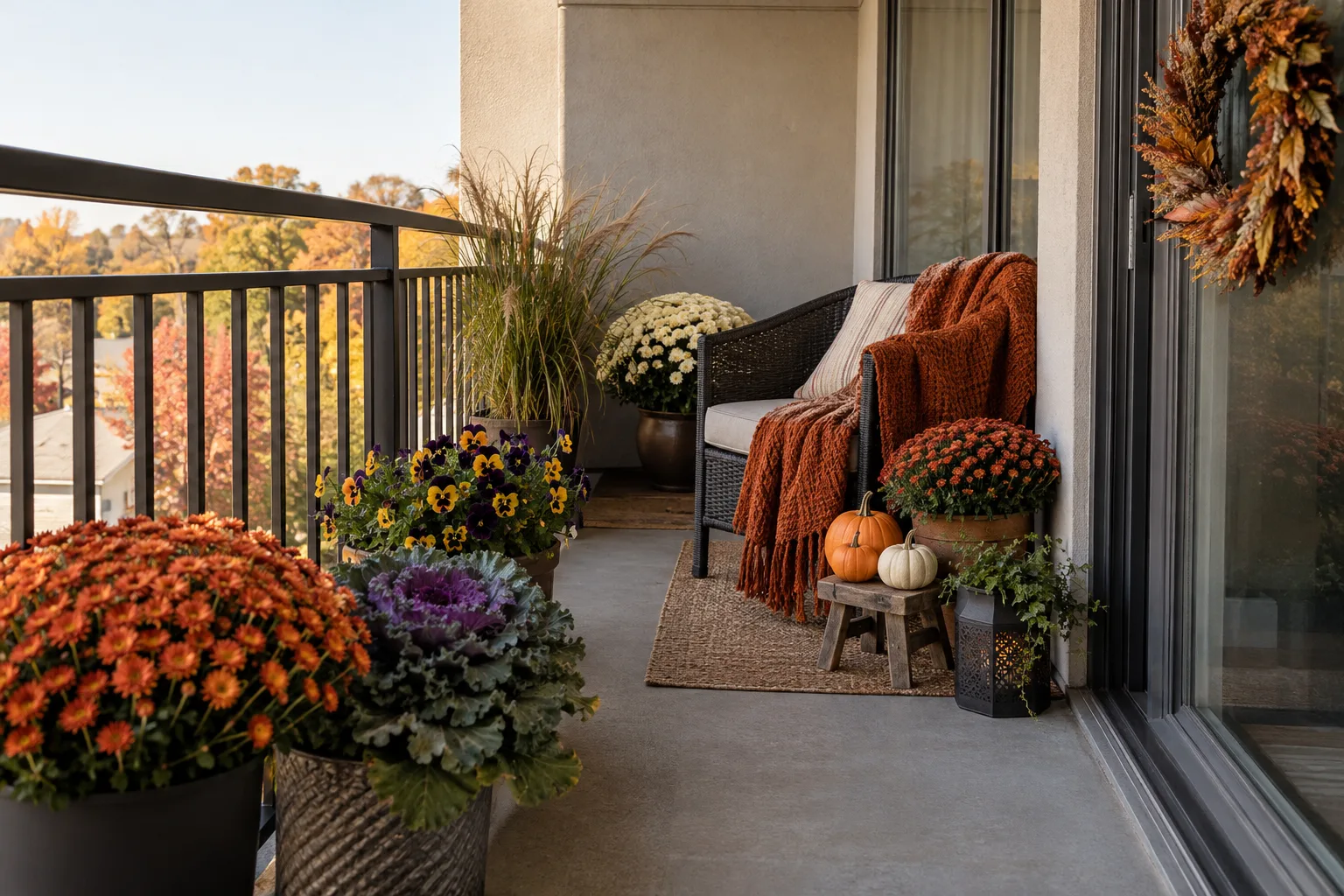
Somewhere between summer’s petunias and winter’s bare railings, a balcony gets one more good stretch: the few weeks where mums are in every garden center, the light turns gold in the afternoon, and a couple of pumpkins on the floor genuinely change how the whole space feels for the six or eight weeks it lasts, easily one of the most satisfying stretches of the gardening year. Fall decorating leans on warmth and texture instead of the airy, green-heavy look of spring and summer, and most of it swaps in and out in an afternoon without touching the parts of the setup that already work.
If you haven’t set up the underlying framework yet, seating, layered plant heights, lighting, our guide to styling a small balcony covers that groundwork. This piece is the seasonal layer on top of it: what changes for fall, what doesn’t need to, and the handful of purely autumn props worth adding for a few weeks.
Part of our complete guide to fall balcony gardening.
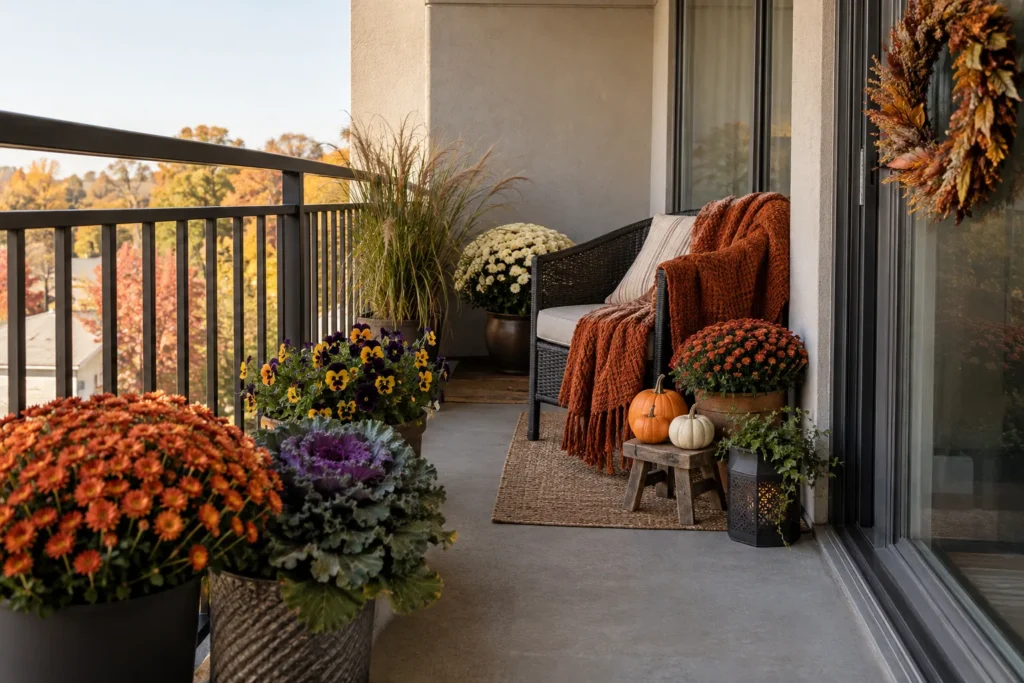
What changes for fall (and what doesn’t)
The seating footprint, the lighting setup, and the material palette from a general balcony styling plan don’t need to be redone for fall, that’s the whole point of getting them right once. What does change: the plants themselves, the color temperature of accessories, and a couple of purely seasonal props that wouldn’t make sense the rest of the year. Think of a fall refresh as three or four swaps layered onto a foundation that’s already working, not a full redecorate you have to start over on each September.
The plant swap: mums, kale, and pansies
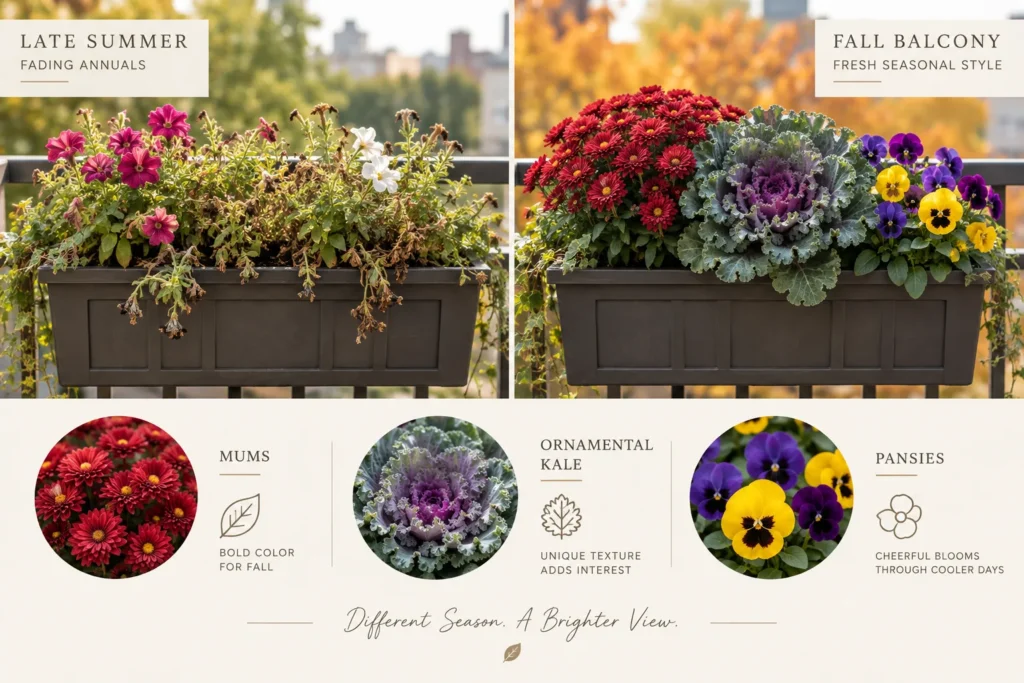
Nothing signals fall on a balcony faster than swapping fading summer annuals for mums, ornamental kale, and pansies. Mums arrive at garden centers already budded or blooming, so the color is immediate, not something you wait weeks for, and ornamental kale gets more vivid as the weather cools instead of fading the way most plants do. For the full planting timeline, container prep, and which combinations work well together, see our guide to fall container gardening on a balcony; this section is really just the decorating shorthand of that guide.
Pumpkins and gourds, sized for a balcony
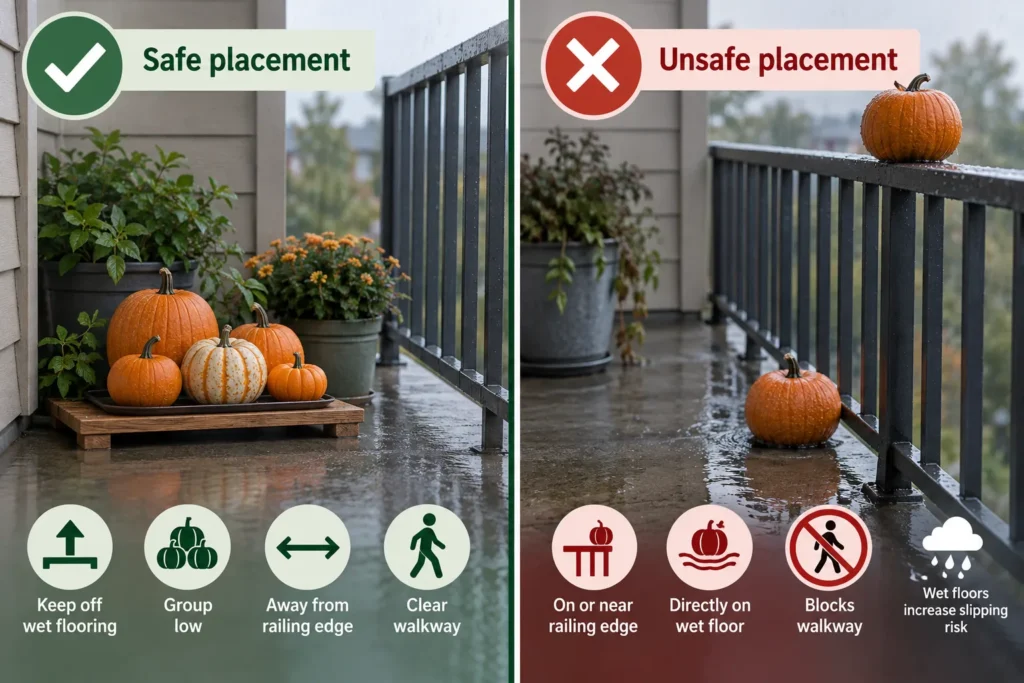
Full-size pumpkins look great on a porch with room to spare; on a balcony, mini and small pie pumpkins usually make more sense, both for scale and because a cluster of three small pumpkins reads fuller and more deliberate than one giant one taking up the same footprint. A few practical details matter more here than they do on solid ground:
- Keep them off wet flooring. A pumpkin sitting directly on a balcony floor that collects rain will soften and rot from the base up within days. A small plant stand, a wooden board, or even an upturned saucer underneath keeps air moving beneath it and off the wet surface.
- Real pumpkins have a shelf life. Expect a few weeks outdoors before softening, faster in a rainy climate. If you want fall decor that lasts the whole season without a mid-October replacement trip, faux pumpkins in a matte, unshiny finish read convincingly from normal viewing distance.
- Mind the weight in a windy spot. Small pumpkins and gourds are light enough to roll or blow off a balcony ledge in a gust; keep them low, grouped, and away from the outer railing edge instead of displayed up on top of it where a gust can send one over.
The mum smell nobody warns you about
Chrysanthemum foliage has a strong, somewhat musky scent that’s noticeably different from most flowering plants, and it’s not universally loved. In an open backyard it dissipates and barely registers; on a small, partly enclosed balcony, especially right next to a door you walk through constantly, a few mum pots can make their presence known every time you step outside. If you’re sensitive to it, place mums toward the far end of the balcony instead of right beside the door, or lean more heavily on ornamental kale and pansies instead, both of which are essentially scentless and give a similar fall color payoff without the tradeoff.
A wreath, adapted for a balcony
A wreath is a classic fall front-porch move, and it translates to a balcony with one adjustment: most balconies don’t have a front door to hang it on, just a sliding glass door or a railing. An adhesive hook rated for glass and outdoor use holds a lightweight wreath on the inside or outside face of a sliding door without drilling or damaging the frame, and a railing-mounted wreath hanger, the same style of hardware used for a stocking at the fireplace, works just as well clipped to a railing and needs no adhesive or drilling at all. Keep it lightweight; a heavy dried-material wreath in a windy spot puts more strain on an adhesive hook than a lighter faux or fabric one will.
Layering warm-toned light on top of your base setup
If your balcony already has warm-white string lights from a general setup, fall is a reasonable time to layer in one accent light source in a warmer amber or copper tone instead of replacing the whole string. A single small lantern with an amber-toned bulb, or a battery candle in a glass jar, adds a seasonal note without redoing the lighting setup you already have working and don’t need to touch again until next year. Treat this as an accent, one or two extra points of light, not a full lighting overhaul; too many competing light sources and color temperatures on a small balcony reads as cluttered, not cozy, undoing the calm effect the base setup was going for in the first place.
Warming up the textiles
The same cushions and throws recommended for a general balcony setup just shift palette for fall: deeper rust, olive, and warm brown tones instead of the lighter or brighter shades that suit spring and summer. A flannel or heavier-weave throw earns its keep once evenings cool down, in a way a thin summer throw doesn’t. You don’t need to buy a whole new set, swapping just the cushion covers over the same cushion inserts gets most of the visual effect for a fraction of the cost of buying new furniture outright.

Three budget tiers
| Budget | What to do |
|---|---|
| Minimal | Swap cushion covers only, add 2-3 mini pumpkins on a stand |
| Moderate | Add potted mums or kale (2-3 pots) plus the minimal tier |
| Full refresh | New throw + cushion covers, mums/kale, pumpkin cluster, and a warmer accent color repeated in one more spot |
Corn stalks and dried material: a fire safety note
Bundled corn stalks, dried wheat, and other dried plant material are a common fall porch prop, but they’re properly flammable, and a balcony often sits closer to a building’s exterior wall, a shared corridor, or another unit’s window than a freestanding porch would. If you’re using any dried material, keep it well clear of any lit candles, string light transformers, or anything else that generates heat, and check your building’s fire code or lease for any restrictions on flammable decor before hanging a large bundle near a shared exterior wall. Faux versions in flame-retardant material sidestep the issue entirely and hold up to wind and rain far better than dried stalks do besides.
Scent beyond the plants
A lot of what reads as “fall” indoors, cinnamon, clove, baked apple, works outdoors too, just more subtly since it dissipates in open air. A battery-operated wax warmer or a well-ventilated candle (mind the fire safety note above if you’re near dried decor) adds a seasonal note during the hour or two you’re out there sitting, without trying to scent the whole balcony the way an indoor candle scents a closed room. This is very much optional; the plants and textiles carry most of the seasonal feel on their own.
Common fall decorating mistakes
- Buying all-new furniture for a seasonal look. Small swaps, cushion covers, a throw, a few plants, get most of the effect at a fraction of the cost.
- Leaving real pumpkins directly on a wet floor. This is the single fastest way to end up with a rotting mess a few weeks in.
- Overcrowding a small balcony with props. The same overcrowding problem that applies to plants (see our guide on keeping a balcony garden from looking overcrowded) applies just as much to seasonal decor; a few well-placed pieces beat a balcony packed with every fall item at the store.
- Ignoring wind with lightweight props. Small pumpkins, paper lanterns, and other light decor pieces can blow off a balcony in wind conditions a heavier summer setup handled without any trouble at all.
When the season turns colder
Fall decor has a shelf life of its own, mums fade, pumpkins soften, and eventually the temperature drops enough that the whole conversation shifts from decorating to protecting. When that happens, our guide to prepping a balcony garden for winter covers moving plants and containers through the actual cold, and fall vegetables and herbs for balcony containers is there if you’d rather use this same seasonal window to grow something you can eat alongside the decorating.