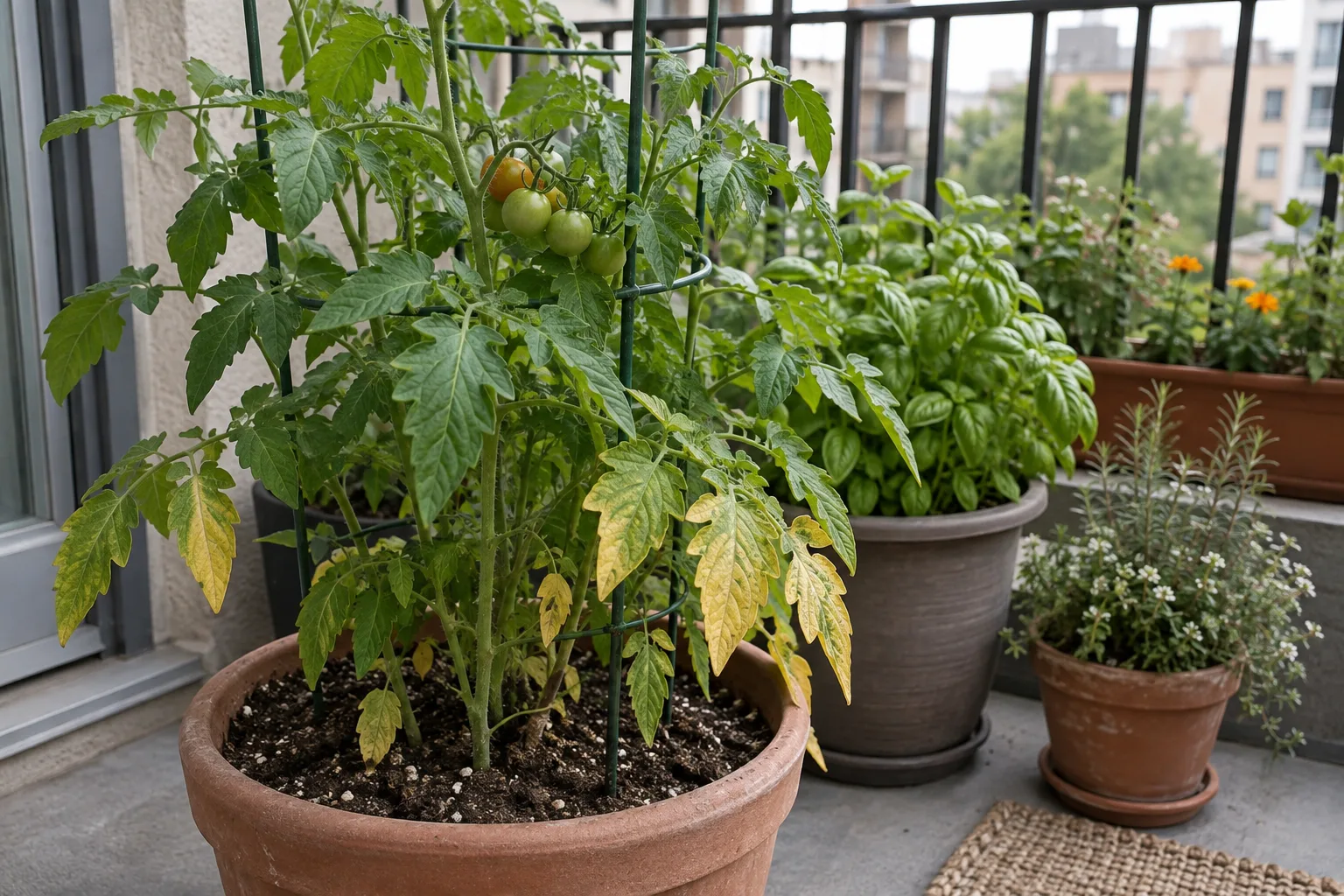
Yellow leaves are the single most common complaint on a balcony, and also the hardest to answer with one blanket fix, because at least six different problems all produce the same symptom. Too much water, too little water, not enough nitrogen, a micronutrient shortage, too little light, too much light, and root damage can each turn leaves yellow, and a couple of them look almost identical at first glance.
The fastest way through it isn’t a list of every possible cause; it’s one question, answered first: which leaves are yellowing, the old ones near the bottom or the new ones near the top? That single detail rules out most of the wrong answers immediately.
Start here: old leaves or new leaves?
Nitrogen is a mobile nutrient, meaning the plant can pull it out of older leaves and redirect it to new growth when supply runs short. That’s why nitrogen-related yellowing almost always shows up on the lower, older leaves first, spreading upward as the deficiency gets worse. Iron and most other micronutrients work the opposite way; they don’t move around inside the plant easily, so a shortage shows up on the newest growth at the top first, while the older leaves stay green.
That one distinction, bottom-up versus top-down, is the most reliable single clue for narrowing down what’s happening, and it’s worth checking before anything else on this list. It’s also worth checking whether the soil surface or pot rim shows any white or yellowish crust before moving on; that detail rules in or out an entirely different cause covered further down.
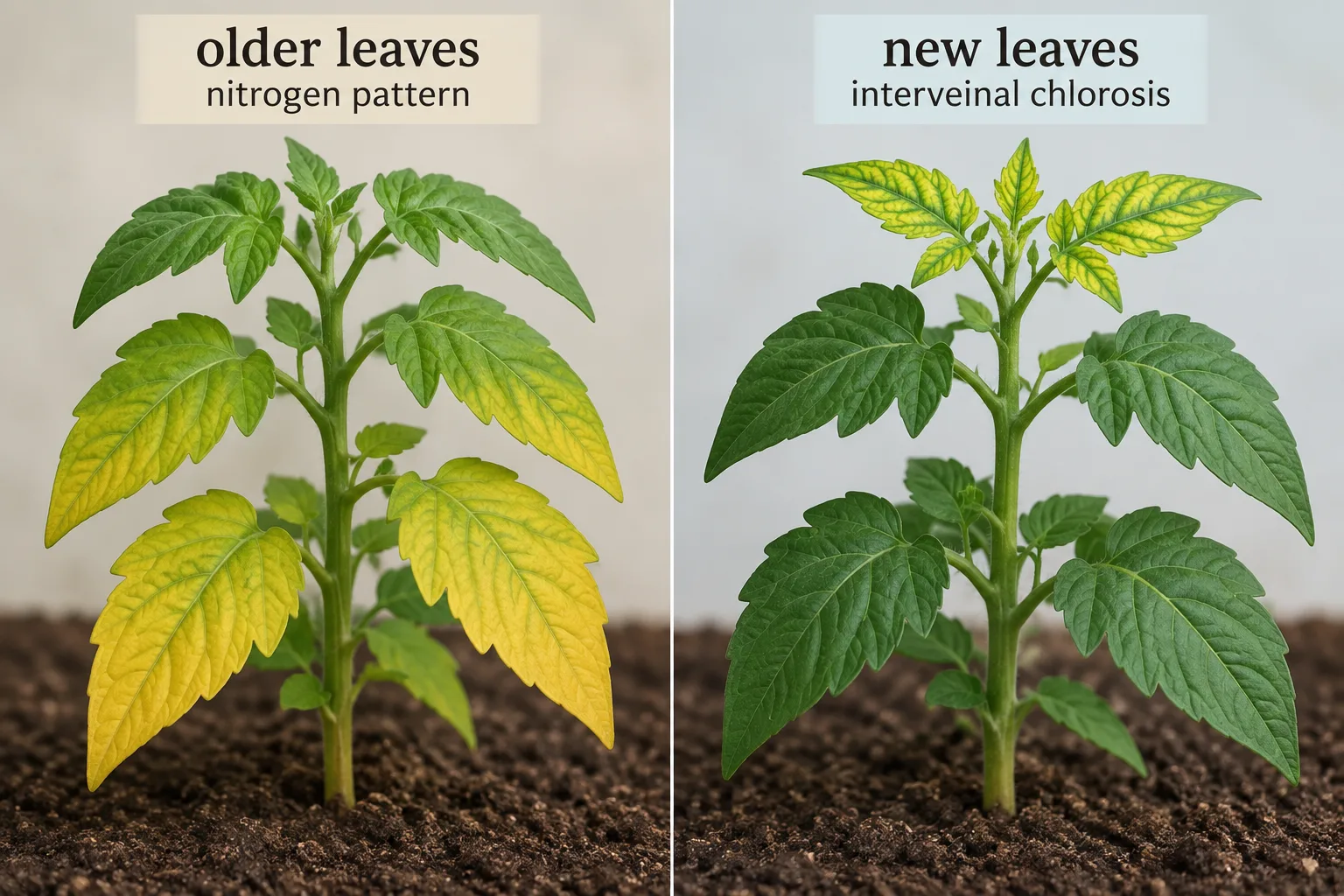
Old leaves, yellowing evenly across the whole leaf: nitrogen deficiency
If the lower leaves are turning a uniform pale green to yellow, with no distinct pattern between the veins and the rest of the leaf, and the plant also seems to be growing slowly with thinner-than-usual stems, that’s a textbook nitrogen shortage. It’s common in balcony containers specifically because container plants can only draw on the nutrients in that one pot, and regular watering gradually washes nitrogen out through the drainage holes over the course of a growing season.
The fix is a balanced, container-formulated fertilizer applied at label strength during the active growing season, roughly every two to four weeks depending on the product. Our guide to fertilizing balcony container plants covers how often and how much, since overcorrecting with fertilizer creates its own set of problems. Already-yellowed leaves won’t turn green again since the nitrogen inside them has already been redistributed elsewhere, but new growth emerging after a correct feeding schedule should come in a normal healthy green within two to three weeks.
New leaves, yellow between green veins: an iron or micronutrient shortage
If it’s the newest growth at the top of the plant that’s yellowing, especially with a distinct pattern where the veins stay dark green and the tissue between them turns pale yellow, that’s interveinal chlorosis, usually tied to iron or another micronutrient the plant can’t access. This shows up more often in containers than in garden beds because potting mix and tap water can push soil pH higher over time, and iron becomes harder for roots to absorb as pH climbs above roughly 6.5 to 7.0. A simple soil pH test strip, inserted into moistened potting mix, confirms whether pH is the underlying driver before assuming it’s a straightforward supply issue.
A chelated iron supplement, applied per the product’s instructions, usually resolves it within a few weeks, since the chelated form stays available to roots even in the same higher-pH conditions that locked out the iron already in the soil. If it keeps coming back after treatment, testing or refreshing the potting mix is worth doing before assuming it’s just a one-time deficiency, since a pH problem in the mix itself will keep re-locking iron away no matter how much is added.
Lower leaves yellowing, soil wet or heavy: check for overwatering first
Lower-leaf yellowing overlaps with nitrogen deficiency, but if the soil is also staying wet longer than it should, feels heavy days after the last watering, or has a musty smell, overwatering is the more likely culprit, not nutrition. Waterlogged soil pushes oxygen out of the root zone, and roots that can’t breathe stop functioning properly even though they’re technically surrounded by water. A finger pushed two inches into the mix that comes out consistently damp days after the last watering, on a plant that isn’t in a naturally moisture-loving group, is the clearest confirming sign.
Cutting back on watering frequency and letting the top couple of inches dry out between waterings is usually enough to reverse mild cases within one to two weeks. If the container has no drainage holes, or the drainage holes are blocked, fixing that structural issue matters more than adjusting the watering schedule, since no watering routine compensates for water that has nowhere to go.
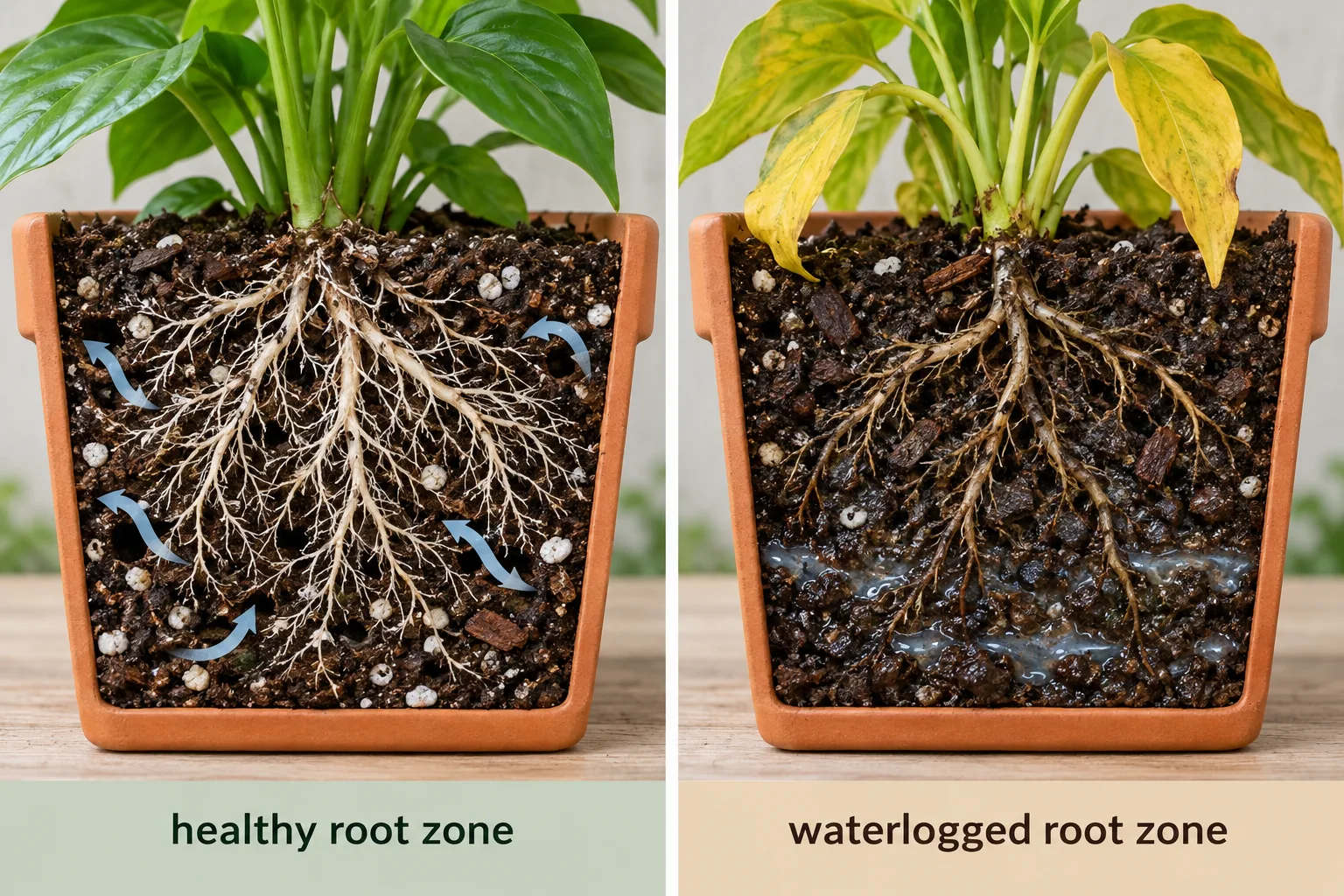
If the yellowing comes with wilting despite wet soil, or a sour smell from the pot, that’s no longer a simple watering fix; it’s worth reading through our guide to root rot on a balcony, since that’s the more serious version of the same underlying problem.
White or yellowish crust on the soil or pot rim: mineral and fertilizer salt buildup
This one is easy to mistake for a nutrient deficiency because it produces yellowing and browning concentrated at leaf tips and edges, a pattern that looks a lot like the potassium deficiency covered further down. The distinguishing detail is on the container itself, not the leaf: soluble salts, whether from fertilizer, tap water minerals, or both, accumulate at the soil surface and around the pot’s rim or drainage hole as water evaporates and leaves the dissolved minerals behind. A crusty white-to-yellow buildup on the soil surface or rim, University of Maryland Extension notes, is the clearest sign this is what’s happening, not a nutrient shortage at all. Excess salts pull moisture out of root tissue by osmosis, producing the same tip-and-edge browning a genuine deficiency would, but the fix is the opposite of adding more fertilizer.
The remedy is leaching: running roughly three times the pot’s volume in fresh water through the soil and letting it drain completely, which flushes the accumulated salts out through the drainage holes. Doing this every four to six months as routine maintenance on containers that get fertilized regularly prevents buildup from reaching the point of visible leaf damage in the first place. If the crust keeps returning quickly after leaching, cutting back on fertilizer frequency or switching to a lower-mineral water source addresses the underlying cause rather than just the symptom each time.
Whole plant pale, growth stretched or leggy: not enough light
A sun-loving plant that’s been placed somewhere too shaded tends toward overall pale or yellowish-green foliage rather than a distinct pattern on specific leaves, usually paired with stretched, leggy growth as the plant reaches toward whatever light it can find. This one is more about the plant’s overall shape and vigor than a leaf-by-leaf pattern. Confirming it before moving the plant is worth doing with an actual light check rather than a guess; our guide to measuring sunlight on a balcony covers how to find out what a spot is actually getting, since balcony light levels are notoriously easy to overestimate from a quick glance.
Once moved somewhere with appropriate light for the species, existing pale leaves usually stay pale, since chlorophyll production in already-formed tissue doesn’t fully reverse, but new growth typically comes in a normal, deeper green within two to four weeks, and the stretched, leggy habit gradually fills back out as subsequent growth is more compact under better light.
Bleached or scorched patches, not solid yellow: too much direct sun
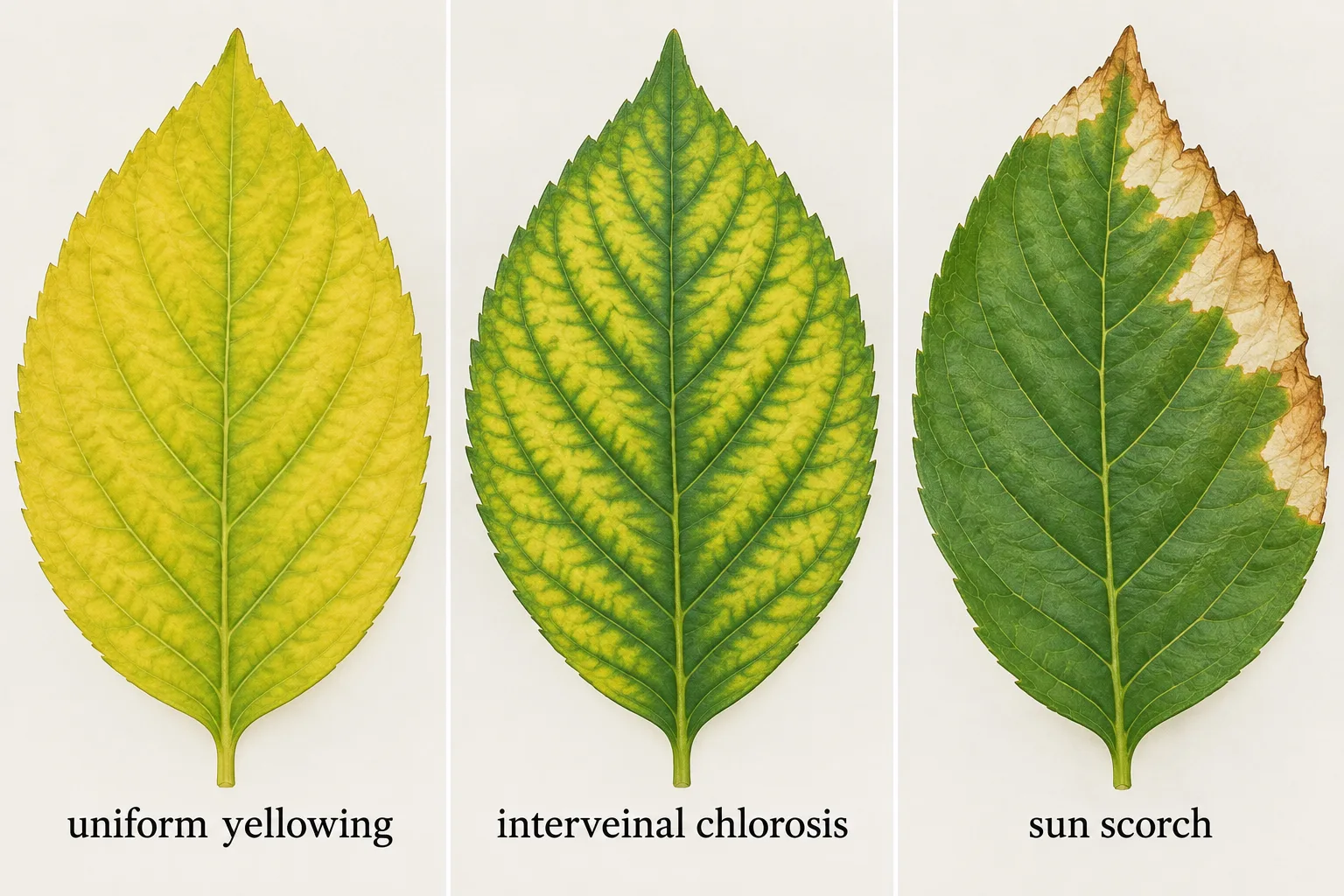
This one is easy to mistake for yellowing from a distance, but it’s a different problem with a different fix. Strong, direct sun breaks down chlorophyll faster than the plant can replace it, especially on shade-tolerant species that end up somewhere too exposed, producing pale, bleached, or eventually crispy brown patches concentrated on the leaves and leaf edges facing the sun most directly. Solid, evenly distributed yellowing across the whole leaf points elsewhere on this list; patchy bleaching that follows sun exposure points here.
Temporary shade cloth over the worst-affected side, or relocating the container to a spot with some afternoon shade, stops further damage right away. Scorched tissue itself doesn’t recover, but a plant otherwise in good health pushes out unaffected new growth within a few weeks once the excess exposure is addressed; a species that’s a genuinely poor match for full sun is better moved permanently or swapped for something better suited to that spot.
Beyond nitrogen and iron: potassium, magnesium, and manganese
If the pattern doesn’t cleanly match nitrogen, iron, or the salt buildup covered above, and there’s no crust visible on the soil or pot rim, a handful of other nutrients cause their own variations on yellowing. Potassium deficiency tends to show up as yellowing or browning concentrated at the leaf edges and tips, working inward, usually on older leaves, a pattern close enough to salt buildup that checking for the telltale crust first is worth doing before treating it as a nutrient issue. Magnesium deficiency produces interveinal yellowing similar to iron, but it’s more common on older, lower leaves rather than new growth, and it often comes with a slightly reddish or purplish tinge at the leaf margins. Manganese deficiency looks a lot like iron deficiency, pale tissue between still-green veins on newer growth, and honestly the two are hard to tell apart without a soil test.
None of these three are as common as straightforward nitrogen shortages, overwatering, or salt buildup in a typical balcony container, so it’s worth ruling out the more likely causes first before assuming a rarer deficiency is the culprit. When one of these three is confirmed, a fertilizer specifically formulated to include secondary and micronutrients, not just the standard nitrogen-phosphorus-potassium ratio, addresses the shortfall more reliably than guessing at a single-nutrient supplement.
A few less common causes worth ruling out
A plant that was recently repotted, divided, or moved to a new spot can drop yellow leaves purely from transplant shock, even when every growing condition afterward is correct; this usually resolves on its own within a couple of weeks as the roots settle in, without needing any fix at all. A sudden cold snap, especially an overnight temperature drop that catches a heat-loving plant like a pepper or tomato off guard, can trigger yellowing within a day or two that has nothing to do with soil or nutrients. And a fertilizer applied too heavily or too concentrated can burn roots and produce yellowing that looks like a deficiency but is really the opposite problem; if yellowing appeared shortly after a feeding, cutting back rather than fertilizing again is the right move.
Pests are worth a close look too, since some produce yellowing that mimics a nutrient or watering problem from a distance. Spider mites and aphids both feed by piercing leaf tissue and drawing out sap, which can leave a stippled, speckled yellowing rather than the smooth, even patterns described above; checking the undersides of leaves for tiny moving specks or a fine webbing is enough to rule pests in or out. Our guides to common balcony garden pests and removing aphids from balcony plants cover identification and treatment if a close look turns up something moving on the leaves.
Preventing yellowing before it starts
Most of the causes above share a common thread: they’re easier to prevent with a few routine habits than to diagnose and fix after the fact. A regular fertilizing schedule during the growing season heads off nitrogen deficiency before it shows up as thin, pale lower leaves, and checking soil moisture with a finger before every watering, rather than watering on autopilot, catches the drift toward overwatering long before it turns into yellowing or root rot.
Matching a plant to the light it actually gets, confirmed with a real check rather than a guess, prevents both the pale, stretched growth of too little light and the bleached scorching of too much. Leaching containers with fresh water every four to six months, especially ones that get fertilized often, keeps salt buildup from ever reaching the point of visible leaf damage, and it’s a five-minute task compared to diagnosing and correcting the crust once it’s already there. None of these habits are specific to any one plant; they’re the same handful of routine checks that head off nearly every cause on this list before it needs a fix at all.
When it’s not actually a problem
Plants shed their oldest leaves as part of normal growth. One or two lower leaves slowly yellowing and dropping off over the course of weeks, on a plant that otherwise looks healthy and is still producing new growth, is usually just ordinary leaf turnover, not a deficiency or a watering problem. The pattern that actually signals trouble is faster, more widespread, or affecting more than the very oldest leaves at any given time.
Quick recap
- Old leaves, evenly yellow, slow growth: nitrogen deficiency, fix with fertilizer
- New leaves, yellow between green veins: iron or micronutrient shortage, fix with chelated iron or a soil pH check
- Old leaves yellow plus wet, heavy, or smelly soil: overwatering, check for root rot if it’s severe
- White or yellowish crust on soil or pot rim: mineral or fertilizer salt buildup, fix by leaching with fresh water
- Whole plant pale and stretched: not enough light, needs a brighter spot
- Patchy bleached or scorched leaves in direct sun: too much sun, needs shade or a different spot
- Stippled or speckled yellowing, especially with tiny moving specks on leaf undersides: check for pests before assuming a nutrient issue
- One or two old leaves slowly dropping on an otherwise healthy plant: normal turnover, not a problem
If none of these match what you’re seeing, or several factors seem to be overlapping at once, the broader balcony plant troubleshooting checklist walks through soil, roots, light, and pests in order and catches problems that fall outside a leaf-color pattern alone.