
Something is off with a plant on your balcony. Maybe the leaves have gone yellow. Maybe growth has stalled for weeks and you can’t tell if that’s normal. Maybe you spotted something crawling across a leaf you’d rather not have crawling anywhere near your tomatoes. Noticing that a plant is struggling is the easy part. The harder part is figuring out which kind of problem you’re looking at, because the fix for one cause can make a different cause worse. Water a thirsty plant less and you’ll finish the job a drought started. Treat a nutrient shortage like a pest problem and you’ll spend a week spraying for bugs that were never there while the plant keeps declining.
This guide is built to shortcut that guessing. Nearly everything that goes wrong with a balcony plant sorts into one of three buckets: a watering or root problem, a pest or disease, or a slower decline tied to light and nutrients. Below, each bucket gets its own section with the specific posts on this site that go deep on it, plus a framework for telling the three apart when the symptoms overlap, which happens more often than most plant-care advice admits.
Why containers fail differently than garden beds
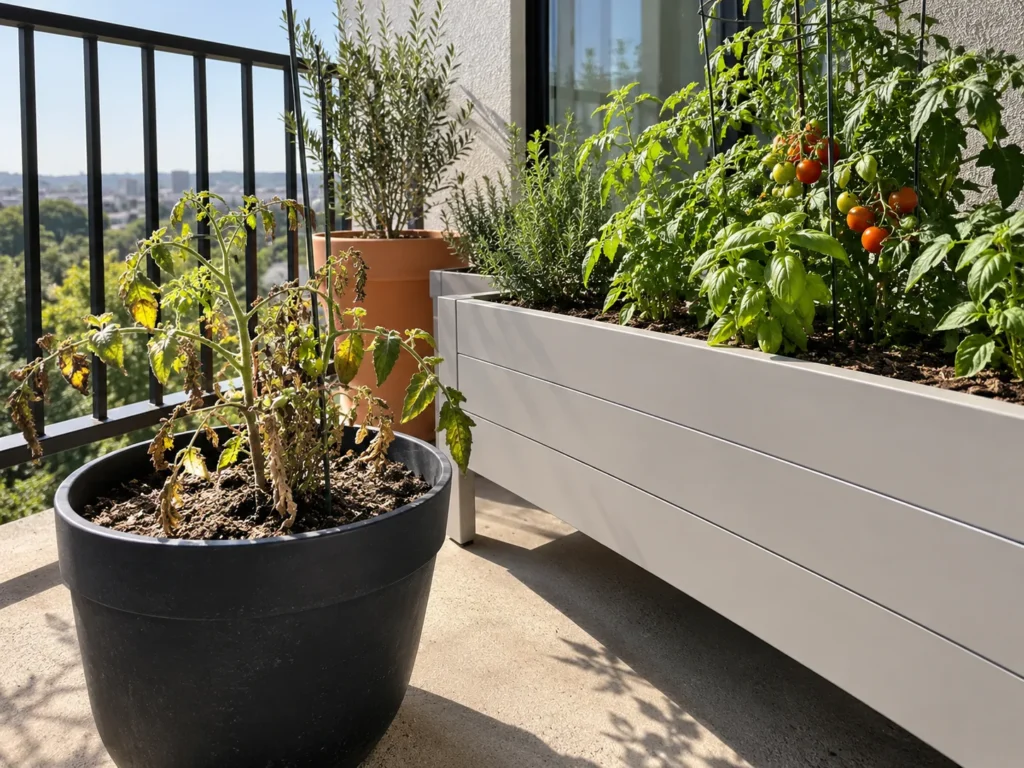
A lot of general plant-care advice assumes a plant growing in open ground, with roots that can spread out, soil that holds a buffer of moisture and nutrients, and a microclimate that changes slowly. None of that applies to a container on a balcony. A pot holds a fixed, small volume of soil, which means water, nutrients, and root space all run out faster than they would in the ground. Temperature swings are sharper too, a dark-colored pot in direct sun can heat the root zone well past what the air temperature suggests, and wind on an elevated balcony dries out soil at a rate that doesn’t match what’s happening at ground level a few floors down.
That’s part of why balcony plant problems tend to move faster than backyard garden problems, and why guessing at a cause and waiting to see what happens costs more on a balcony than it does in a bed. A watering mistake that a garden bed might absorb without much drama can turn into root rot in a container within a couple of weeks. Knowing which of the three categories below you’re dealing with, early, is worth more on a balcony than almost anywhere else you might garden.
Start by narrowing down what you’re seeing
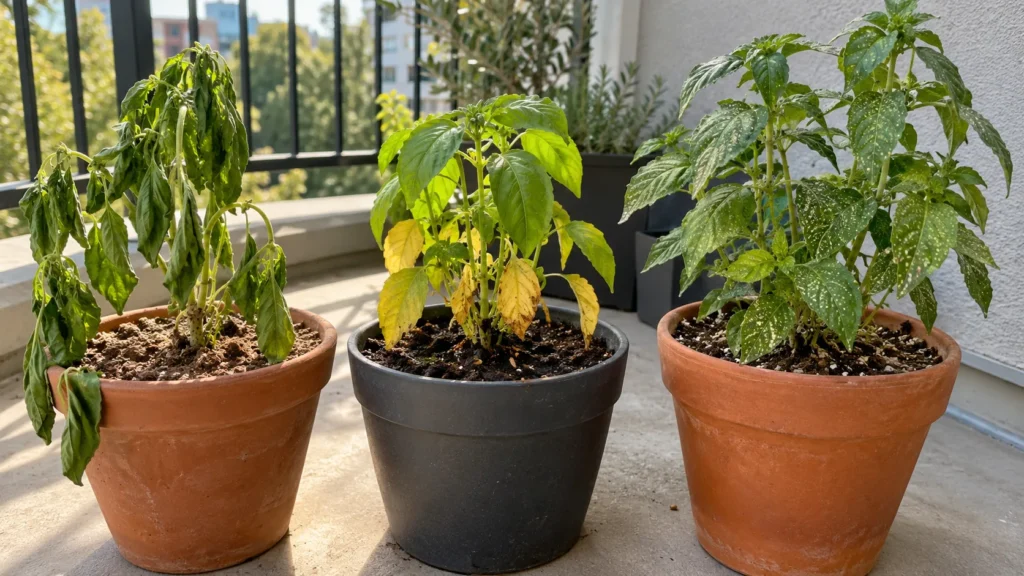
Before opening a specific guide, it helps to match your symptom to a likely cause. The table below isn’t a diagnosis by itself, the exact picture varies by plant, pot, and location, but it’s a reliable place to start looking.
| What you’re seeing | Likely cause | Where to start |
|---|---|---|
| Leaves yellowing, soil feels consistently wet | Overwatering or early root rot | Watering and root problems |
| Leaves crisping or curling, soil dries out within a day | Underwatering, or a pot too small for the plant | Watering and root problems |
| Visible insects, sticky residue, fine webbing on leaves | A pest infestation | Pests and disease |
| A dusty white or gray coating on leaves and stems | A fungal problem, most often powdery mildew | Pests and disease |
| Slow growth, pale or small new leaves, long gaps between leaves on the stem | Light or nutrient deficiency | Decline, light, and nutrient diagnosis |
| Plant hasn’t gotten better or worse in a month or more | Usually a nutrient or root-space issue, not anything acute | Decline, light, and nutrient diagnosis |
If more than one row matches what you’re seeing, that’s common, not a sign you’re reading the table wrong. A plant that’s been overwatered for weeks often ends up with weakened roots that make it more vulnerable to fungal problems too, which is one reason balcony plant issues show up stacked on top of each other instead of as a single clean cause. Work through whichever symptom is strongest first, then recheck the plant once that’s addressed before assuming a second cause is also in play.
A quick example of how this works in practice

Say your pothos has yellow lower leaves and the soil feels damp two days after you last watered it. Running that through the table points to overwatering or early root rot, not underwatering, even though yellow leaves get blamed on both constantly. The next move isn’t to water less and wait. It’s to check the roots directly: slide the plant out of its pot, look at the color and smell of the roots, and decide from there whether you’re dealing with a watering habit that needs adjusting or damage that’s already underway. That single check, which takes about two minutes, is the difference between fixing a watering schedule and catching root rot before it spreads through the whole root ball.
Cluster one: watering and root problems

More container plants are lost to watering mistakes than to any other single cause, and the frustrating part is that overwatering and underwatering often look nearly identical from across the balcony: drooping stems, yellowing leaves, a generally tired appearance. Fixing the wrong one makes the real problem worse, so this is the cluster worth getting right before touching anything else.
The guide to telling overwatering and underwatering apart exists specifically for that overlap. It covers the soil, leaf, and stem signs that point one way or the other, which matters because pouring more water into an already-soggy pot, on the assumption that wilting always means thirst, is one of the most common ways a watering mistake turns into a dead plant.
If overwatering has been going on for a while without anyone noticing, the next stop is root rot, which starts underground and only shows up in the leaves once it’s already progressed. How to catch root rot early and save the plant covers what healthy versus rotted roots look and smell like when you tip a plant out of its pot, and which plants are worth the effort of trimming and repotting versus starting over.
Yellowing leaves deserve a section of their own, since the cause isn’t always watering at all. Natural lower-leaf aging, a nutrient shortage, and root stress can all produce yellow leaves that look identical to an overwatered plant’s yellow leaves. Why your balcony plant’s leaves are turning yellow walks through how to sort out which cause applies to your specific plant instead of assuming the first explanation that comes to mind.
Finally, a lot of watering problems on a balcony aren’t really about technique, they’re about absence. If your plant struggles specifically after a trip or a busy stretch where watering slipped, the fix isn’t a different watering schedule, it’s a system that doesn’t depend on you remembering every single day. How to keep balcony plants watered while you’re away covers the options, from simple wicking reservoirs to a ten-minute favor from a neighbor, and how to pick between them based on how long you’ll be gone and how forgiving the specific plant is.
Cluster two: pests and disease
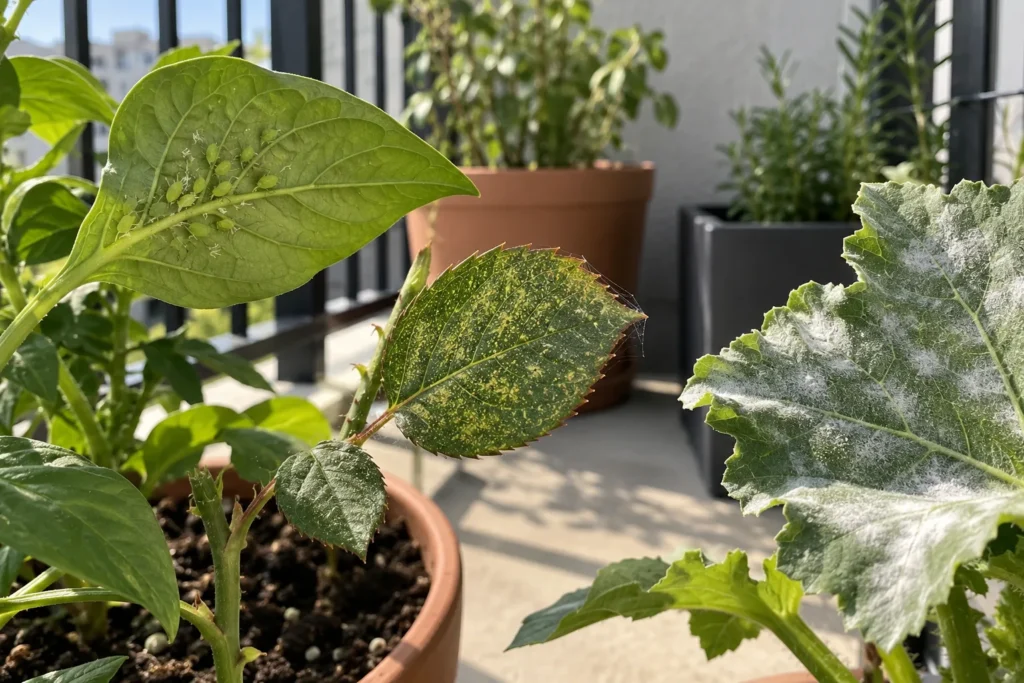
Pest and disease symptoms tend to be more visually obvious than watering problems, once you know what to look for. Insects you can see, sticky residue on leaves, fine webbing between stems, or a powdery coating are all signs pointing away from water and toward something living on the plant that shouldn’t be.
Aphids are the most common balcony pest by a wide margin: small, pale green or black insects that cluster on new growth and the undersides of leaves. Removing aphids from balcony plants covers the fastest ways to clear an infestation before it spreads, which aphids do quickly on a balcony where pots sit close enough together to share pests within days.
Aphids aren’t the only pest that shows up in a container garden. Spider mites, whiteflies, and a handful of others each leave different signs, fine stippling on leaves, a cloud of tiny flying insects when you brush a plant, and each needs a different treatment than the one that works on aphids. Common balcony garden pests beyond aphids is the reference for identifying whichever one has shown up on your plant before you reach for a treatment aimed at the wrong bug.
Fungal problems sit in a separate category entirely from insects, and the most common one on a balcony is powdery mildew: a dusty white or gray film that spreads across leaves and stems, usually where airflow is poor and humidity sits high for long stretches. Powdery mildew and other fungal problems on balcony plants explains what triggers it specifically in a container setting and the spacing and airflow changes that keep it from coming back once you’ve treated it.
One pest-adjacent question comes up often enough to deserve its own answer: whether certain plants marketed as natural pest deterrents, citronella, marigolds, lavender among them, really do what the plant tag claims. Do mosquito-repelling plants work on balconies? gives a straight answer, since a lot of plant-shopping advice overstates what these varieties can do on their own, particularly in the small, open airflow of a balcony compared to an enclosed patio.
Cluster three: decline, light, and nutrient diagnosis
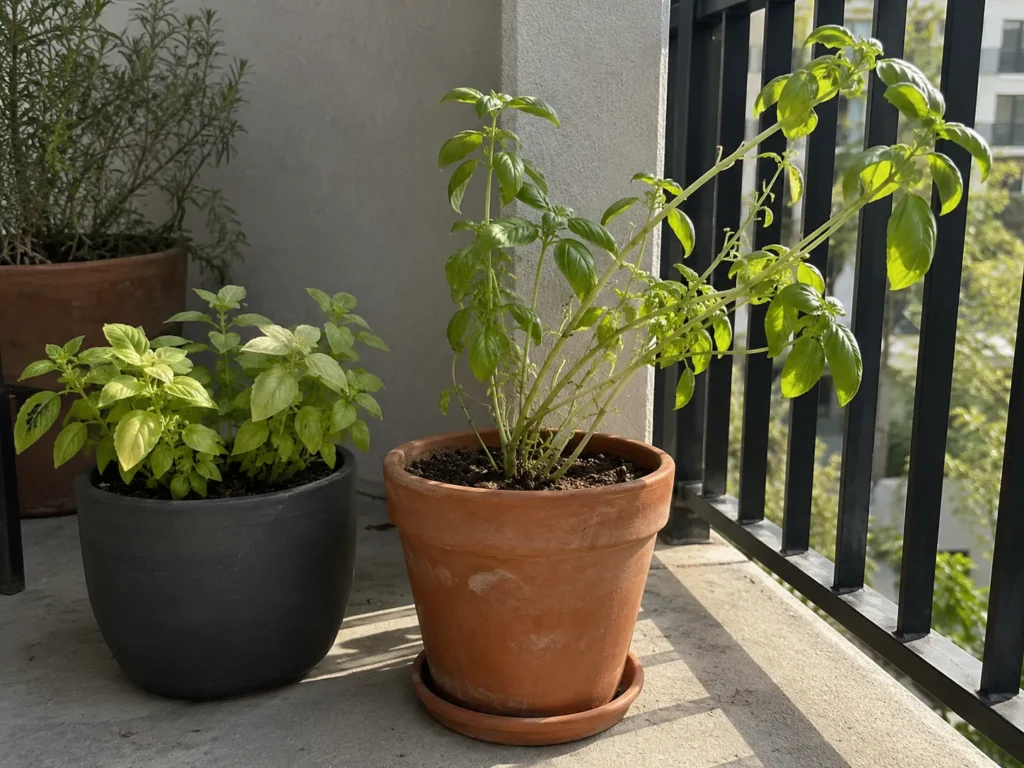
Not every struggling plant is sick or infested. Sometimes a plant is simply not thriving: slower growth than it should have, stems stretching toward whatever light source they can find, new leaves smaller and paler than the ones that came before. This kind of decline is quieter than a pest infestation and easy to write off as normal until months have passed and the plant looks nothing like it did when you brought it home.
When nothing about the symptoms points clearly toward water or pests, how to diagnose why your balcony plant is dying is the broader checklist worth working through first. It covers the full range of causes in the order worth checking them, which keeps you from locking onto one explanation early and missing something more obvious.
If the issue is specifically slow, leggy, or stunted growth without any clear sign of disease, why your balcony plant is stunted, leggy, or not growing goes deep on the two causes that produce nearly identical symptoms: not enough light, and not enough of a specific nutrient. Telling them apart matters because the fixes point in opposite directions. Moving a plant to brighter light doesn’t help a nitrogen shortage, and feeding a plant that’s light-starved just hands it more fuel to stretch even further toward a window it can’t reach.
When it’s more than one thing at once
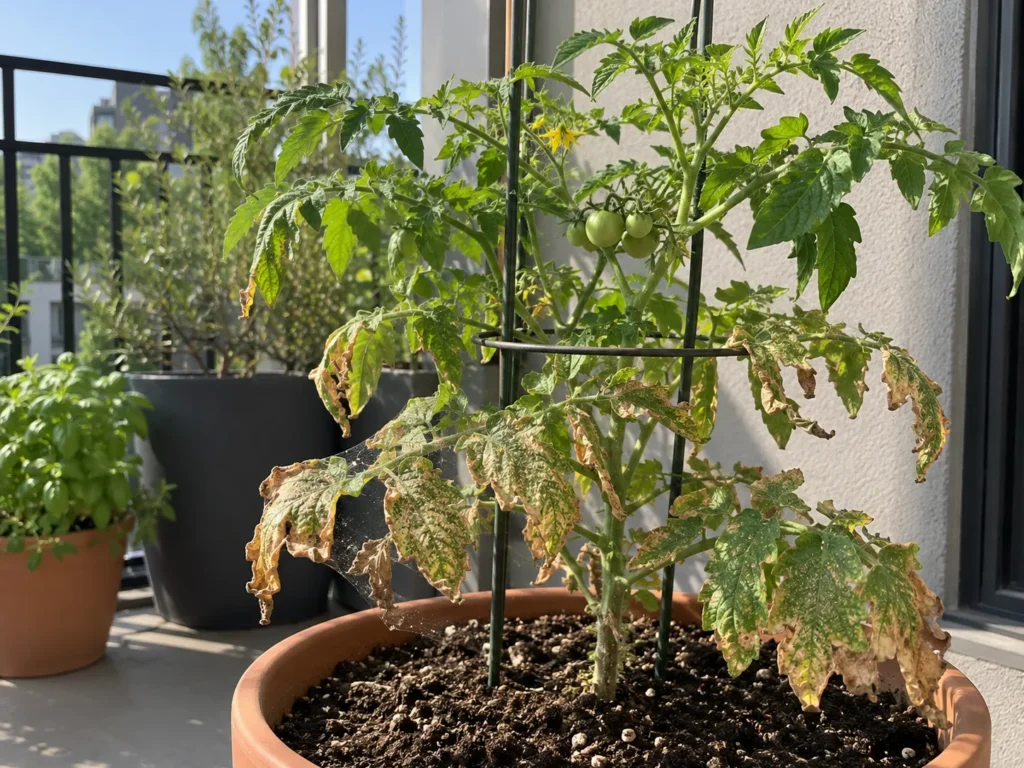
Balcony containers are small, closed systems, and problems in one area tend to spread into another faster than they would in open ground. A plant weakened by overwatering has less resistance to fungal disease. A plant stressed by a nutrient shortage is a more attractive target for aphids than a healthy one would be. A plant that’s root-bound and declining slowly can develop yellowing leaves that look, at a glance, exactly like a watering problem.
None of this means every struggling plant needs to be treated for every possible cause at once, which usually does more harm than good. It means fixing the clearest problem first, then checking back on the plant a few days later instead of assuming one fix solved everything, is worth building into how you handle a struggling plant from now on. If a second symptom shows up after the first one clears, it was probably there the whole time, just masked by the louder problem.
A second example makes this concrete. A balcony tomato plant that’s been slightly underwatered for a few weeks develops crisped leaf edges, your first instinct is to fix the watering, and you should. But an underwatered plant is also a stressed plant, and stressed plants are the ones spider mites tend to colonize first, since the thin webbing they leave behind is easier to establish on leaves that are already dry and curling. If you fix the watering and the leaves stop crisping but a fine stippled pattern remains on the older growth, that’s the mites showing through once the louder symptom is gone, not a new problem showing up out of nowhere. Checking the plant again a week after the first fix is what catches that kind of layered issue before it spreads to the pots next to it.
Prevention, once the current problem is handled
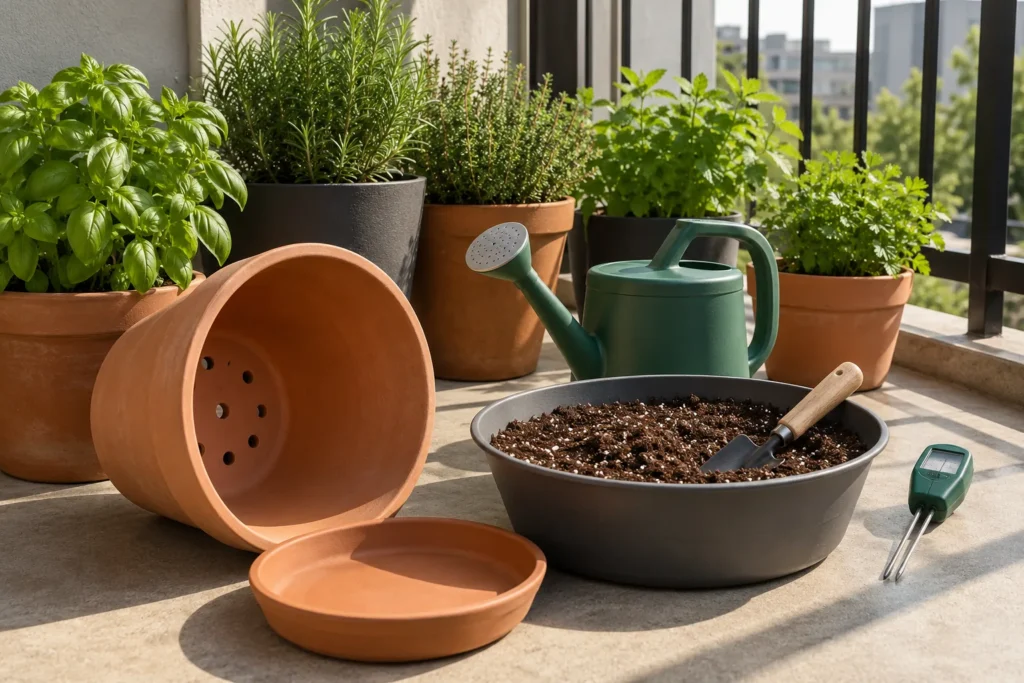
Every post linked above is written for the moment something has already gone wrong, but most of these problems are preventable with the fundamentals a balcony garden eventually needs to get right: a container sized properly for the plant it holds, a potting mix that drains instead of staying soggy, and a watering routine that responds to the plant and the current weather instead of running on a fixed schedule regardless of either. If you’re setting up a new balcony garden instead of troubleshooting an existing one, how to start a balcony garden is a better place to begin than this page.
Give a fix a few days before deciding it didn’t work
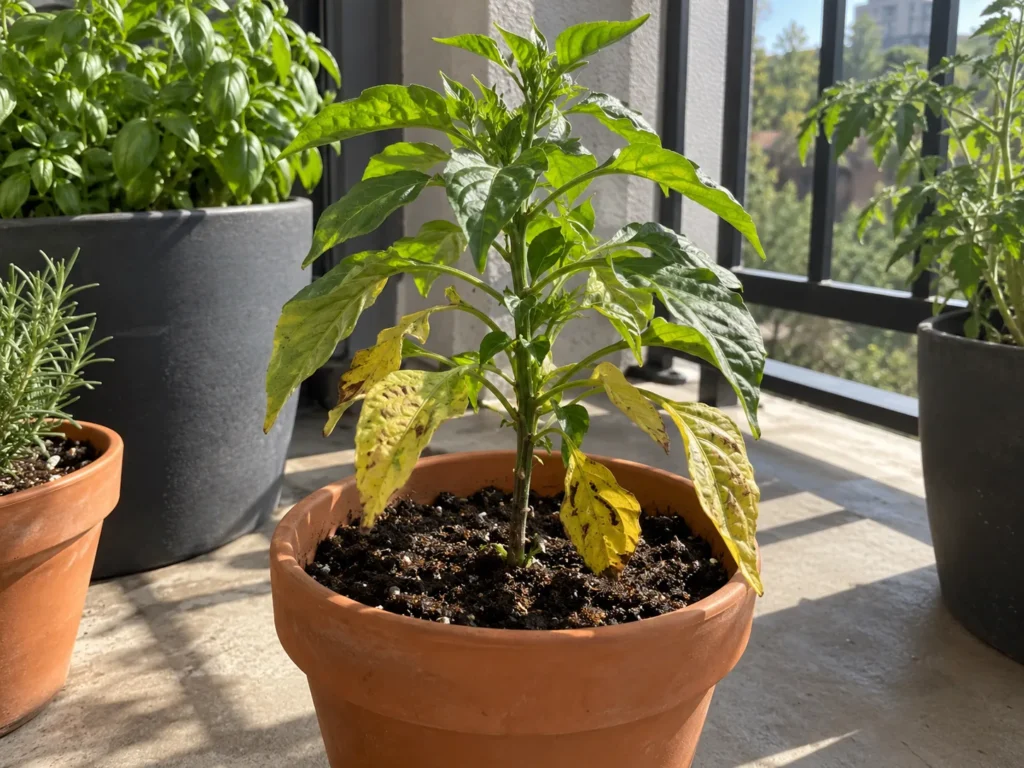
One more thing worth knowing before you start working through any cluster above: plants don’t recover instantly, even once the underlying cause is addressed correctly. A plant recovering from overwatering can look worse for several days after you cut back on water, as roots that were damaged catch up to a smaller demand. A plant that was nutrient-deficient won’t turn fully green again overnight once you feed it, since leaves that have already yellowed generally don’t reverse, new growth coming in healthy is the real sign the fix worked.
Give any change close to a week before deciding it failed and moving on to a different cause, unless the plant is declining sharply enough that waiting isn’t a reasonable option. Most balcony plant problems, once correctly identified, respond faster than people expect. The slow part is almost always the diagnosis, not the recovery.